
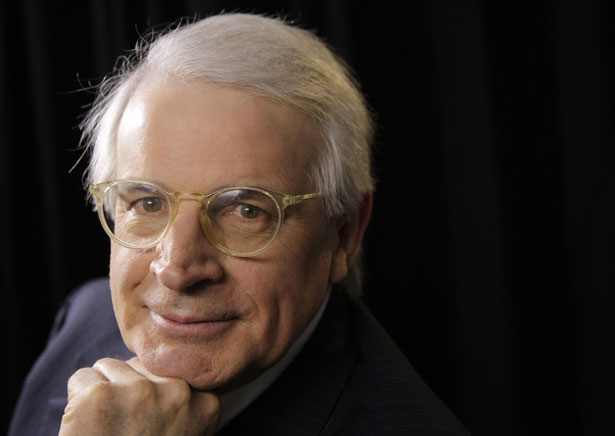
David Stockman, former budget director under Ronald Reagan. (AP Photo/Kathy Willens.)
This story originally appeared at Truthdig. Robert Scheer is the author of The Great American Stickup: How Reagan Republicans and Clinton Democrats Enriched Wall Street While Mugging Main Street (Nation Books).
Why is David Stockman driving everyone crazy? The shoot-the-messenger frenzy that has greeted Sunday’s New York Times op-ed by Ronald Reagan’s former budget director leaves one searching for the message that has so unhinged his critics.
I borrowed that word “unhinged” from more than one of Stockman’s critics upset over his “rant” bemoaning the loss of the gold standard and the statist economics practiced by just about every American president from Franklin Roosevelt through Ronald Reagan on to the current inhabitant of the White House.
The only exception was a few golden years of fiscal responsibility under Dwight Eisenhower, who, like Stockman, was possessed of prudent Midwestern economic values. Stockman remains some kind of naive libertarian actually convinced that a free market ought to be free of control by the financial cartels and the cronies they purchase in government. What’s all the outrage about? What’s wrong with “putting the great Wall Street banks out in the cold to compete as at-risk free enterprises, without access to cheap Fed loans or deposit insurance”? That’s the same cold world in which the rest of us live.
The headline on Stockman’s piece—“State-Wrecked: The Corruption of Capitalism in America”—is unquestionably accurate. Actually, the title of his just-released book—“The Great Deformation: The Corruption of Capitalism in America”—is a bit softer, but you get the point. What his critics find so disturbing is not a quant argument about the purity of monetary policy but rather the bold assertion that the overall American system of crony capitalism is in fact wrecked. This is a contention that most Americans might readily agree with in terms of their daily experience, but one that the hardly suffering pundit class would rather not contemplate.
For all of the strident attacks on Stockman’s column, I have yet to read a serious critique of his most brazen claim, that the bailouts and quantitative easing that have saved Wall Street and brought the stock market back to historic heights represent class warfare with the vast majority of Americans on the losing side:
“Since the S&P 500 first reached its current level, in March 2000, the mad money printers at the Federal Reserve have expanded their balance sheet sixfold (to $3.2 trillion from $500 billion). Yet during that stretch, economic output has grown by an average of 1.7 percent a year (the slowest since the Civil War); real business investment has crawled forward at only 0.8 percent per year; and the payroll job count has crept up at a negligible 0.1 percent annually. Real median family income growth has dropped 8 percent, and the number of full-time middle class jobs, 6 percent. The real net worth of the ‘bottom’ 90 percent has dropped by one-fourth. The number of food stamp and disability aid recipients has more than doubled, to 59 million, about one in five Americans.”
Popular
"swipe left below to view more authors"Swipe →
It wasn’t Stockman who wrecked the economy. It was Bill Clinton who deregulated the too-big-to-fail banks, and it was George W. Bush and Barack Obama who bailed them out. But even Paul Krugman, who knows how bad things are and yet manages to be charitable in appraisals of his Princeton colleague Ben Bernanke, dismisses Stockman’s critique as “cranky old man stuff. …”
Fed Chairman Bernanke, who predicted this would be an era of the “Great Moderation” back in 2004 and as late as March 2007 assured the nation that the subprime mortgage crisis “seems likely to be contained,” remains a member in good standing of the political establishment. Not so Stockman, who dares write: “Instead of moderation, what’s at hand is a Great Deformation, arising from a rogue central bank that has abetted the Wall Street casino, crucified savers on a cross of zero interest rates and fueled a global commodity bubble that erodes Main Street living standards through rising food and energy prices. …”
Bernanke, who throws $85 billion a month at the bankers who caused this mess, purchasing their toxic mortgage based derivatives, is still treated with respect. But Stockman, who opposed bailing out the banks so they, like those tens of millions of foreclosed homeowners, could learn a tough-love lesson in real economics, is now an object of derision.
Herein is a lesson that the bankers should have been taught back during the Clinton presidency when, as Stockman writes, the principle of a bailout for Wall Street’s hustlers “was reinforced by the Fed’s unforgivable 1998 bailout of the hedge fund Long-Term Capital Management.”
That fiasco’s enablers—Alan Greenspan, Robert Rubin and Lawrence Summers—and the more disastrous ones to follow were crowned “The Committee to Save the World” on Time magazine’s Feb. 15, 1999, cover and are still welcomed in those polite circles where truth-teller Stockman is being treated as a pariah.
Read Robert Scheer on the troubling messages contained in the tradition of the Seder Passover meal.

