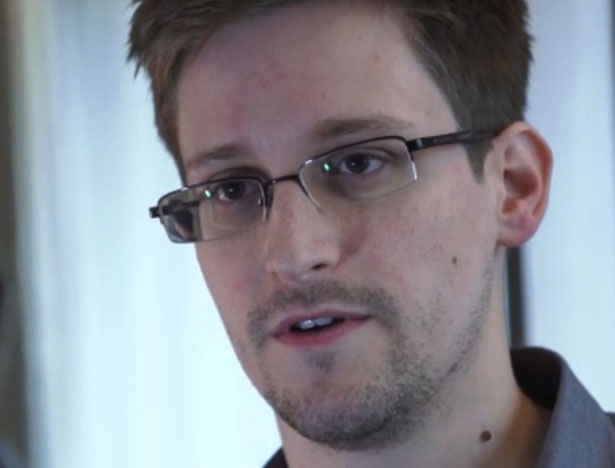
Edward Snowden. (Courtesy of guardiannews.com)
While the whistleblower Edward Snowden, who revealed the National Security Agency’s mass spying, was still stuck in Moscow’s Sheremetyevo airport, he received support from an unexpected quarter. Four leaders of Solidarity, the workers’ movement in Poland that upended that country’s totalitarian Communist regime in the 1980s, issued an open letter demanding that their government give Snowden sanctuary from the global manhunt being conducted by the United States. The signers were Barbara Labuda, Józef Pinior, Zbigniew Bujak and Władysław Frasyniuk, all of whom had the experience of being stalked by their government when they went underground during the period of martial law that began in 1981. “Edward Snowden did not kill anyone, did not kidnap or attack or maim anyone,” they wrote. “And yet, he is hunted and cornered like a terrorist. Why? Because he revealed an inconvenient truth about the activities of the authorities of his country. He revealed to the world that the American government systematically controls the behavior of millions of his [fellow] citizens through mass registering and listening to their telephone, Skype, Facebook, email and chat activities. Snowden’s revelations uncovered an ugly face of the American administration.”
And they voiced their expectation that the European Parliament “will recognize the value of his act and will extend over him the protections of European democratic institutions, which were created in order to defend and enlarge civic freedoms and human rights.”
Around the same time, in the West, a word familiar from the not so distant past—“dissident”—began to be attached to Snowden and other whistleblowers, like Julian Assange of WikiLeaks and Chelsea Manning, who soon received her ruthless sentence of thirty-five years for disclosing classified documents. In The New York Times, for instance, John Broder and Scott Shane wrote: “In 2006, when Edward J. Snowden joined the thousands of computer virtuosos going to work for America’s spy agencies, there were no recent examples of insiders going public as dissidents.” The use of the word is striking, because it was last widely employed to name those who, in the face of seemingly hopeless odds, had resisted the totalitarian rule of the Soviet Union and its client governments—in other words, people like the four Solidarity leaders who signed the letter in support of Snowden. Used this way, the word carried the implication that the US government might be that sort of oppressive power, or is perhaps on its way to becoming one. As support for Snowden grew globally and the Obama administration widened its campaign to capture him, that picture of Snowden’s situation became so broadly accepted that the White House felt impelled to challenge it explicitly. Obama’s press secretary, Jay Carney, asserted, “He is not a human rights activist. He is not a dissident.”
Popular
"swipe left below to view more authors"Swipe →
Or to translate: “We are no Soviet Union.”
And certainly, the four Poles, of all people, are as fully aware as any sensible person of the abyss of difference that separates the Obama administration from, say, the regime of Joseph Stalin, slayer of tens of millions of his own people. And yet it is chillingly true at the same time that the US government has gone further than any previous government—not excluding Stalin’s—in setting up machinery that satisfies certain tendencies that are in the genetic code of totalitarianism. One is the ambition to invade personal privacy without check or possibility of individual protection. This was impossible in the era of mere phone wiretapping, before the recent explosion of electronic communications—before the cellphones that disclose the whereabouts of their owners, the personal computers with their masses of personal data and easily penetrated defenses, the e-mails that flow through readily tapped cables and servers, the biometrics, the street-corner surveillance cameras. But now, to borrow the name of an intelligence program from the Bush years, “Total Information Awareness” is technologically within reach. The Bush and Obama administrations have taken giant strides in this direction. That China and Russia—and Britain, and many other countries—have done the same is hardly comforting to the humble individual under the eye of the universal spying apparatus.
A second totalitarian tendency has been the ambition to control the entire globe—a goal built into fascist as well as communist ideologies of the early twentieth century. In Hannah Arendt’s words, “Evidence that totalitarian governments aspire to conquer the globe and bring all countries on earth under their domination can be found repeatedly in Nazi and Bolshevik literature.” Neither achieved it, or even came close. But now, in the limited arena of information, a sort of shadow or rudiment of this ambition is near realization by the “sole superpower,” the United States. Much attention has been paid to Americans’ loss of privacy rights, but relatively overlooked in the debate over the government’s surveillance activities (at least in the United States) has been that all foreign communications—including those occurring in the lands of close allies, such as Germany—are fair game and are being swept into the US data banks.
The extent of the US global reach over information was mirrored in Snowden’s fate. Astonishingly, almost no fully democratic country would have him. (The conspicuous exception was Bolivia, whose president suffered the indignity of a forced diversion and landing of his plane when he was suspected of carrying Snowden to safety.) Almost all others, including Poland, bowed to US pressure, actual or potential, to refuse Snowden protection. The Polish letter writers were scandalized by this spectacle. “The fact that only dictatorial governments agreed to give him shelter shames the democratic states,” they wrote. “Our democracies discredit themselves with their indifference and cowardice in this matter.”
What happened to Snowden in Moscow diagramed the new global reality. He wanted to leave Russia, but the State Department, in an act of highly dubious legality, stripped him of his passport, leaving him—for purposes of travel, at least—stateless. Suddenly, he was welcome nowhere in the great wide world, which shrank down to a single point: the transit lounge at Sheremetyevo. Then, having by its own action trapped him in Russia, the administration mocked and reviled him for remaining in an authoritarian country. Only in unfree countries was Edward Snowden welcome. What we are pleased to call the “free world” had become a giant prison for a hero of freedom.
Open letter by leaders of Poland’s solidarity movement in defense of Edward Snowden.

