
The Night the Nazis Came to Murder My Grandfather

The Night the Nazis Came to Murder My Grandfather

The Night the Nazis Came to Murder My Grandfather

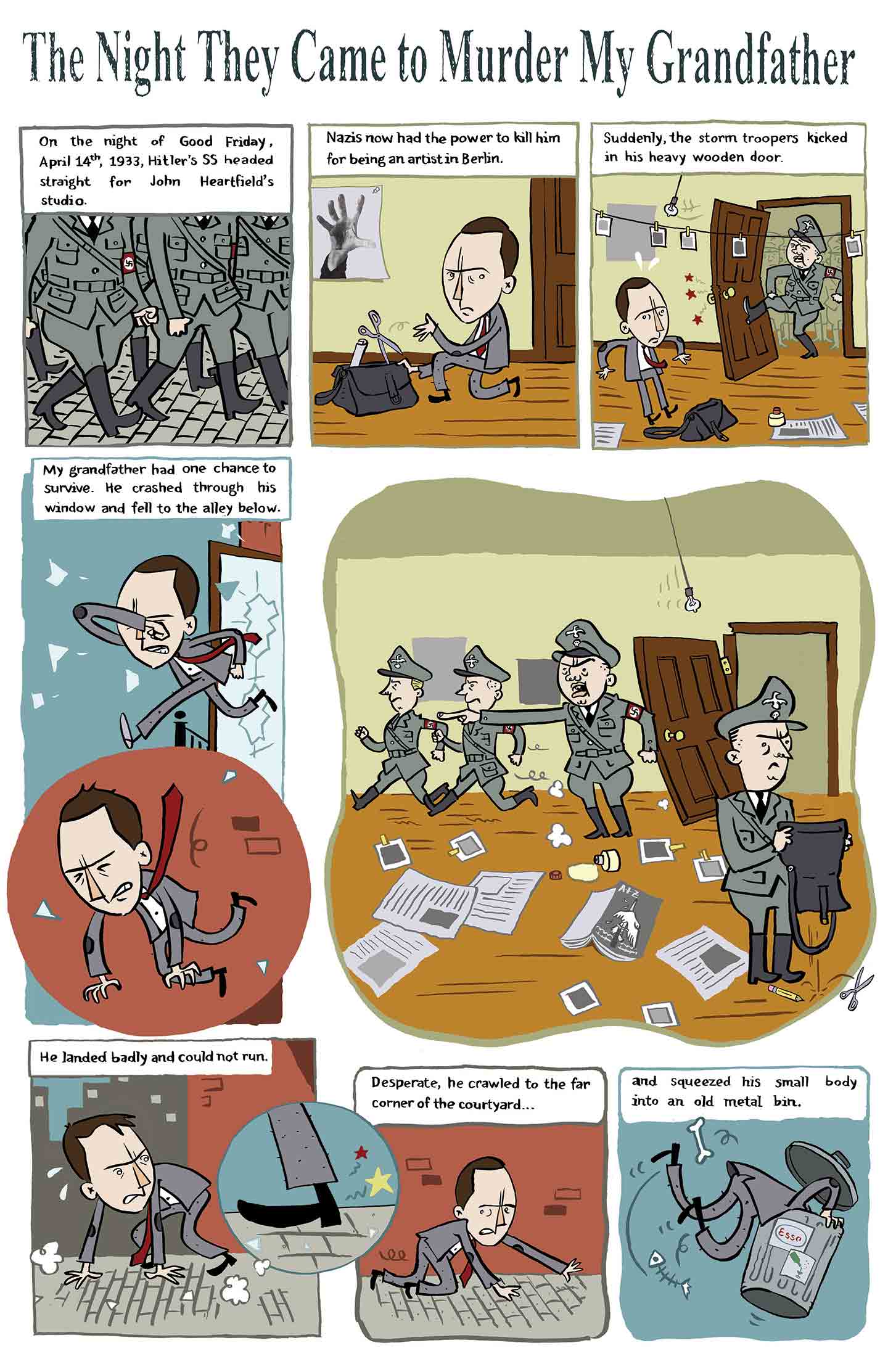
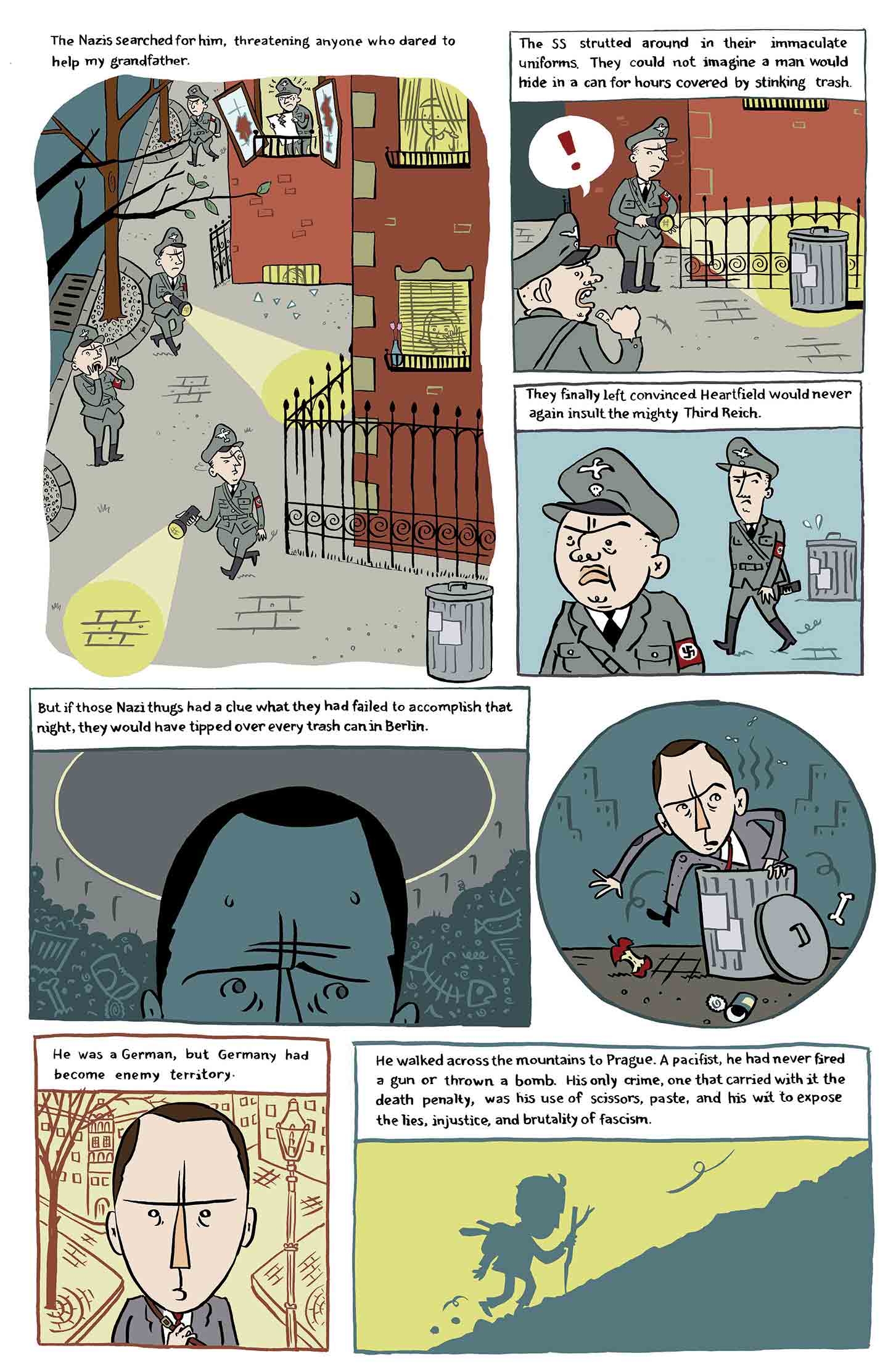
John Heartfield was a lifelong foe of fascism who used his art as a weapon—and whose devastating portrayals of Hitler, Goering, and Mussolini nearly cost him his life.

Copy Link
Facebook
X (Twitter)
Bluesky
Pocket
Email

As World War I decimated a generation, a young Berlin artist born Helmut Herzfeld changed his name to John Heartfield to protest out-of-control German nationalism. In 1918, he was a founding member of Berlin Club Dada—a group of artistic rebels whose influence in all areas of culture continues to this day.

Heartfield revolutionized the look of German book jackets and set design. He was a lifelong pacifist whose political beliefs were a constant in his art; his stunning collages, known as “photomontages,” exposed the growing threat of fascism in Europe. Using just scissors and paste, Heartfield employed an extensive visual memory and a searing wit to expose the horrors hidden under fascism’s shiny surface. One month after becoming the undisputed leader of Germany, Adolf Hitler ordered Heartfield’s arrest. The artist narrowly avoided an SS squad, escaping to Czechoslovakia, where he continued to attack the Third Reich with his “art as a weapon.” When the German Army entered Czechoslovakia in 1938, Heartfield was high on the Gestapo’s most-wanted list. Once again, he narrowly escaped—this time to London, where for 12 years he enjoyed a measure of peace. However, the Czech Refugee Fund denied his written request to remain in England for “his health and his work.” In 1950 his brother Wieland brought him to East Germany, where Heartfield’s years in England again placed him under suspicion. However Heartfield had powerful allies there, including his lifelong friend and theater collaborator Bertolt Brecht. After Heartfield’s death in 1968, the East German government gathered his original montages, models, and sketches into an archive of his pioneering stage design work, which was virtually inaccessible for many years—making it almost impossible for academics or the public to view his original work. In 2008, I decided to reintroduce the world to the life and work of my grandfather, a man Brecht called “one of the most important European artists.”

I first met artist Lance Hansen after The Nation published Lance’s graphic biography of George Grosz, who had been Heartfield’s close friend and collaborator. Lance originally asked me to work with him on a comic strip about my grandfather. But I thought Lance’s initial drawings captured my grandfather’s character so well that I suggested we collaborate on a graphic novel telling John Heartfield’s extraordinary life story. Please visit JohnHeartfieldExhibition.com to learn more.
Disobey authoritarians, support The Nation

Over the past year you’ve read Nation writers like Elie Mystal, Kaveh Akbar, John Nichols, Joan Walsh, Bryce Covert, Dave Zirin, Jeet Heer, Michael T. Klare, Katha Pollitt, Amy Littlefield, Gregg Gonsalves, and Sasha Abramsky take on the Trump family’s corruption, set the record straight about Robert F. Kennedy Jr.’s catastrophic Make America Healthy Again movement, survey the fallout and human cost of the DOGE wrecking ball, anticipate the Supreme Court’s dangerous antidemocratic rulings, and amplify successful tactics of resistance on the streets and in Congress.

We publish these stories because when members of our communities are being abducted, household debt is climbing, and AI data centers are causing water and electricity shortages, we have a duty as journalists to do all we can to inform the public.

In 2026, our aim is to do more than ever before—but we need your support to make that happen. 

Through December 31, a generous donor will match all donations up to $75,000. That means that your contribution will be doubled, dollar for dollar. If we hit the full match, we’ll be starting 2026 with $150,000 to invest in the stories that impact real people’s lives—the kinds of stories that billionaire-owned, corporate-backed outlets aren’t covering. 

With your support, our team will publish major stories that the president and his allies won’t want you to read. We’ll cover the emerging military-tech industrial complex and matters of war, peace, and surveillance, as well as the affordability crisis, hunger, housing, healthcare, the environment, attacks on reproductive rights, and much more. At the same time, we’ll imagine alternatives to Trumpian rule and uplift efforts to create a better world, here and now. 

While your gift has twice the impact, I’m asking you to support The Nation with a donation today. You’ll empower the journalists, editors, and fact-checkers best equipped to hold this authoritarian administration to account. 

I hope you won’t miss this moment—donate to The Nation today.

Onward,

Katrina vanden Heuvel 

Editor and publisher, The Nation

Ad Policy
x

