After This Shutdown Surrender, Chuck Schumer Needs to Go
The Democratic leader’s cave-in makes it all too clear: It’s time to clean house in the Senate.
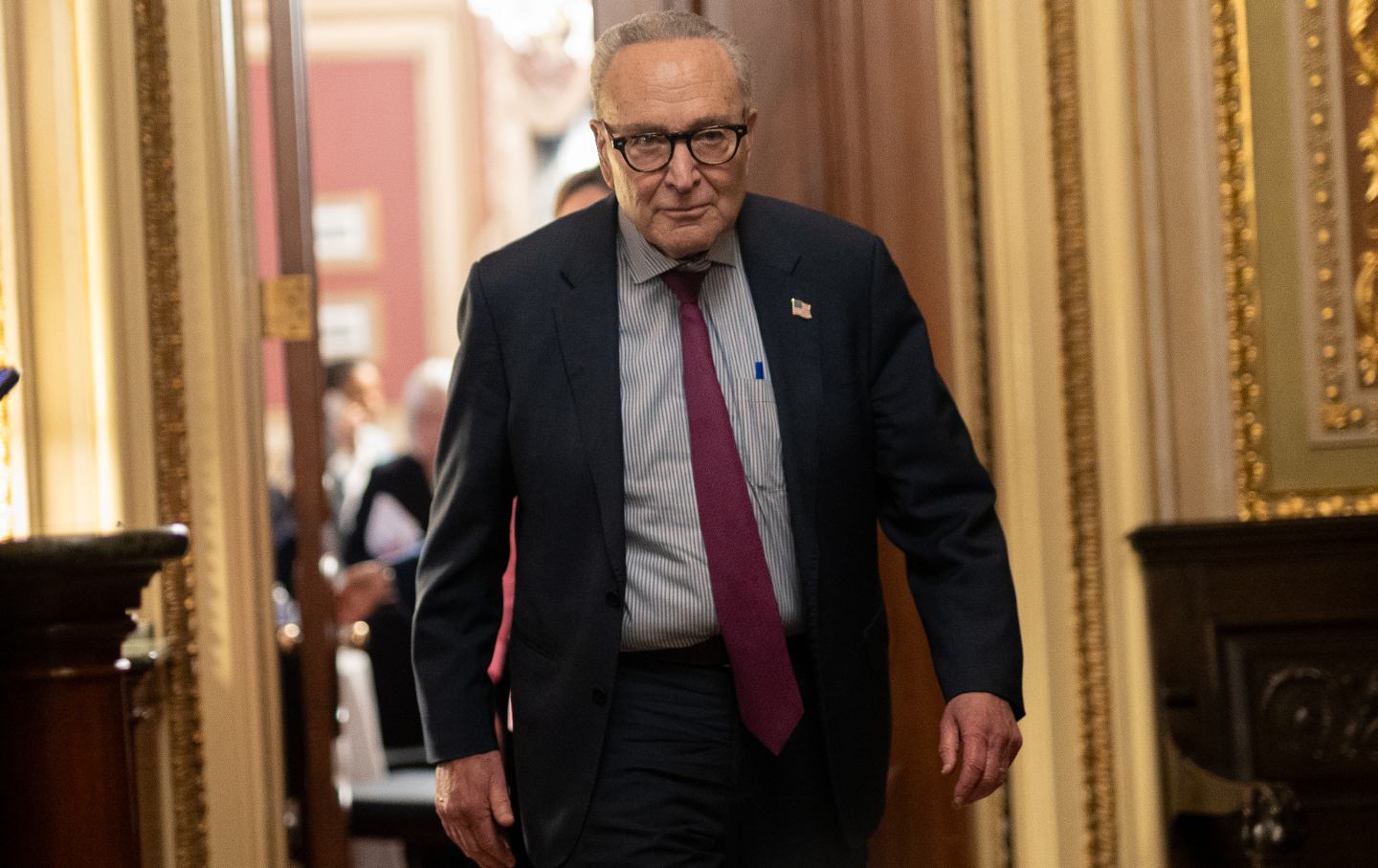
Senate minority leader Chuck Schumer leaves a Senate Democratic caucus meeting at the US Capitol on November 9, 2025.
(Nathan Posner / Anadolu via Getty Images)Last Tuesday, voters all over the United States sent a resounding message: They were sick of Donald Trump, sick of the Republican Party’s attacks on what remains of the American welfare state (seen most clearly in the ongoing government shutdown as well as threats to gut Medicaid), and wanted their elected representatives to do something about the affordability crisis making their lives harder. This anger underscored not only the Democratic landslides in Virginia and New Jersey but also democratic socialist Zohran Mamdani’s historic victory in New York City’s mayoral election.
So now, less than a week after voters loudly repudiated Trump, how are Senate Democrats—including minority leader Chuck Schumer—responding? By negotiating a shutdown deal with Republicans that will give Trump almost everything he wants, entrench the GOP’s austerity budget, and deepen the affordability crisis. Democrats might ask themselves how it is that they won the election but ended up giving away the store—or, rather, they might ask themselves that if they were not so practiced at snatching defeat from the jaws of victory.
To be as fair as possible to Democratic leaders, they always had a weak hand on the shutdown. Republicans control the House of Representatives and need only eight Democrats in the Senate to override a filibuster and clinch a deal. Further, Trump is almost uniquely depraved in his willingness to inflict pain on poor people (including by cutting SNAP benefits, a policy that directly increases hunger) and throwing the country’s infrastructure into chaos (with airline services starting to be curtailed as air traffic controllers were laid off).
But even allowing for the fact that they were fighting an uphill battle, the extent to which the Democrats have capitulated is remarkable. On Sunday, Jonathan Karl of ABC News reported that
there will be more than enough Democrats to vote in favor of re-opening the government tonight. They’ll get a promise of a vote on health care—but nothing more. Most of the Democratic leadership will likely vote against it.
The bill will extend funding until Jan 31 for most of the government and include three year-long appropriations bills—leg branch, military construction/Veterans affairs and Agriculture (including SNAP).
So, to summarize, at a moment when the elections had left Republicans on the ropes, Democrats caved, in exchange for a couple of months of government funding and a vote on healthcare that they are bound to lose, if Republicans even hold one. It’s hard to see that as much of a deal at all. There’s nothing in the deal that couldn’t have been secured before the shutdown. By signing on, a small cohort of Democratic senators are validating the cynical view that the shutdown was simply a stunt to hurt Republicans in the off-cycle elections.
Many Democratic lawmakers acknowledged that the deal does not come close to fulfilling the party’s promise to defend healthcare spending. House minority leader Hakeem Jeffries said, “I don’t think that the House Democratic Caucus is prepared to support a promise, a wing and a prayer, from folks who have been devastating the health care of the American people for years.” Representative Greg Casar, chair of the Congressional Progressive Caucus, said the deal was a “betrayal of millions of Americans counting on Democrats to fight for them. Republicans want health care cuts. Accepting nothing but a pinky promise from Republicans isn’t a compromise—it’s capitulation.” Senator Elizabeth Warren described the deal as “a mistake.”
In an interview with me on Sunday, Lindsay Owens, executive director of Groundwork Collaborative, a progressive strategy group, spoke of the way the deal is politically damaging to the Democratic Party’s brand. She noted that the exit polls from the elections show that “Democrats were benefiting a lot from pressing their historic advantage on healthcare and from fighting to lower healthcare costs. It really helped there be a message that Democrats were running on, but with consonant actions.” Owens added that affordability has been a dominant issue over the last few election cycles, both helping Trump win in 2024 and costing Republicans this year after Trump’s failure to solve the cost-of-living crisis. She argues that if Democrats “now surrender, I just don’t think they have credibility on cost of living.”
Chuck Schumer was the central architect of this fiasco. Even though he negotiated the deal, he himself said on Sunday that he won’t vote for it. He clearly prefers to let other Democrats take the fall.
Aaron Astor, a historian at Maryville College, made the intriguing argument at the deal could hurt both the Republican Party and Chuck Schumer:
Shutdowns rarely get any policy concessions. But they can provide political fodder for either primaries or the next midterm general election. For Dems, this one will wreck Schumer. But it will raise salience of health care affordability for next November if no ACA subsidy passes. After last Tuesday, Dems know that affordability is THE big issue that will help in 2026, just as it crushed Dems in 2024. GOP has never put forth a real alternative to the ACA so without subsidies, they’ll own major premium increases, whether they like it or not. But Schumer has done a terrible job messaging any of this and he is absolutely loathed by the Dem base now.
The progressive organization Indivisible suggested as much in a statement: “We hope to celebrate the Democratic Party for fighting back. But if they surrender, the next step is primaries and new leadership. We get the party we demand, and we intend to demand one that fights.” And ambitious House Democrats, like California’s Ro Khanna and Massachusetts’s Seth Moulton, who is running for the Senate, began calling for Schumer’s head. This issue is clearly not going away.
The shutdown deal is a humiliating defeat for the Democrats, but the party could still salvage this situation. Chuck Schumer needs to be removed as party leader and also defeated in his 2028 Senate primary. The other Democrats who voted for the deal need to be primaried as well (though, alas, at least two of those senators—Dick Durbin and Jeanne Shaheen—are retiring before they can be ousted). Only then will the party be able to look voters in the eye and say it is willing to fight the Republicans to save healthcare.