
Pete Buttigieg Refuses to Reform a Dangerously Unsafe Airline Industry
Countless near misses and faulty equipment require systematic attack—not soothing rhetoric.
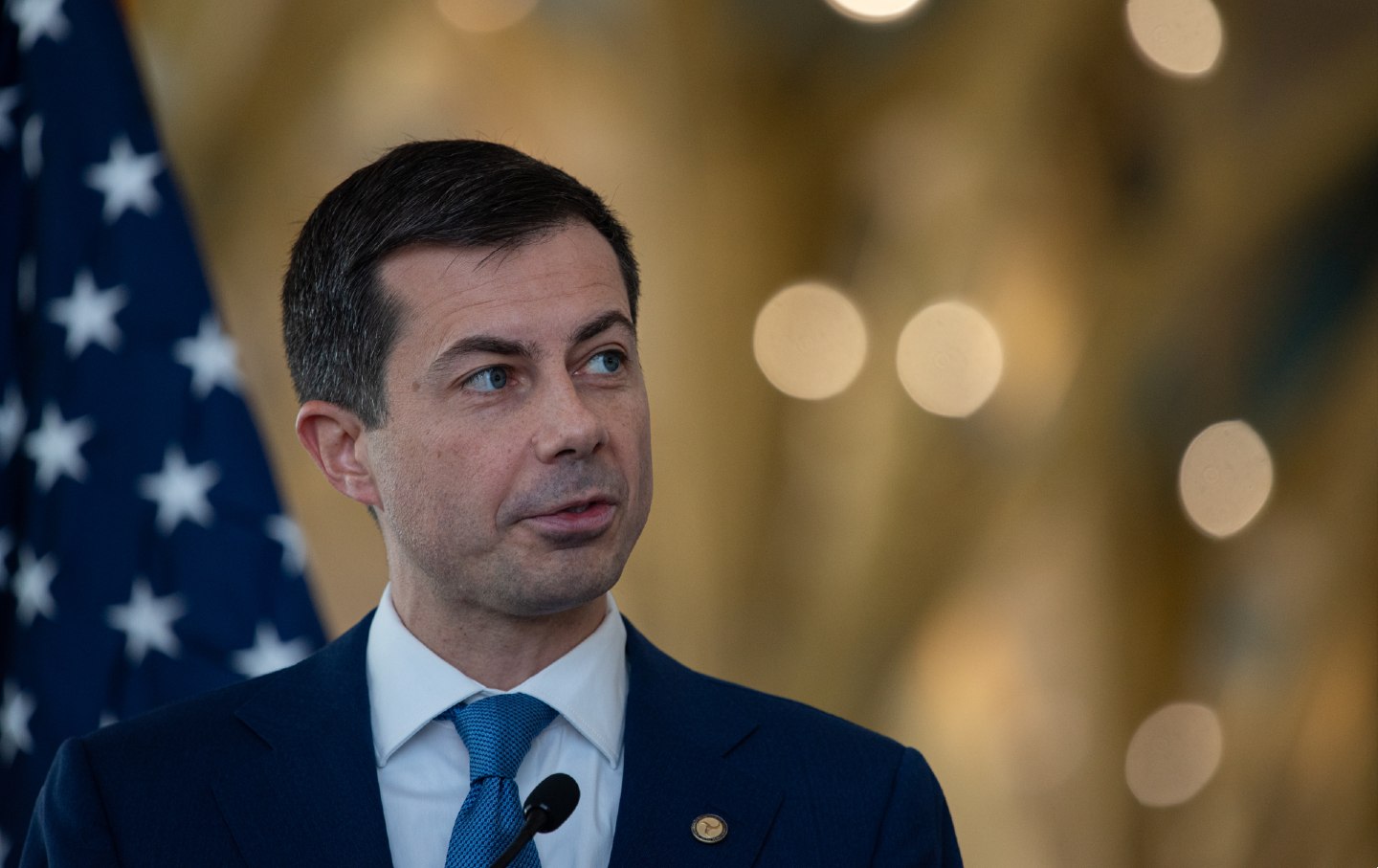
One of the services that McKinsey & Company offers its corporate clients is crisis management advice, including how to navigate through a public relations disaster. Pete Buttigieg, the former McKinsey consultant who is now the transportation secretary, often acts as if crisis management is still his stock in trade. In his tenure as a cabinet member, he’s faced a number of high-profile disasters: the Southwest Airlines scheduling crisis of December 2022, when the cancellation of nearly 17,000 flights left roughly 2 million passengers stranded; the February 2023 derailment of a Norfolk Southern freight train carrying toxic chemicals in East Palestine, Ohio, which created an environmental disaster; and the emergency landing last Friday of a Alaska Airlines Boeing 737 Max 9 after a door plug blew out.
Buttigieg has responded to each of these calamities in the spirit of crisis management, prioritizing the offering of soothing public relations messages over trying to find the root causes of problems. He seems to think his main job is to assure the American people that the system is in good working order rather than preventing repeated calamities. In the case of the Southwest Airlines meltdown, it took political pressure from lawmakers and the media to force Buttigieg to both investigate the company’s actions and impose a hefty fine of $140 million. With the Norfolk Southern train derailment, Buttigieg’s initial response was to again drag his feet and insist he had little power to act. Buttigieg later acknowledged that his diffident response and slowness to go to East Palestine was the wrong approach—if only in public relations terms.
But there’s little sign that Buttigieg has learned anything from his earlier forays into crisis management. With the Alaska Airlines disaster, Buttigieg has again taken the approach of going to the public with the reassuring message that there’s nothing to worry about and the system is fundamentally sound. On Wednesday, Buttigieg told reporters that the Federal Aviation Authority (FAA) was doing “a great job” and “I have confidence in any aircraft cleared by the FAA.” The FAA has grounded more than 150 Boeing planes.
Beyond the specifics of each incident, the problem with Buttigieg’s trademark approach is that it is reactive rather than proactive, offering after-the-fact solutions rather than looking at the systematic problems that are bedevilling American transportation.
The issue of plane safety is a complex one. Defenders of airplane manufacturers and the airlines insist the system is safer than ever. In August, The New York Times noted “an alarming pattern of safety lapses and near misses in the skies and on the runways of the United States. While there have been no major U.S. plane crashes in more than a decade, potentially dangerous incidents are occurring far more frequently than almost anyone realizes — a sign of what many insiders describe as a safety net under mounting stress.”
Last July, for example, there were 46 close calls.
The Alaska Airlines mishap was also a close call: Miraculously, no one died, but that was likely because there were no passengers seated near the door that blew out, and also because Alaska Airlines, aware that the Boeing 737 Max 9 was bedeviled with safety problems, had voluntarily instigated a policy of not flying the plane over water. As The New York Times notes:
By sheer luck, the two seats next to where the hole opened were among only seven on the plane that happened to be empty. Also by sheer luck, the blowout happened before the jet had reached cruising altitude, where the sudden loss of cabin pressure would have been far more severe. Passengers might have been sucked out of the hole or, if unmasked, died from a lack of oxygen.
The close calls are a matter partly of luck and partly of airlines trying to be more cautious with flawed planes. This is not a sustainable model for an industry where millions depend on safety every day. Flying under this system is a game of Russian roulette. At some point, luck runs out and the barrel has a bullet in it. When we fly, we’re just whistling past the graveyard.
Writing in The American Prospect, journalist Luke Goldstein provided the much needed systematic analysis that Buttigieg is reluctant to undertake. Goldstein observes, “The specific piece of equipment, a plug door that broke off a Boeing 737 MAX 9 aircraft during Alaska Airlines Flight 1282 from Portland on Friday night, in fact illustrates many of the broader trends in the airline industry today: the desire to cram more passengers into finite space, the standardization of production across outsourced subcontractors, and the lack of oversight from federal regulators into these increasingly dangerous schemes.”
He goes on to explain that Boeing “went through a restructuring during the 1990s from an ‘association of engineers’ to a firm run by Wall Street shareholders. This catastrophic path has led to another systemic crisis for one of the world’s two major commercial aviation companies, underscoring the deterioration of Boeing’s product quality by financialization, cost-cutting, and outsourcing.”
Popular
“swipe left below to view more authors”Swipe →This analysis is congruent with a 2019 New Republic article that quoted a former Boeing physicist, Stan Sorscher as saying the company has “a culture of financial bullshit, a culture of groupthink.”
The actual door plug that blew out seems to have been made by Spirit AeroSystems—a spin-off from Boeing that became its own firm in 2005. As The Lever reported on Monday: “Less than a month before a catastrophic aircraft failure prompted the grounding of more than 150 of Boeing’s commercial aircraft, documents were filed in federal court alleging that former employees at the company’s subcontractor repeatedly warned corporate officials about safety problems and were told to falsify records.”
The news site adds that the former Spirit employees claim that the FAA “has failed to properly regulate companies like Spirit, which was given a $75 million public subsidy from Secretary Pete Buttigieg’s Transportation Department in 2021.” A separate report documents that Boeing has spent more $65 million in just the last four years lobbying lawmakers of both parties to thwart government regulation.
Taking together, these reports paint a dire picture of airline safety that goes beyond individual mishaps into a more systematic problem of a deregulated, financialized industry that is able to use its wealth to evade oversight at the risk of public safety. Beyond safety, the airline industry is bedeviled with many other systematic problems that include price gouging of customers and mistreatment of employees.
One could imagine a take-charge transportation secretary who sees these systematic problems as an opportunity to become a reformer. Such a secretary would use his or her megaphone to call attention to the failures of the industry and push for wholescale reform—including much stronger regulatory powers for the state.
Pete Buttigieg is obviously not filling that needed role of a reforming transportation secretary. He is, in fact, a classic case of a public official who has been captured by the industry he is supposed to oversee.
It’s worth asking why he is avoiding the opportunity he has been given. If Buttigieg wanted a future career in politics, he would in fact be pushing loudly for reform. Taking on corporate misconduct and corruption would do wonders for his political reputation. But it’s clear that Buttigieg doesn’t see much of a future for himself in politics. Perhaps he’s auditioning for a return to McKinsey, where he can get a plum job as a crisis management consultant.
More from
Jeet Heer 
Why Trump Is Embracing Vivek Ramaswamy’s Vile Ad Why Trump Is Embracing Vivek Ramaswamy’s Vile Ad
The president is leaning into the politics of toxic parenting.

Even Republicans Are Waking Up to Trump’s Corruption Even Republicans Are Waking Up to Trump’s Corruption
And, somewhat shockingly, so are Democratic elites.

Where Is the Outrage Over Trump’s Racist Targeting of Ilhan Omar? Where Is the Outrage Over Trump’s Racist Targeting of Ilhan Omar?
The establishment press and some Democrats are strangely mute over the president’s flagrant abuse of the legal system.

The Real AI Threat Is Already Here The Real AI Threat Is Already Here
Never mind some future apocalypse—AI is being used right now to cause enormous suffering.

Elon Musk’s James Talarico Smear Blew Up In His Face Elon Musk’s James Talarico Smear Blew Up In His Face
But that doesn’t mean the danger from Musk’s lies is over.
Does America First Really Mean Israel First? Does America First Really Mean Israel First?
Mike Huckabee’s aide shows how an extremist agenda dominates Trump’s Middle East policy.

