
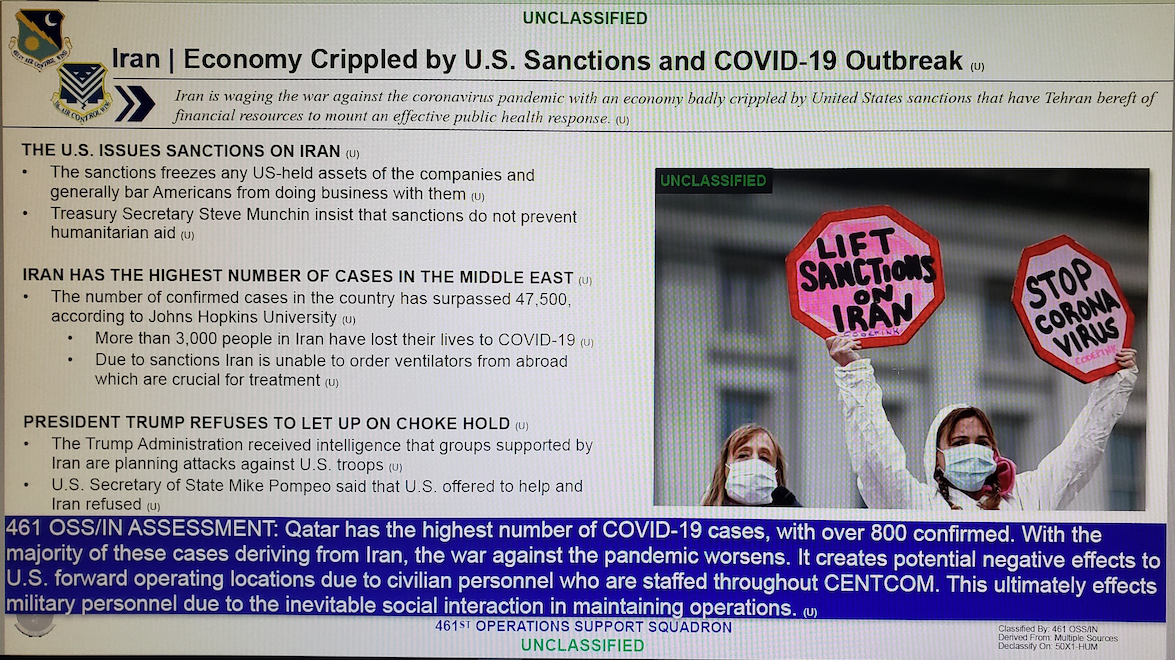
US sanctions on Iran have “badly crippled” its economy as well as its ability to respond to the coronavirus pandemic, which endangers nearby US troops, according to a military intelligence brief obtained by The Nation.
The document, dated April 3, says that Qatar—host to the largest US military base in the region—”has the highest number of COVID-19 cases, with over 800 confirmed.” While the briefing does not make clear whether that figure includes US military personnel, the number is doubtless far higher today. The Pentagon did not respond to a query by The Nation asking how many US military personnel in Qatar have tested positive for the virus.
The majority of these cases, the brief says, derive from Iran, which is located across the Persian Gulf from Qatar. The document warns that US sanctions have “left Iran bereft of financial resources to mount an effective public health response” to the pandemic and “unable to order ventilators from abroad, which are crucial for treatment.”
Despite this, sanctions remain in effect. To quote one segment of the briefing: “president trump refuses to let up on choke hold.”
The military is not alone in seeing the dangers. Norman Roule, a retired CIA official who served as national intelligence manager for Iran until 2017, told The Nation, “The international community should do everything it can to enable the Iranian people to obtain access to medical supplies and equipment, not just because it’s the right thing to do, the human thing to do, but also because as Iranians travel throughout the region, they will continue to disperse the virus.”
Popular
"swipe left below to view more authors"Swipe →
Roule, a 34-year veteran of the CIA, is no sympathizer of the Iranian regime. He stressed that “Iran has an obligation to be open as to the nature of the virus’s impact within its borders,” but he said that if the coronavirus spreads unchecked throughout the country, it threatens everyone. “Iranian military personnel are in Yemen, Iraq, Syria, and parts of Afghanistan, and Iran also has a history of training foreign militants,” Roule said. These populations “could spread viruses throughout the region and from there, the international community.”
The intelligence brief appears to echo Roule’s concern about the threat of the virus spreading outside Iran’s borders, warning, “It creates potential negative effects to U.S. forward operating locations due to civilian personnel who are staffed throughout CENTCOM. This ultimately affects military personnel due to the inevitable social interaction in maintaining operations.”
The intelligence brief, produced by the Air Force’s 461st Operations Support Squadron and marked For Official Use Only, was provided to The Nation by a Pentagon official on the condition of anonymity to avoid professional reprisal. It notes that “Secretary of State Mike Pompeo said that [the] U.S. offered to help and Iran refused.”
While Pompeo has rhetorically expressed openness to easing sanctions, no concrete offer has been made, and he has not given any indication that he has dropped his 12 preconditions for sanctions relief. Jake Sullivan, who negotiated with Iran while serving as the State Department’s director of policy planning under the Obama administration, reportedly said of Pompeo’s preconditions, “The 12 requirements the secretary set seem intended to ensure that no deal ever happens.”
Earlier this month, two dozen former US and European officials, including former secretary of state Madeline Albright, called on the Trump administration to lift sanctions in order to help Iran better respond to the pandemic, saying in a statement that “an outbreak anywhere impacts people everywhere.”
Iran suffers from the highest number of coronavirus cases of any country in the Middle East. It reportedly has 75,000 cases, with some 1,400 new ones being reported each day. Officially, 5,200 Iranians have died.
The Trump administration maintains what it calls a “maximum pressure” campaign against Iran. Not only has the administration barred US firms from doing business with Iran but in May 2019, the administration ended sanctions exemptions for foreign countries buying Iranian oil. The move wrecked Iran’s economy, leading the IMF to forecast zero growth for the country in 2020.
The coronavirus will likewise severely damage the economy. Daniel Russel, a former US diplomat who served as the assistant secretary of state for East Asian and Pacific affairs until 2017, told The Nation that while pandemics have a devastating initial effect on public health, a brutal second wave can come in the form of an economic downturn—particularly in developing countries like Iran.
“I ran the Asia Bureau in the State Department, and I was constantly reminding people that no matter how bad things seem, they can always be made worse,” Russel said.
If relations with Iran improve, financial institutions are still unlikely to want to work with Iran. Roule explained that banks will probably see too much risk and exposure in working with the country. Even during the Obama administration, which lifted sanctions, European banks were reluctant to conduct business with Iran.
Iran has unsuccessfully requested $5 billion in loans from the IMF in order to combat Covid-19, in addition to a $50 million loan from the World Bank. This marks the first time that Iran has asked the World Bank for a loan since 2005.
Secretary of State Pompeo has vociferously opposed Iran’s request for a loan, saying that the country would use the money for “corrupt purposes.”
“The Trump administration should start taking concrete steps to give banks and suppliers the clarity they need to help Iranians access vital humanitarian and medical assistance,” Senator Ed Markey told The Nation. “The Iranian regime has long demonstrated its disregard for the well-being of its own people, but the United States should do more within our power to help coronavirus assistance reach those who need it inside Iran. That’s what makes us different from Iranian leaders.”
Markey is far from the only prominent member of Congress to call for sanctions relief amid the pandemic. Senators Chris Murphy, Tim Kaine, and Patrick Leahy have sent multiple letters to the administration urging it to ease sanctions.
Congresswoman Ilhan Omar, who serves on the Foreign Affairs committee, told The Nation, “Keeping sanctions in place on Iran during a global pandemic is unconscionable. These sanctions are only harming innocent civilians who bear the brunt of this crisis while having zero effect on the behavior of the Iranian government. Civilians are unable to receive lifesaving medicine and humanitarian supplies due to the US-placed sanctions.”
Correction: This article was updated to convey that the briefing does not make clear if the number of cases in Qatar includes US military personnel.

