US Foreign Policy Has an Extinction Agenda
As the world loses time to act, US elites are working to dominate the remains of a ruined planet.
In April 2022, the Intergovernmental Panel on Climate Change issued the sort of warning that would galvanize a sane society into historic action. Unless greenhouse gas emissions cease rising by 2025, the IPCC found, humanity will not be able to limit the warming of the planet to 1.5 degrees Celsius, the temperature at which the worst ravages of climate change might still be avoided—though not all of them, just the most catastrophic. The choice implied by the IPCC was between a globe-spanning initiative to halve emissions by 2030, thereby giving us a chance of remaining within the 1.5˚C threshold, or a 21st century defined by an increasingly uninhabitable world.
Drastic as that choice is, the IPCC made clear that a path out of civilizational disaster is doable. The emissions reductions necessary to stay within a 1.5˚C rise would “shave 1-2 percent” off the projected global growth of GDP through 2050, according to a summary from Damien Carrington, the environment editor at The Guardian. But the IPCC’s ultimate point was that the timeline is unforgiving: some “30 months,” Carrington wrote, before the future promises to be unlivable for an unthinkable proportion of humanity.
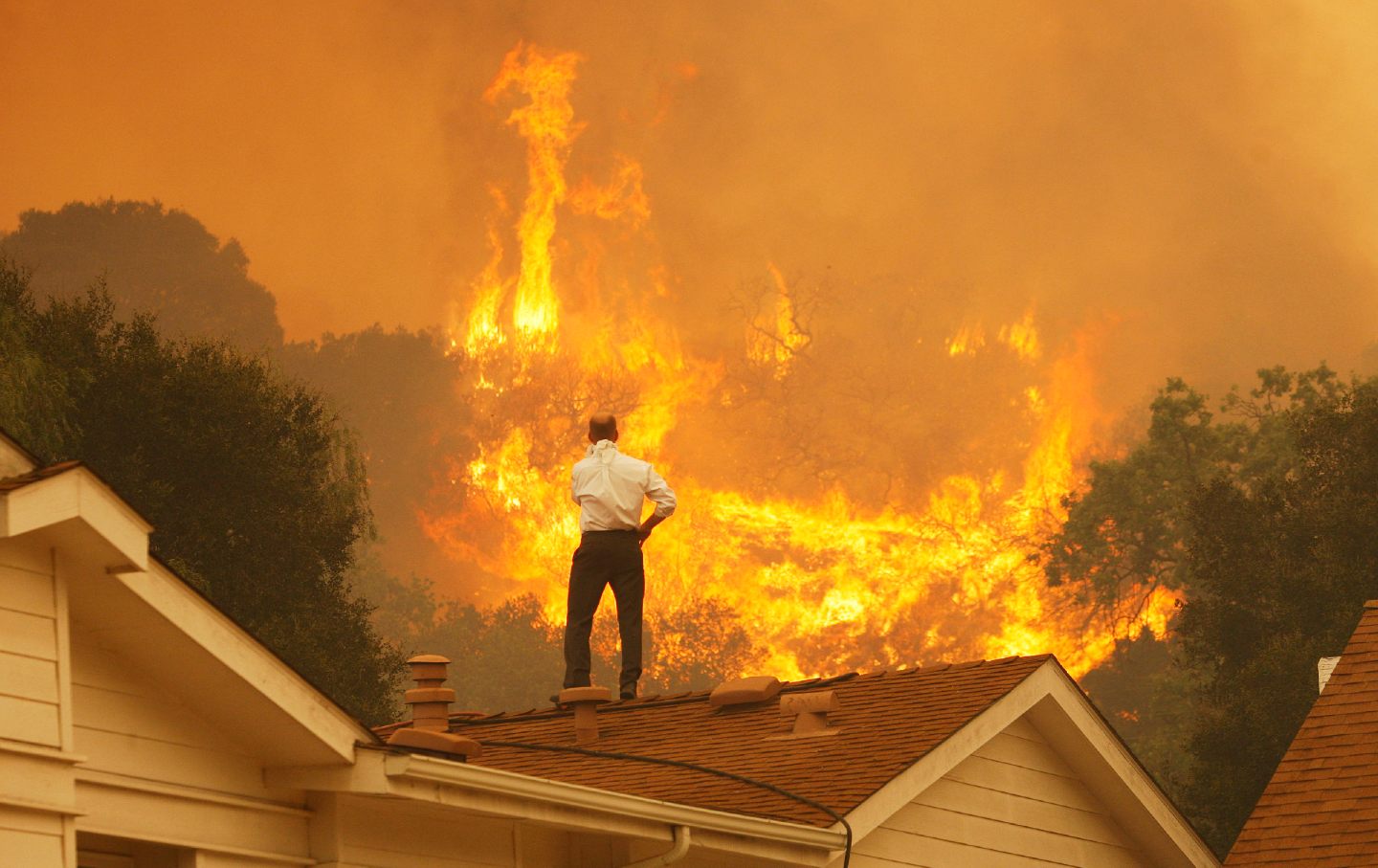
Seventeen months have passed since the IPCC’s warning. Summer 2023 featured both the hottest July ever recorded and an understandable focus on wet-bulb temperatures, which helps measure the point at which external heat and humidity overwhelm the body’s ability to cool itself and survive extended exposure. Lahaina, Hawaii, once a paradise, lies in ruins from the worst US wildfire in over a century, with at least 115 people dead as of this writing. As horrific as the blackened ruins of Maui are, it’s a prologue of what nature has in store for our communities if nothing changes.
Yet US foreign-policy thinking operates as if none of this is happening—or, rather, as if US foreign policy has better things to do than mitigate the advance of global devastation. At a moment when the imperatives of survival demand unprecedented global cooperation for decarbonization, the question preoccupying US foreign-policy elites is over how many cold wars to wage.
A bipartisan elite consensus exists for denying China the technologies and markets it needs for economic growth and containing Beijing militarily. Russia’s election interference in 2016 and its 2022 invasion of Ukraine have prompted a significant policymaking constituency within (and beyond) the Democratic Party for persistent confrontation with Moscow. There is some dissent on Russia within the Republican Party, but as an adjunct of loyalty to Donald Trump or a preference for intensifying the cold war with China. The security apparatus is generally on board for either version of the strategy known as “great power competition.” As our presidential election season begins to coalesce, the IPCC report has already been forgotten. We are in for a debate on US foreign policy that future generations will not forgive.
Advocates of the great-power-competition framework typically argue that there is no inherent trade-off between competition and addressing the climate crisis. The Biden administration’s 2022 national security strategy, which built on the 2018 defense strategy of the Trump administration, pledges cooperation with rival powers “to address shared challenges in an era of competition.” Among all of our shared international problems, it calls climate change “the greatest and potentially existential.” The language is revealing. There is nothing remotely “existential” to Americans or anyone else about the US losing geopolitical and geo-economic primacy, which for Washington (if not Beijing) are the stakes of great-power competition. There is most certainly something “existential” to Americans and everyone else about less of the world being habitable. Basic understandings of strategy would prioritize dealing with the existential danger.
On paper, it’s easy to exempt from imperial struggle the mutual challenges that the great powers face. It’s less feasible in practice. In July, US climate envoy John Kerry visited Beijing to restart climate talks after Biden took measures to restrict China’s access to semiconductors, a crucial component of both economic and military growth. Kerry wanted China to accelerate phasing out its carbon emissions, but as the economist Dean Baker explained, the argument that Beijing “must be denied the opportunity to improve the living standards of their people because we messed up the planet so badly” is unlikely to sway anyone in China. The former Pentagon official Van Jackson noted in his newsletter Un-Diplomatic that China “has zero incentive to green any faster than its current path as long as it looks out and sees a world economy that’s fracturing (because it then requires energy independence, which is its chief aim).” It turns out that attempting to suppress a rising competitor inclines that competitor to intransigence, even—especially—on issues of shared interest.
During the early phase of the War on Terror, the George W. Bush administration reserved the right to take devastating military action under what’s known as the “One Percent Doctrine,” whereby if there were even a 1 percent chance that terrorists could get weapons of mass destruction, it had to be treated as an imminent certainty. But when it comes to climate catastrophe, we have actual certainty. All that’s necessary for a future uninhabitable for much of humanity is for things to continue as they are.
In one sense, the consequences are foreseeable. The migration flows will be far more extensive than those that convulsed US and European politics in the mid-2010s. But other effects are unimaginable. Recall that the ash spewed from a volcanic eruption in Iceland in 1783 is partly responsible for the French Revolution. The 120 million tons of sulfur dioxide released into the atmosphere caused such severe weather—including hailstones large enough to kill livestock—that it disrupted harvests to the point of rendering the French social contract unviable five years later. Despite all this, US foreign-policy circles treat climate collapse as a less urgent problem than the prospect that Chinese advances in artificial intelligence will give it a military advantage over Washington.
It’s hard enough under normal conditions to unite nations in a common purpose. What’s urgent here is to unite nations in a task at odds with the imperatives of capitalism, which have brought the world to the brink of uninhabitability. We do not have to ignore the atrocities of the great powers in the interest of climate cooperation. We just have to jettison strategies like great-power competition that make present and future atrocities more intractable. Averting mass death and even civilizational collapse ought to be the central organizing principle of US grand strategy. To do otherwise, as both major parties and the security apparatus prefer, is to pursue an agenda that marches toward extinction. And there aren’t many months on the IPCC’s calendar left.
Disobey authoritarians, support The Nation
Over the past year you’ve read Nation writers like Elie Mystal, Kaveh Akbar, John Nichols, Joan Walsh, Bryce Covert, Dave Zirin, Jeet Heer, Michael T. Klare, Katha Pollitt, Amy Littlefield, Gregg Gonsalves, and Sasha Abramsky take on the Trump family’s corruption, set the record straight about Robert F. Kennedy Jr.’s catastrophic Make America Healthy Again movement, survey the fallout and human cost of the DOGE wrecking ball, anticipate the Supreme Court’s dangerous antidemocratic rulings, and amplify successful tactics of resistance on the streets and in Congress.
We publish these stories because when members of our communities are being abducted, household debt is climbing, and AI data centers are causing water and electricity shortages, we have a duty as journalists to do all we can to inform the public.
In 2026, our aim is to do more than ever before—but we need your support to make that happen.
Through December 31, a generous donor will match all donations up to $75,000. That means that your contribution will be doubled, dollar for dollar. If we hit the full match, we’ll be starting 2026 with $150,000 to invest in the stories that impact real people’s lives—the kinds of stories that billionaire-owned, corporate-backed outlets aren’t covering.
With your support, our team will publish major stories that the president and his allies won’t want you to read. We’ll cover the emerging military-tech industrial complex and matters of war, peace, and surveillance, as well as the affordability crisis, hunger, housing, healthcare, the environment, attacks on reproductive rights, and much more. At the same time, we’ll imagine alternatives to Trumpian rule and uplift efforts to create a better world, here and now.
While your gift has twice the impact, I’m asking you to support The Nation with a donation today. You’ll empower the journalists, editors, and fact-checkers best equipped to hold this authoritarian administration to account.
I hope you won’t miss this moment—donate to The Nation today.
Onward,
Katrina vanden Heuvel
Editor and publisher, The Nation