
Ghost Stories
The specters of Lorrie Moore.
The Ghosts of Lorrie Moore
An enigmatic new novel retells a disorienting story about death, love, the Civil War, and everything in-between.
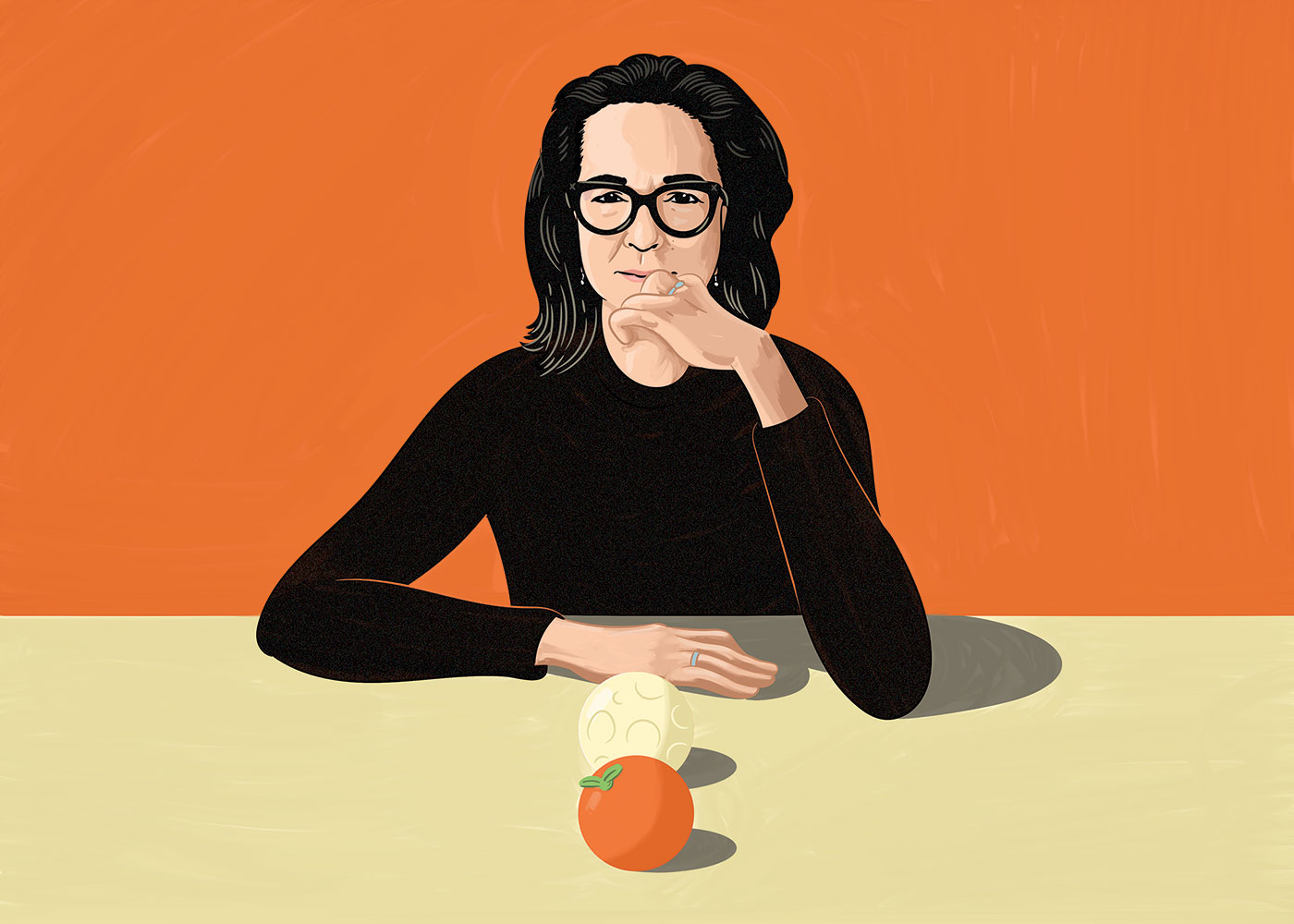
Illustration by Liam Eisenberg.
In “Agnes of Iowa,” a short story in Lorrie Moore’s 1998 collection Birds of America, we meet a couple from Iowa visiting New York City. Their marriage has been failing for quite some time. The protagonist, Agnes, has grown impatient with the “pathetic third-hand manner in which the large issues and conversations of the world were encountered.” Once they’re in New York, though, things seem to get better. The couple window-shop and roller-skate in Central Park and gamely behave like normal happy tourists. Agnes marvels at the city’s sense of humor and even finds some humor in her own life: The city “seemed to embrace and alleviate the hard sadness of people having used one another and marred the earth the way they had.” At one point, as Agnes and her husband, Joe, are sitting in a cafe, he turns to her and makes a clown face. Agnes is taken aback, horrified rather than amused, and when she attempts to imitate him, to show him how he looks, she produces “a look of such monstrous emptiness and stupidity” that Joe bursts out laughing. Their relationship is doomed and Agnes has become embittered. But by the end, they can at least have a laugh at things.
Books in review
I Am Homeless [i]f This Is Not My Home: A Novel
Buy this bookHow couples come together, and joke around and fight and break up, has long been at the center of Moore’s fictional universe. Best known for her short stories, Moore has carried her preoccupation with relationship misfires into her novels as well. In Anagrams, Who Will Run the Frog Hospital?, and A Gate at the Stairs, the featured couples are not always romantic, but they grope toward an intimacy of one kind or another, and when they find it—if they find it—it is fleeting, uneven, often comical as well as comic, and usually destined to end badly. Their jokes have an underlying sadness. It turns out you don’t have to make a clown face to behave like a clown.
In her new novel, I Am Homeless if This Is Not My Home, Moore introduces us to a failed couple conducting a relationship postmortem—and for good measure, she also throws in a literal clown. The book follows a middle-aged history teacher named Finn who is grappling with a dying brother and a deteriorating career and who is soon haunted by his ex-girlfriend Lily, a “laugh therapist” who dresses like a clown as part of her practice. Lily has died by suicide, but apparently she isn’t quite dead yet: She persuades Finn to drive her south to a lab where she plans to donate her no longer useful human body to science. Whether Lily is actually alive or not remains something of an open question. (“Do you know about Schrodinger’s cat?” she jokes.) But that doesn’t prevent the kind of witty and wounding relationship banter that has become Moore’s hallmark. Finn and his deceased ex-girlfriend have it out from Illinois to Tennessee, with Lily in an increasing state of rot. But unlike Moore’s other books, I Am Homeless if This Is Not My Home remains enigmatic. Like Lily—and the relationship at its core—the novel is somewhat uncategorizable: It refuses, almost sidesteps, easy interpretation.
I Am Homeless begins with a seemingly unrelated plotline set in the Reconstruction era. We meet Libby, the proprietor of a lodging house in a small town in Kentucky, who writes diary entries in the form of letters to her sister that will never be sent. These entries recount her interactions with a peculiar lodger, an actor with suspicious muttonchops who is “dapper as a finch” and might possibly be John Wilkes Booth. After killing Lincoln, Booth was able to evade arrest for a time, so maybe this is him. Or maybe not—again, we aren’t given many clues.
The chapters from this plotline alternate with chapters set in a world that is more determinate but equally weird. Finn’s story begins in New York City just before the catastrophic 2016 election. He has driven in from Illinois and is staying at an Airbnb in an “industrialized zone of Chelsea.” Finn is in New York to visit his brother, who is in hospice care. The brother, Max, is close to death after a long bout of cancer, with eyes that goggle in his head and skin “the smooth hue of an apricot.” The two kill time watching the World Series. The impending election provides an ambient anxiety, but Finn isn’t worried about a possible Trump victory because the notion seems too preposterous. Many of us felt the same way back then.
Before Max can die, however, Finn receives a text from Sigrid, a friend of his ex-girlfriend Lily. She has some bad news that summons him back to Illinois: Lily has had a history of suicide attempts, and Finn suspects the worst. He leaves New York knowing that he will probably never see Max again but also fearing that he has already seen the last of Lily. By the time he arrives in Illinois, Lily is apparently already dead and interred at a green cemetery—a rush job. “There was a deep freeze headed this way,” Sigrid tells him, “and no one would have been able to dig a plot.”
Finn goes off to the cemetery to visit her grave, but what he finds instead surprises him: Lily standing before him “in the dead fleabane, holding a large grapefruit like a globe, her shroud draped around her, a cocooning filthy gown.” Is this a figment of his imagination or is this reality—or perhaps something in between? Like our maybe-but-maybe-not Booth in the other narrative, Lily’s state of being remains a mystery.
Finn’s narrative constitutes the core of the novel, and for a while it’s unclear why we’re cutting away to Libby at all. Eventually, Finn and Lily make their way to Tyler after a long drive through the night and end up staying at the inn—and in the room that seemingly belonged to our maybe-Booth. The plots intersect when Finn finds and reads Libby’s diary. This is the only explicit connection between the two storylines. Any further connection must be inferred and is difficult to reconcile without equating the personal loss of loved ones with the large-scale bloodbath of the Civil War and the traumas endured during the Reconstruction period, which I hope isn’t the novel’s intention. Maybe there is something to be said, in the layering of these two narratives, about continuing to live after devastation; about private and national mourning; about the lies inherent in any official account—but one is left wondering whether the narratives do, in fact, speak to each other at all or even whether they’re designed to. We are reading not only a ghost story but a story that is itself spectral.
In some ways, though, how and why these two storylines relate is beside the point. Like all good ghost tales, the book is rife with nostalgia, and mostly in a good way: We’re treated to baseball, apple trees, the Civil War, a traveling freak show, lore about Lincoln’s assassination. Alongside the predictable and comforting Americana, a series of stranger images also begins to accumulate. Does the main character have sex with what might be a corpse instead of a person? He does. Does the wryly funny innkeeper murder someone? Yes. One might wonder—as Finn leaves Lily in Knoxville “in full bioluminescence, shining from her own uncajolable deadness,” and as Libby contemplates gluing a dead man’s eyes shut—whether it’s even possible to fully understand what’s going on.
Yet one thing in the novel is constant: humor. Like Agnes in New York, Lily tries to get us to laugh—she is, after all, a laugh therapist by training. But her jokes can be a little grim. “Two of our mass shooters were named Dylan,” she observes. “Music is worthless.” When Finn asks her what death is, she replies, “It’s sort of what you make of it.” Her jokes feel canned, or at least inadequate to the moment. But this seems deliberate on Moore’s part. Lily is aware on some level that she’s compensating, that her efforts to lighten the mood can only fail. Toward the end of the book, as Finn drops her off, he says to her in anger, “But your whole vocation, your clown thing, was supposed to be a distraction from death! That was your job.” “I guess I just sucked at it,” Lily replies. “But you knew that.”
The funny woman contorting herself to make light of a shitty situation is often really a way for Moore to write about sadness. Her first novel, the ingeniously constructed Anagrams, follows Benna Carpenter and her friends Eleanor and Gerard (imaginary and real, respectively) as they use humor to navigate shifting dynamics and loss. In Who Will Run the Frog Hospital?, we meet a teenage girl named Berie and her friend Sils, who come of age one summer in upstate New York when Sils needs an abortion. They too turn to jokes to avoid acknowledging the gravity of a situation. “We were never very witty as girls, but we thought we were,” says the narrator in a moment of self-awareness. “We loved to laugh violently, convulsively, no sound actually coming out until suddenly we’d have to gasp in a braying way for breath.”
In A Gate at the Stairs, Moore’s 2009 novel, we follow a restaurant owner, Sarah, as she adopts a baby late in midlife and hires a college student named Tassie to help out with childcare. Awkward jokes ensue as Sarah and Tassie navigate their differences in social class. Often the two joke with each other nervously, sometimes meaninglessly, when a deeper connection seems impossible. “A distant memory flew to my head: a note passed to me from a mean boy in seventh grade,” Tassie recalls. “Laugh less, it commanded.”
Popular
“swipe left below to view more authors”Swipe →In I Am Homeless if This Is Not My Home, Finn and Lily joke around to distract from their grief or to make it more bearable. The jokes tend to be confounding rather than funny, but they also bring a broken couple back together. That Finn ends up bathing Lily’s likely dead body in a room formerly occupied by a person who may have been John Wilkes Booth is ridiculous. And yet it is also tender (perhaps disturbingly so):
When he moved the washcloth down one arm the skin of her hand, soaking in the water, seemed to come off a bit and he slipped it back on like a glove. She was now sheer as the rice wrap on a spring roll, the bean sprouts and chopped purple cabbage visible inside her.
Is this even happening? Are the events of the book to be taken at face value? Can the reader accept that Lily is actually back from the dead, or is Finn doing something far darker with her body? Is he carting around a corpse that he imagines is alive? Is he lugging it up the stairs at an inn and doing things to it in a bedroom that John Wilkes Booth once slept in? These questions remain unresolved—and somehow, that’s OK. The novel ends up elegiac and oddly sweet. If the book can be said to coalesce, it might be around the idea of the American death drive and the ghosts that come with it. Lily really wants to die; she has attempted suicide a few times in the past. The way she finally accomplishes it is grisly. Meanwhile, others are dying whether they want to or not—at the hands of assassins or cancer or a terrible civil war—and while it is 2016 in the novel’s main narrative, it’s hard not to think of Covid around the corner. But the humor drive persists throughout, though it is of a heartbroken variety. Even amid all the loss, at least we have bad jokes.
Disobey authoritarians, support The Nation
Over the past year you’ve read Nation writers like Elie Mystal, Kaveh Akbar, John Nichols, Joan Walsh, Bryce Covert, Dave Zirin, Jeet Heer, Michael T. Klare, Katha Pollitt, Amy Littlefield, Gregg Gonsalves, and Sasha Abramsky take on the Trump family’s corruption, set the record straight about Robert F. Kennedy Jr.’s catastrophic Make America Healthy Again movement, survey the fallout and human cost of the DOGE wrecking ball, anticipate the Supreme Court’s dangerous antidemocratic rulings, and amplify successful tactics of resistance on the streets and in Congress.
We publish these stories because when members of our communities are being abducted, household debt is climbing, and AI data centers are causing water and electricity shortages, we have a duty as journalists to do all we can to inform the public.
In 2026, our aim is to do more than ever before—but we need your support to make that happen.
Through December 31, a generous donor will match all donations up to $75,000. That means that your contribution will be doubled, dollar for dollar. If we hit the full match, we’ll be starting 2026 with $150,000 to invest in the stories that impact real people’s lives—the kinds of stories that billionaire-owned, corporate-backed outlets aren’t covering.
With your support, our team will publish major stories that the president and his allies won’t want you to read. We’ll cover the emerging military-tech industrial complex and matters of war, peace, and surveillance, as well as the affordability crisis, hunger, housing, healthcare, the environment, attacks on reproductive rights, and much more. At the same time, we’ll imagine alternatives to Trumpian rule and uplift efforts to create a better world, here and now.
While your gift has twice the impact, I’m asking you to support The Nation with a donation today. You’ll empower the journalists, editors, and fact-checkers best equipped to hold this authoritarian administration to account.
I hope you won’t miss this moment—donate to The Nation today.
Onward,
Katrina vanden Heuvel
Editor and publisher, The Nation
More from The Nation

The Best Albums of 2025 The Best Albums of 2025
From Mavis Staples to the Kronos Quartet—these are our music critic’s favorite works from this year.

Forrest Gander’s Desert Phenomenology Forrest Gander’s Desert Phenomenology
His poems bridge the gap between nature’s wild expanse and the private space of one’s imagination.
Capitalism’s Toxic Nature Capitalism’s Toxic Nature
A conversation with Alyssa Battistoni about the essential and contradictory nature of capitalism to the environment and her new book Free Gifts: Capitalism and the Politics of Nat...
Solvej Balle and the Tyranny of Time Solvej Balle and the Tyranny of Time
The Danish novelist’s septology, On the Calculation of Volume, asks what fiction can explore when you remove one of its key characteristics—the idea of time itself.
Muriel Spark’s Magnetic Pull Muriel Spark’s Magnetic Pull
What made the Scottish novelist’s antic novels so appealing?
Luigi Pirandello’s Broken Men Luigi Pirandello’s Broken Men
The Nobel Prize-winning writer was once seen as Italy’s great man of letters. Why was he forgotten?

