Too Many Economists Thought This Was Impossible
The increase in the number of people working has helped tamp down inflation and has shown the importance of aiming for full employment.
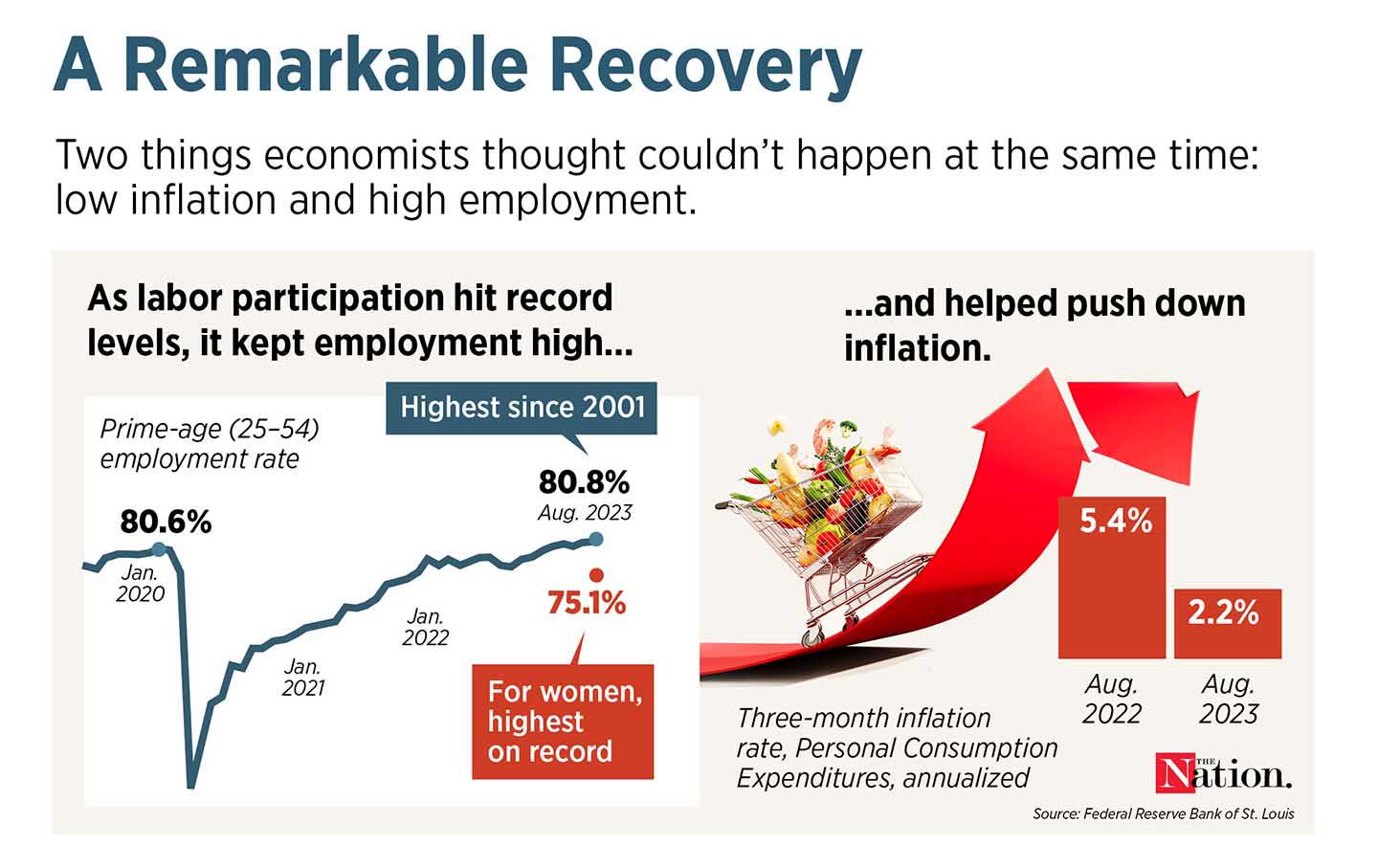
There are reasons to be cautiously optimistic about the US economy. While the inflation rate remains higher than before the pandemic, it has fallen during the past six months as supply chains have normalized and the broader economy has worked itself through the chaos of reopening. This occurred even as unemployment remained low—within the mid–3 percent range. Many economists said this would be nearly impossible.
We are not out of danger yet. Creeping energy prices and the resumption of student-loan payments could drive down growth. But a wave of productive investments unleashed by last year’s Inflation Reduction Act may be enough to counteract those negative forces.
Journalists have largely ignored one crucial aspect of this recovery: the expansion of labor force participation. The increase in the number of people working has helped tamp down inflation and has shown the importance of aiming for full employment. But to keep these advances going, we must invest more in care work. Otherwise, the skyrocketing costs of childcare in this country could hold back the economy, undoing our remarkable gains.
The growth of the labor force is so comprehensive it’s tough to summarize, but there are three straightforward data points to see it. First, overall labor-force participation, at 62.8 percent, is a half-point higher than the Congressional Budget Office had predicted it would be before the pandemic. There’s a more active labor market now than in 2019, and it’s a testament to the power of fiscal spending to fight a recession. It also proves that we weren’t at full employment before Covid.
Second, the percentage of adults between the ages of 25 and 54 with jobs is the highest in decades; overall, it’s as high as it was in 2001, and for women, it’s the highest on record. The 2010s were a decade of wondering where the jobs were—and even asking whether people wanted to work. The stubbornly high unemployment rate—which was as high as 8 percent at the beginning of 2013—had many economists assuming that high unemployment rates were just how the economy worked. Now we know that if the demand is there, the workers will show up.
Third, the employment rate for people with disabilities is the highest since data started being recorded in 2008. At 23 percent, it is four points higher than in 2019. It’s not just a matter of improvements in technology; as labor markets get tighter, employers expand the pool of workers from which they hire.
There are a few reasons this hasn’t received much coverage. First, inflation remains high, which is probably what people mean when they say the economy’s vibes are bad. But there are also more opportunistic reasons. The press loves stories from the point of view of bosses, and pundits rush to cover catchphrases like “quiet quitting.” When outlets do this, they miss how dynamic the economy is: Yes, people have been quitting jobs at record rates, but it is because they are taking new and better jobs.
Many economists said during the Great Recession that the kinds of numbers we’re seeing now would never exist again. They said the mass unemployment of the 2010s was inevitable. They said it wasn’t the result of policy choices; technological change and workers who simply lacked the skills or effort to find jobs were to blame.
But there’s also a more theoretical problem: Many economists believe that both the workforce and what the economy can produce are fixed in the long term. But this economy demonstrates that a tight labor market can pull in more workers, which allows the economy to produce more and incentivizes companies to produce more efficiently, which alleviates the supply constraints that drive inflation.
These are all reasons to embrace the goal of full employment. But it’s also important to look at what’s next. At the end of September, $24 billion in funding for childcare centers ended. That could put a drag on this progress. In many European countries, close to 80 percent of women work. Our much lower labor participation rates for women are largely driven by our fragmented and broken childcare system. We’ve made tremendous progress in increasing labor participation—but to keep it up, we need a care infrastructure that supports working families. That would make this recovery get even stronger.
Disobey authoritarians, support The Nation
Over the past year you’ve read Nation writers like Elie Mystal, Kaveh Akbar, John Nichols, Joan Walsh, Bryce Covert, Dave Zirin, Jeet Heer, Michael T. Klare, Katha Pollitt, Amy Littlefield, Gregg Gonsalves, and Sasha Abramsky take on the Trump family’s corruption, set the record straight about Robert F. Kennedy Jr.’s catastrophic Make America Healthy Again movement, survey the fallout and human cost of the DOGE wrecking ball, anticipate the Supreme Court’s dangerous antidemocratic rulings, and amplify successful tactics of resistance on the streets and in Congress.
We publish these stories because when members of our communities are being abducted, household debt is climbing, and AI data centers are causing water and electricity shortages, we have a duty as journalists to do all we can to inform the public.
In 2026, our aim is to do more than ever before—but we need your support to make that happen.
Through December 31, a generous donor will match all donations up to $75,000. That means that your contribution will be doubled, dollar for dollar. If we hit the full match, we’ll be starting 2026 with $150,000 to invest in the stories that impact real people’s lives—the kinds of stories that billionaire-owned, corporate-backed outlets aren’t covering.
With your support, our team will publish major stories that the president and his allies won’t want you to read. We’ll cover the emerging military-tech industrial complex and matters of war, peace, and surveillance, as well as the affordability crisis, hunger, housing, healthcare, the environment, attacks on reproductive rights, and much more. At the same time, we’ll imagine alternatives to Trumpian rule and uplift efforts to create a better world, here and now.
While your gift has twice the impact, I’m asking you to support The Nation with a donation today. You’ll empower the journalists, editors, and fact-checkers best equipped to hold this authoritarian administration to account.
I hope you won’t miss this moment—donate to The Nation today.
Onward,
Katrina vanden Heuvel
Editor and publisher, The Nation