The World Has Never Cared About Gaza’s Suffering
Gaza is being obliterated, and no global power is doing anything to stop it.
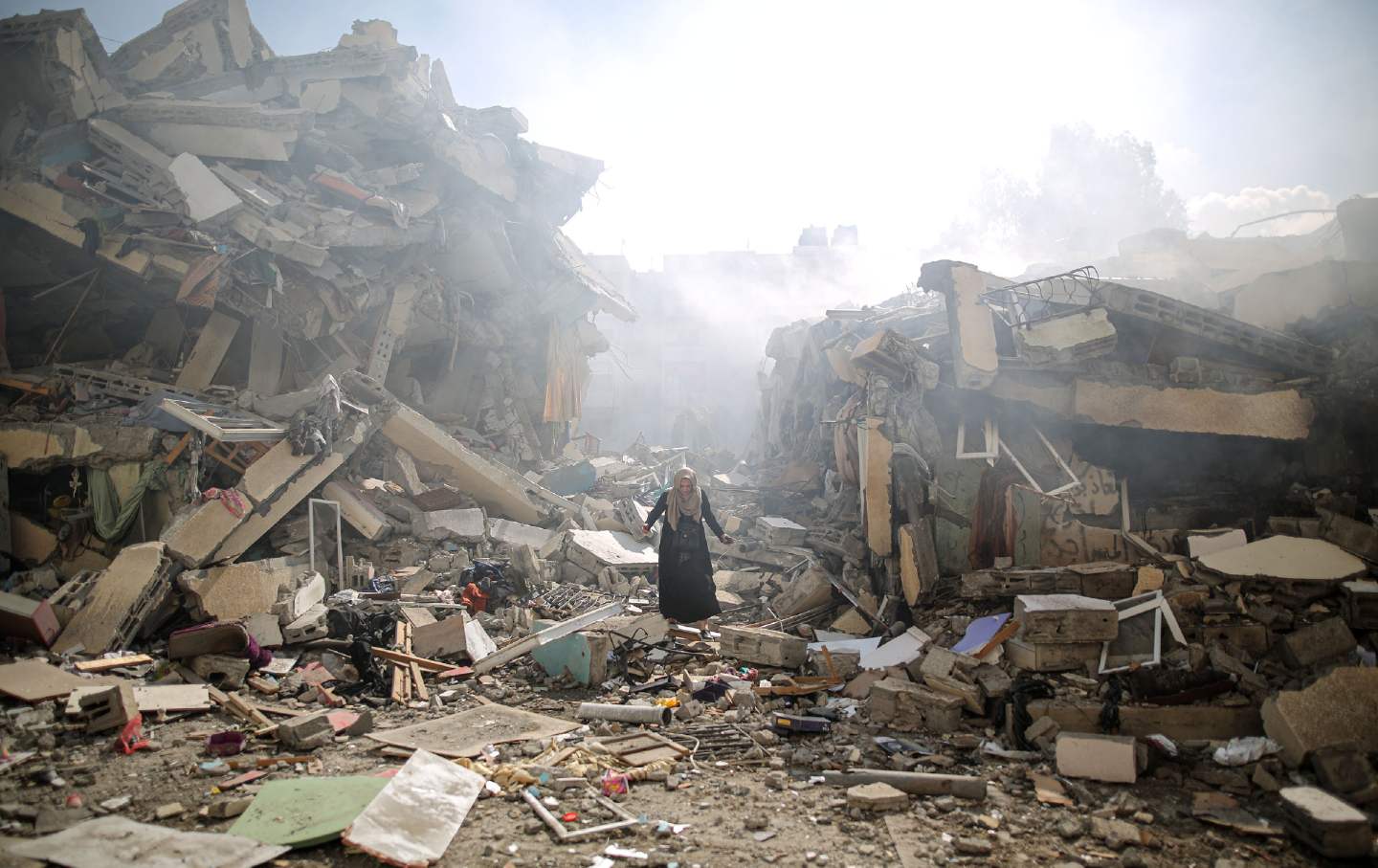
A woman walks amid the rubble of residential buildings destroyed by Israeli air strikes in the al-Zahra neighborhood of the Gaza Strip on October 19, 2023.
(Mustafa Hassona / Anadolu via Getty Images)On October 6, blood, pain, and suffering in Palestine were of no interest to the world. They were too mundane, too “normal” to be acknowledged. Never mind that “normal” meant a Gaza that had been smothered by a 17-year Israeli blockade and a 56-year occupation. Never mind that it meant a Gaza where Israeli military invasions had become almost routine; with civilians laid to rest after every attack, and with entire neighborhoods leveled—tens of thousands of homes, mosques, churches, hospitals, cultural centers, and educational institutions crumbling to rubble every couple of years.
In Gaza, “normal” was the meager four to 12 hours of electricity a day. Hospitals had become destinations of last resort because, in this “normal,” there were just 1.4 beds for every thousand residents.
It was “normal” for families to starve, for essential medicines to run out, for graduates to stare at bleak futures, and for the vast majority to survive on mere aid.
Yet, this “normal”’ had long been met with a deafening global silence. This “normal” went unnoticed, a mere backdrop to world politics, seldom worth more than a passing remark.
Until recently. Until October 7. When Israeli civilians were killed, the world sat upright. They took note, they discussed, they condemned. They saw the horror of blood spilled in historic Palestine. Conversations about Palestine became mainstream only when the blood took on a different hue.
The very same world that had remained nonchalant about the everyday horrors in Gaza and in all of occupied Palestine was now interested and invested.
Twenty days on, the Gaza Strip has borne the brunt of over 12,000 tons of explosives. This translates to an average of 33 tons of explosives for every square kilometre of Gaza since October 7.
Israel has slaughtered around 6,000 Palestinians, including more than 2,300 children, with over 1,500 people still under the rubble. It has injured more than 16,000 children and women and men left to teeter on the edge of life, with almost no hospitals left to seek treatment, and almost no treatments available if they do manage to get to a hospital.
Israeli bombs have demolished residential blocks, including my own. My home, like so many thousands of others, stands no more. Around 1.4 million Gazans have been displaced. Gaza is being obliterated, and no global power is doing anything to stop it.
For the past 20 days, the world has appeared fixated on one haunting question. It has seemingly resolved that the answer is to obliterate Gaza from the map. But one question lingers globally: How do we do it? How do we annihilate Gaza?
Israel, in both its political rhetoric and military posturing, has made no secret of its ambition to wipe the Gaza Strip off the face of the earth and to subdue the “human animals” that call it home. But as they advance this genocidal agenda, politicians, A-list celebrities, and Western figureheads don’t just nod in agreement—they offer full support to help them achieve it.
In the United States, Joe Biden passes the hat around Congress, collecting loose change amounting to billions of dollars, all earmarked for Israel’s “Gaza Genocide project.” Even Japan, half a world away, sidles up to the Security Council to cast its vote against halting the Gaza genocide.
Popular
“swipe left below to view more authors”Swipe →The Arab leadership, in a masterstroke of duplicity, has voiced their support for Palestine, decrying any suggestions of ousting them from Gaza to the Sinai. A mass expulsion to the Negev, though, seems more palatable. Egypt, always the loyal neighbor to the besieged Gaza Strip, has generously offered the Gazans a menu of coffins with a side of, well, almost nothing but some Covid equipment.
No one has proposed that Gaza should not be wiped out.
Standing as the voice for my kin, comrades, and the denizens of Gaza, I table a most modest proposal: Institute a cease-fire. This isn’t a plea to end the genocide in Gaza. Instead, I present a method, more economical, less chaotic, and exponentially more effective. Cease the aerial onslaught and destruction.
We, the people of Gaza, will take it from here.
We will recover our dead from beneath the debris, knowing that even with aid, thousands more are destined to perish. Grief will consume many in the wake of lost homes, cherished memories, and shattered dreams. Epidemics of ancient diseases will claim lives amid the ruins of our graveyard of a city. Others will suffer from the aftereffects of the lethal gases and chemicals from phosphorus bombs, missiles, and other arsenals—weaponry Israel is conveniently field-testing in Gaza for its future endeavors.
Some will return to their semi-standing homes, seeking solace but finding death as the weakened structures collapse. Numerous others, surrounded by this overwhelming death, will surrender to the despair and take their own lives.
A mere handful might endure, conveniently turning into subjects of study for Western academia who seek to soothe their consciences by championing justice from the safe confines of their ivory towers, having borne witness to our annihilation.
A cease-fire. Now. Grant us the luxury of one last hug. Our end is nigh, rest assured.
Disobey authoritarians, support The Nation
Over the past year you’ve read Nation writers like Elie Mystal, Kaveh Akbar, John Nichols, Joan Walsh, Bryce Covert, Dave Zirin, Jeet Heer, Michael T. Klare, Katha Pollitt, Amy Littlefield, Gregg Gonsalves, and Sasha Abramsky take on the Trump family’s corruption, set the record straight about Robert F. Kennedy Jr.’s catastrophic Make America Healthy Again movement, survey the fallout and human cost of the DOGE wrecking ball, anticipate the Supreme Court’s dangerous antidemocratic rulings, and amplify successful tactics of resistance on the streets and in Congress.
We publish these stories because when members of our communities are being abducted, household debt is climbing, and AI data centers are causing water and electricity shortages, we have a duty as journalists to do all we can to inform the public.
In 2026, our aim is to do more than ever before—but we need your support to make that happen.
Through December 31, a generous donor will match all donations up to $75,000. That means that your contribution will be doubled, dollar for dollar. If we hit the full match, we’ll be starting 2026 with $150,000 to invest in the stories that impact real people’s lives—the kinds of stories that billionaire-owned, corporate-backed outlets aren’t covering.
With your support, our team will publish major stories that the president and his allies won’t want you to read. We’ll cover the emerging military-tech industrial complex and matters of war, peace, and surveillance, as well as the affordability crisis, hunger, housing, healthcare, the environment, attacks on reproductive rights, and much more. At the same time, we’ll imagine alternatives to Trumpian rule and uplift efforts to create a better world, here and now.
While your gift has twice the impact, I’m asking you to support The Nation with a donation today. You’ll empower the journalists, editors, and fact-checkers best equipped to hold this authoritarian administration to account.
I hope you won’t miss this moment—donate to The Nation today.
Onward,
Katrina vanden Heuvel
Editor and publisher, The Nation
More from The Nation

The US Is Looking More Like Putin’s Russia Every Day The US Is Looking More Like Putin’s Russia Every Day
We may already be on a superhighway to the sort of class- and race-stratified autocracy that it took Russia so many years to become after the Soviet Union collapsed.

Israel Wants to Destroy My Family's Way of Life. We'll Never Give In. Israel Wants to Destroy My Family's Way of Life. We'll Never Give In.
My family's olive trees have stood in Gaza for decades. Despite genocide, drought, pollution, toxic mines, uprooting, bulldozing, and burning, they're still here—and so are we.
Trump’s National Security Strategy and the Big Con Trump’s National Security Strategy and the Big Con
Sense, nonsense, and lunacy.

Does Russian Feminism Have a Future? Does Russian Feminism Have a Future?
A Russian feminist reflects on Julia Ioffe’s history of modern Russia.
Ukraine’s War on Its Unions Ukraine’s War on Its Unions
Since the start of the war, the Ukrainian government has been cracking down harder on unions and workers’ rights. But slowly, the public mood is shifting.
I’m a Teacher in Gaza. My Students Are Barely Hanging On. I’m a Teacher in Gaza. My Students Are Barely Hanging On.
Between grief, trauma, and years spent away from school, the children I teach are facing enormous challenges.

