
Democrats Are Supposed to Be in Trouble. Tell That to Andy Beshear.
Kentucky’s pro-choice, pro-union governor just beat the combined power of Donald Trump, Mitch McConnell, and the Republican money machine.
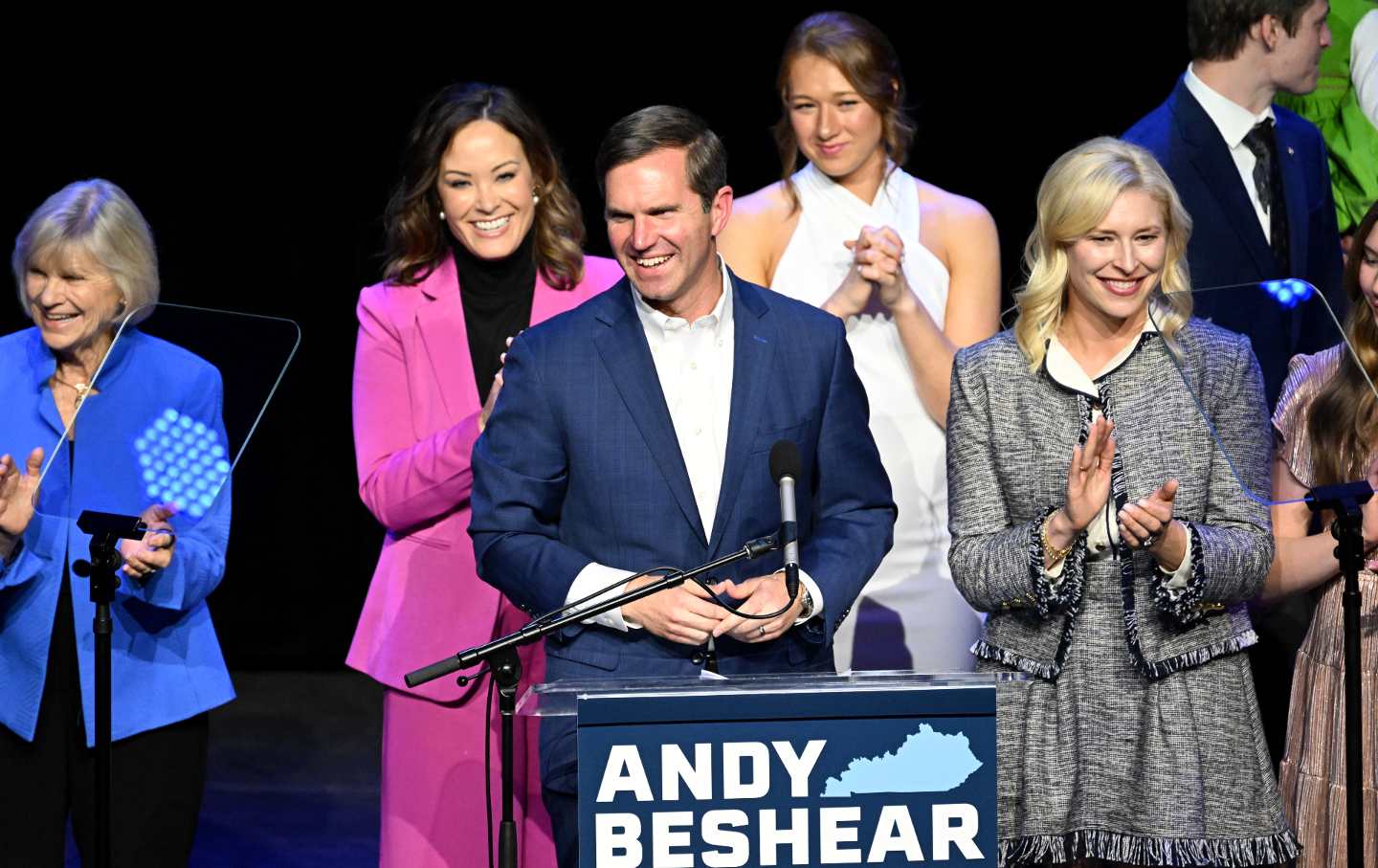
Andy Beshear delivers his victory speech to a crowd at an election night event at Old Forrester’s Paristown Hall on November 7, 2023, in Louisville, Ky.
(Stephen Cohen / Getty Images)Trumpism may define the Republican Party. But it definitely doesn’t define election results—even in supposedly red states.
Just ask Kentucky Republican Attorney General and gubernatorial candidate Daniel Cameron.
After he won his party’s gubernatorial nomination in May, Cameron announced, “Let me just say, the Trump culture of winning is alive and well in Kentucky.”
Cameron rose in politics as a protégé of Senate minority leader Mitch McConnell, Kentucky’s most powerful Republican. He had the strong support of GOP-aligned billionaire donors and corporate interests in a race that would eventually see five major super PACs spending heavily on his behalf. As the first Black nominee for the state’s top job, Cameron was seen by at least some pundits as having the potential to expand the GOP base. And he had already proved he could win a statewide race, cruising to a 58-42 percent victory in his 2019 campaign for attorney general. By most measures in a state where Donald Trump beat Democrat Joe Biden by a 26-point margin, carrying 118 of 120 counties, Cameron should have had the upper hand in this year’s gubernatorial race.
So Cameron, who collected an early endorsement from Trump, built his entire campaign on a strategy of presenting himself as the former president’s candidate. Television ads in the final weeks of the campaign featured the Republican telling voters, “I’m the only candidate endorsed by President Trump and the only candidate who stood up to Joe Biden.”
Kentuckians were not impressed.
Cameron lost on Tuesday to incumbent Governor Andy Beshear, a Democrat who ran as pro-choice, pro-LGBTQI+ rights, pro–public education, pro-labor candidate with stands on the issues that pretty much paralleled those of President Biden. That doesn’t mean that Biden, whose approval ratings are dismal at this point in Kentucky and nationally, is destined to win the Bluegrass State, or many other border and Southern states, in 2024. The route for Biden and other Democrats running in recent years has followed along the East and West Coasts and through the Great Lakes States. But the Kentucky result does mean that Democratic candidates and Democratic issues remain far more viable than political and media elites would have us imagine.
The election wasn’t even close. Beshear, who won his first term in 2019 by barely 5,000 votes, swept to victory on Tuesday night by almost 70,000 votes—for a 52.5-47.5 margin.
That result was celebrated not just by Beshear and his backers in Kentucky but also Biden and national Democrats. They know that Kentucky’s off-year gubernatorial election results have anticipated every presidential election result in the 21st century. In cycle after cycle, when Kentucky has voted Republican for governor, a Republican has been elected president the next year—and when Kentucky has voted Democratic for governor, a Democrat has won the presidency the next year. That’s encouraging for Biden and the Democrats, as was the sweeping victory for a constitutional amendment to enshrine abortion rights in the reddish state of Ohio, the election of a Democrat in a critical Pennsylvania Supreme Court race, and the consolidation of Democratic control over both chambers of the Virginia state legislature. So it came as no surprise that the president responded to the results by declaring, “Across the country tonight, democracy won and MAGA lost. Voters vote. Polls don’t. Let’s go win next year.”
Biden was obviously putting the best spin on the results. But there was no spin needed for Democrats who have been arguing that, no matter what Biden’s poll numbers may be, the appeal of many of the party’s core issues remains strong.
Beshear did not win reelection by running the sort of cautious, Republican-lite campaign that Democratic strategists used to counsel the party’s candidates to mount in red states. While the mild-mannered 45-year-old son of a former Democratic governor is generally referred to as a moderate, he campaigned on a platform that was in tune with national Democrats: for teacher pay hikes, universal pre-K education, a “clean green economy,” and a break with the “anger politics” that has dominated the discourse since the Republican Party abandoned the mainstream and veered toward the Tea Party right and Trumpism.
And when it came to so-called “hot-button” issues, this border-state Democrat leaned in.
Popular
“swipe left below to view more authors”Swipe →Beshear, who vetoed a sweeping abortion ban that had been approved by Kentucky’s Republican-controlled legislature in 2022, featured pro-choice ads as part of his reelection strategy and effectively portrayed Cameron, an ardent foe of abortion rights, as an extremist on the issue. Reflecting on the Kentucky results, Sara Tabatabaie, the executive director of the group Vote Pro-Choice, said, “There is not a state in the country where voters want politicians to interfere in deeply personal healthcare decisions. As long as our rights are under threat, pro-choice values are a mobilizing force.”
But Beshear did a good deal more than embrace reproductive rights:
- In March of this year, the governor vetoed anti-trans legislation—which proposed to ban gender reassignment surgery for anyone under 18, and barred inpatient and outpatient gender-affirming hospital services—stating, “My faith teaches me that all children are children of God and Senate Bill 150 will endanger the children of Kentucky.” Cathryn Oakley, the state legislative director for the Human Rights Campaign, said, “Gov. Beshear heard the voices of transgender kids, their families, and medical experts and chose to treat transgender children with dignity and respect. We strongly urge the Kentucky legislature to uphold the governor’s veto and stop these discriminatory attacks on vulnerable children.”
- After United Auto Workers union members went on strike in September, Beshear joined a picket line outside a Kentucky Ford plant, and he ran this fall as an unapologetic pro-union candidate. “I’m proud to be a governor endorsed by the UAW,” declared Beshear. “Our UAW families are fighting for better wages and better healthcare benefits—something we should want for every single one of our citizens. We need them to come out of this being able to provide more opportunity for their kids and a better future here in Kentucky.”
Those are Democratic messages that won big in a Republican state.
What the 2023 election results from Kentucky suggest is that the Democratic brand is not in trouble. National polls that have Trump leading in many battleground states confirm that Biden faces challenges, as incumbent presidents seeking a second term in turbulent times often do. But Biden’s party—and its issues—came out of the 2023 off-year election looking a good deal stronger than even some Democrats dared to imagine.
Disobey authoritarians, support The Nation
Over the past year you’ve read Nation writers like Elie Mystal, Kaveh Akbar, John Nichols, Joan Walsh, Bryce Covert, Dave Zirin, Jeet Heer, Michael T. Klare, Katha Pollitt, Amy Littlefield, Gregg Gonsalves, and Sasha Abramsky take on the Trump family’s corruption, set the record straight about Robert F. Kennedy Jr.’s catastrophic Make America Healthy Again movement, survey the fallout and human cost of the DOGE wrecking ball, anticipate the Supreme Court’s dangerous antidemocratic rulings, and amplify successful tactics of resistance on the streets and in Congress.
We publish these stories because when members of our communities are being abducted, household debt is climbing, and AI data centers are causing water and electricity shortages, we have a duty as journalists to do all we can to inform the public.
In 2026, our aim is to do more than ever before—but we need your support to make that happen.
Through December 31, a generous donor will match all donations up to $75,000. That means that your contribution will be doubled, dollar for dollar. If we hit the full match, we’ll be starting 2026 with $150,000 to invest in the stories that impact real people’s lives—the kinds of stories that billionaire-owned, corporate-backed outlets aren’t covering.
With your support, our team will publish major stories that the president and his allies won’t want you to read. We’ll cover the emerging military-tech industrial complex and matters of war, peace, and surveillance, as well as the affordability crisis, hunger, housing, healthcare, the environment, attacks on reproductive rights, and much more. At the same time, we’ll imagine alternatives to Trumpian rule and uplift efforts to create a better world, here and now.
While your gift has twice the impact, I’m asking you to support The Nation with a donation today. You’ll empower the journalists, editors, and fact-checkers best equipped to hold this authoritarian administration to account.
I hope you won’t miss this moment—donate to The Nation today.
Onward,
Katrina vanden Heuvel
Editor and publisher, The Nation
More from The Nation

The Supreme Court Has a Serial Killer Problem The Supreme Court Has a Serial Killer Problem
In this week's Elie v. U.S., The Nation’s justice correspondent recaps a major death penalty case that came before the high court as well as the shenanigans of a man who’s angling...
Corporate Democrats Are Foolishly Surrendering the AI Fight Corporate Democrats Are Foolishly Surrendering the AI Fight
Voters want the party to get tough on the industry. But Democratic leaders are following the money instead.

Marching Against a Corrupt Regime Marching Against a Corrupt Regime
People taking to the streets for democracy.

It Would Be Madness to Give Trump and His Toadies Even More Power It Would Be Madness to Give Trump and His Toadies Even More Power
And yet, that’s what the Supreme Court appears prepared to do.
Trump Is Dragging Republicans to Crushing Defeat After Crushing Defeat Trump Is Dragging Republicans to Crushing Defeat After Crushing Defeat
The president is deeply unpopular, his policies are failing, and Republicans are losing—everywhere.

