Ahmed Abu Artema Tried to Get the World to Care About Gaza’s Pain
The activist and Nation contributor pleaded with the world to stop Israel’s war on Gaza. Then, on October 24, his son was killed.
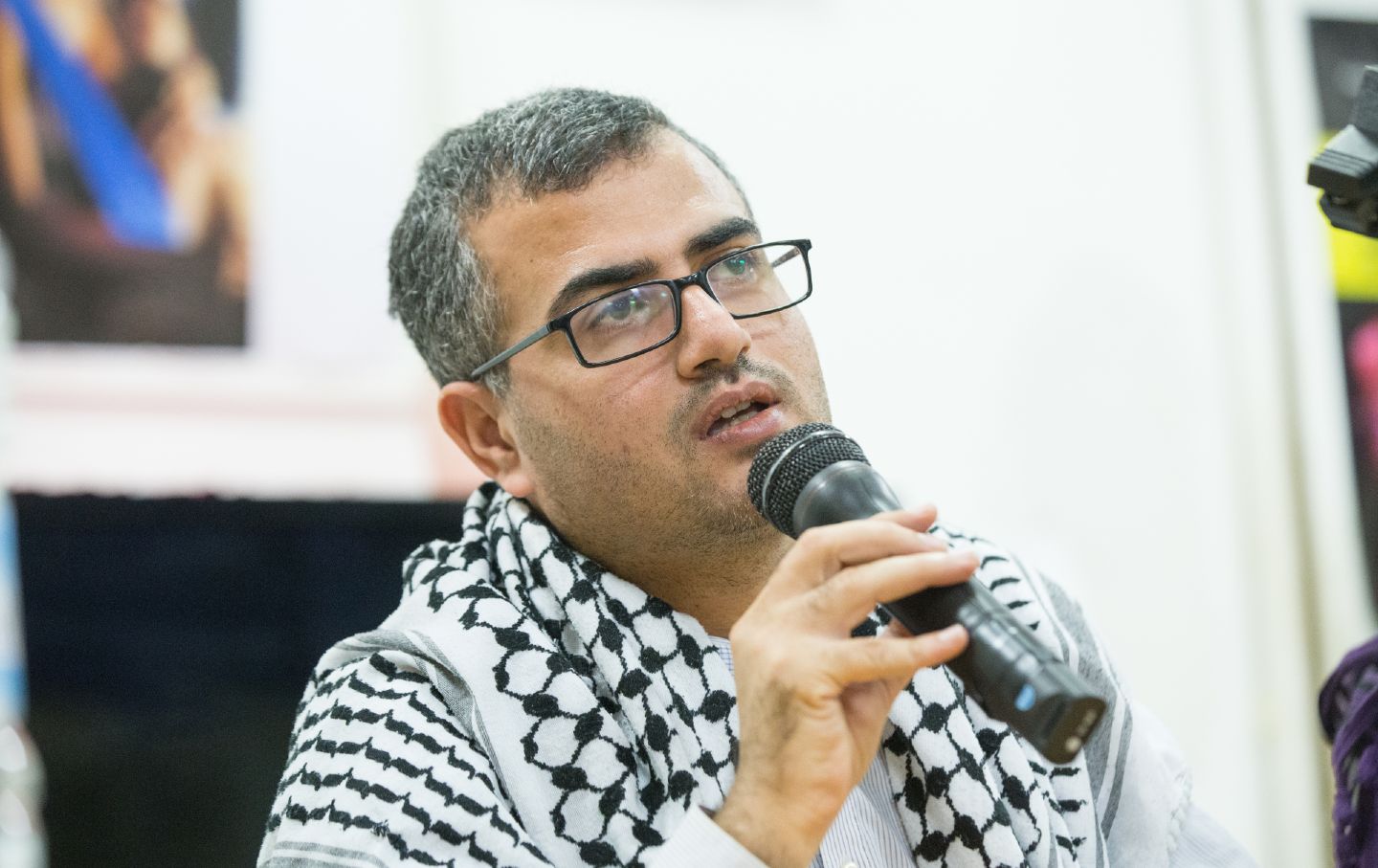
I met Ahmed Abu Artema only once, in March of 2019, but if I close my eyes for just a moment, I can still conjure him sitting in The Nation’s conference room, soft-spoken and bookish in a pair of black rectangular glasses, reluctantly commanding our attention.
Ahmed is a writer and peace activist who was born in the Rafa refugee camp to a family that had been expelled from what is now Israel. He had come to speak with us, a small band of editors and interns, about life under siege in the Gaza Strip and about the mass nonviolent movement he’d helped galvanize to resist it.
Every Friday, for more than a year, he recounted, thousands of people in Gaza would make their way to the border fence with Israel as part of what they called the Great March of Return. They were, as he wrote in a 2018 piece for The Nation, “fighting back peacefully with our bodies and our love for life, appealing to the justice that remains in the world.” For this, Israeli soldiers shot and tear-gassed them, killing more than 200 protesters and wounding tens of thousands.
Before Ahmed left The Nation’s office, we agreed that he should continue to share his words with our readers—and he did. Over the next four years, he wrote articles, at once poetic and urgent, that bore witness to Israel’s strangling grip on Gaza. In 2019, during one of the Israeli military’s periodic bombing campaigns, he wrote of trying to calm his terrified young son Abdul Rahman with hugs and even humor, telling him, “Look, son, these bombs are far away and fall in the sea not near us, so whenever you hear them again, I want you to jump high in the air, laugh, and shout ‘Hey!’”
Not long after, in the spring of 2020, he described the tense quiet of the early days of Covid, as Gaza’s shattered health system prepared for the arrival of the deadly virus. And just last month, when Israel began its bloodiest war on Gaza yet, he did his best to make the “blur of cascading violence” real for readers.
“The stench of death is on the streets,” he wrote, “and the nights are endless, with no electricity and intensifying bombardments.”
On October 24, just 10 days after he published those words, Ahmed’s oldest son Abdullah was killed in one of those intensified bombardments. He was 13 years old and adored by his father for his “innocence, kindness, compassion, mercy, and…self overflowing with goodness.” Abdullah had just returned from a trip to the corner store to buy bread—though he had found no bread, only biscuits—when the bomb fell. The blast killed four other relatives—two of Ahmed’s aunts, one of those aunt’s daughters, and his step-mother—and seriously injured Ahmed. He is now recovering from second-degree burns but, thankfully, is expected to heal.
In the devastating weeks since the bombing, I have returned again and again to the articles Ahmed has written for us over the years, and I have been haunted by the message he wove with lyrical desperation through each one. Somehow, I didn’t fully understand what he was doing when I first read the pieces; I didn’t hear the plea threaded through every one of the hooks and pegs. But now, reading them collectively, it’s achingly obvious.
“It’s time for the world to finally say to Israel that enough is enough,” he wrote in 2019.
“Palestinians, like all people in the world, want to live free,” he begged that same year.
“We need all people of conscience around the world to understand the relentless oppression that created this horrific reality,” he urged only weeks ago. “Raise your voices in solidarity with us.”
The world did not listen to those words—not to the first of them, nor to the last. Now, Ahmed’s son is dead, as are over 4,000 other children in Gaza; 1,250 children remain missing.
Like so many other Palestinians, Ahmed tried to get the world to notice. He tried to get us to care. He marched, he wrote, he pleaded. This time, if we want to prevent more death, if we want to prevent parents from ever having to feel the abject grief that Ahmed does, we must listen.
Disobey authoritarians, support The Nation
Over the past year you’ve read Nation writers like Elie Mystal, Kaveh Akbar, John Nichols, Joan Walsh, Bryce Covert, Dave Zirin, Jeet Heer, Michael T. Klare, Katha Pollitt, Amy Littlefield, Gregg Gonsalves, and Sasha Abramsky take on the Trump family’s corruption, set the record straight about Robert F. Kennedy Jr.’s catastrophic Make America Healthy Again movement, survey the fallout and human cost of the DOGE wrecking ball, anticipate the Supreme Court’s dangerous antidemocratic rulings, and amplify successful tactics of resistance on the streets and in Congress.
We publish these stories because when members of our communities are being abducted, household debt is climbing, and AI data centers are causing water and electricity shortages, we have a duty as journalists to do all we can to inform the public.
In 2026, our aim is to do more than ever before—but we need your support to make that happen.
Through December 31, a generous donor will match all donations up to $75,000. That means that your contribution will be doubled, dollar for dollar. If we hit the full match, we’ll be starting 2026 with $150,000 to invest in the stories that impact real people’s lives—the kinds of stories that billionaire-owned, corporate-backed outlets aren’t covering.
With your support, our team will publish major stories that the president and his allies won’t want you to read. We’ll cover the emerging military-tech industrial complex and matters of war, peace, and surveillance, as well as the affordability crisis, hunger, housing, healthcare, the environment, attacks on reproductive rights, and much more. At the same time, we’ll imagine alternatives to Trumpian rule and uplift efforts to create a better world, here and now.
While your gift has twice the impact, I’m asking you to support The Nation with a donation today. You’ll empower the journalists, editors, and fact-checkers best equipped to hold this authoritarian administration to account.
I hope you won’t miss this moment—donate to The Nation today.
Onward,
Katrina vanden Heuvel
Editor and publisher, The Nation