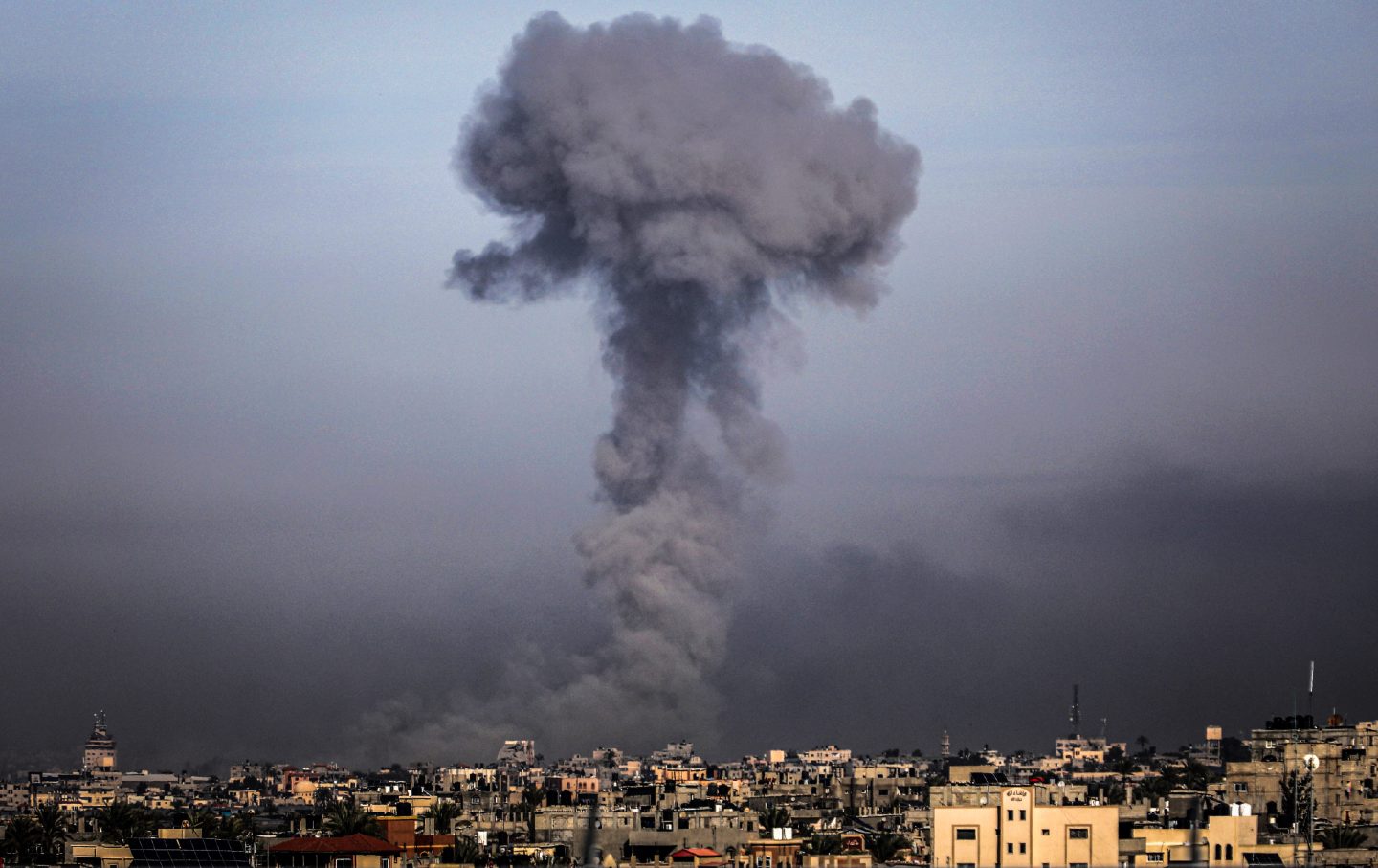
Smoke rises after an Israeli airstrike on the Palestinian city of Khan Yunis on January 8.
(Abed Rahim Khatib / picture alliance via Getty Images)Readers of The New York Times were treated on Monday morning to a breaking-news alert heralding what seemed like a welcome development: “Israel says it has begun to scale back war.” That description, which led the Times website, is about as close to the opposite of the way Israel’s war is heading as could appear in the leading US newspaper.
The Israeli Defense Forces spokesman, Radm. Daniel Hagari, gave the Times the interview that it used for its headline. But Hagari’s quotes never actually promise the “less intense phase” in the Times paraphrase. Hagari instead describes the focus of the pitiless Israeli campaign shifting southward—while his superiors in the Israeli government indicate that it could expand regionally.
Northern Gaza, which has been the focus of intense Israeli ground operations, will apparently see more of what the Times calls “targeted raids” rather than attacks from larger-scale infantry, artillery, and airstrikes. Some Israeli brigades will redeploy out of Gaza, a development announced last week—but one intended to make the war more sustainable for “prolonged fighting,” as Hagari put it then. That fighting will refocus on the central and the southern regions of Gaza, where Israel had previously demanded that most of the population relocate. “It was far from clear that the new phase of Israel’s offensive would be less dangerous for Gazan civilians,” the Times’ Patrick Kingsley observed. That was quite an understatement, considering the starvation and spread of infectious disease the war has inflicted upon those civilians, all as Israel has destroyed Gaza’s healthcare infrastructure.
The description of a “less intense” war was rendered all the more absurd by Israel’s lethal strike on a senior Hezbollah commander, Wissam al-Tawil, in southern Lebanon on Monday. (Haaretz, the liberal Israeli newspaper, attributed the strike to Israel.) Since the beginning of the Israeli reprisal on Gaza for Hamas’s October 7 massacre, Hezbollah has hit northern Israel with its missile arsenal to raise the costs of sacking Gaza, and the IDF has responded in kind. The persistent exchanges of fires have stayed just under the threshold of a declared second front. But that’s an arbitrary measure, not one that changes the reality faced by anyone who lives in northern Israel or southern Lebanon, tens of thousands of whom have fled.
The killing of al-Tawil follows two other high-profile IDF slayings over the last two weeks that look more like the future of the current conflict than its past. On Christmas, an Israeli strike in Damascus killed the Iranian Gen. Razi Mousavi of the Islamic Revolutionary Guard Corps. And on Wednesday, in the Dahiyeh suburb of Beirut, an Israeli drone killed Saleh al-Arouri, a senior political figure in Hamas.
While any Hamas leader must have considered his days numbered after October 7, Israel’s willingness to strike into the heart of Lebanon, which is reeling from a protracted economic crisis, has created deep fear that the so-called “Northern Front” will formally open. For the second time since October 7, Hassan Nasrallah of Hezbollah last week declined in a speech to declare war, but reiterated that there is only so much it will tolerate. The “Lebanese don’t want to be dragged, even Hezbollah does not want to be dragged into a regional war,” implored Abdallah Bou Habib, Lebanon’s foreign minister.
If there is a shift in Israel’s war, it’s less about a reduction in intensity in Gaza than it is a refocus against a more distant, formidable enemy. Israeli Defense Minister Yoav Gallant told The Wall Street Journal on Sunday night that Israel’s ultimate targets live far beyond Gaza. “My basic view: We are fighting an axis, not a single enemy,” Gallant told the paper. “Iran is building up military power around Israel in order to use it.” Like his colleagues in the Israeli government, Gallant signaled that Israel is running out of patience to negotiate calm on the Lebanese border—but did so by threatening Lebanese civilians, not Hezbollah: “They see what is happening in Gaza. They know we can copy-paste to Beirut.”
As for Gaza itself, Gallant portrayed the shift in military focus away from northern Gaza less as a decision to tamp down the war than a function of the IDF’s accomplishing most of what it can in the north. The coming phase, dependent more on “different types of special operations”—something no one should confuse with de-escalation—will “last for a longer time,” Gallant told the Journal. This promise of a protracted war comes as the United Nations’ most senior humanitarian-aid official, Martin Griffiths, has already judged Gaza to be “uninhabitable” and South Africa brings a genocide case against Israel that will get underway on Thursday at the International Criminal Court.
The longer that Israel culls Gazans—something Israeli government officials have recently phrased as an “opportunity” to ethnically cleanse Gaza —the greater the pressures for the war to spiral outward. Tamping those pressures down is the express purpose of Secretary of State Antony Blinken, who has returned to the Middle East and is expected in Israel early this week. “This is a conflict that could easily metastasize, causing even more insecurity and even more suffering,” Blinken correctly observed in Qatar this weekend. The response the Israelis provided Blinken, who has often looked hapless during his post-October 7 Mideast visits, was to kill al-Tawil in Lebanon while telling American news outlets it will kinda-sorta-but-not-really lower the scale of violence inflicted upon Gazans so President Biden can have some domestic and diplomatic breathing room.
Blinken is right that the war could escalate and grow more destructive. But the reality is that regionalization is already here. Much as Gallant looked beyond Hamas to the Iranian “Axis of Resistance” coalition that includes Hamas, Iranian strategy since October 7 has aimed beyond Israel and at its geopolitical patrons.
If Iranian strategy operates beneath the waterline of formally declared conflict, those waters are heavily mined and are already prompting counterproductive US actions. The Houthis in Yemen have jeopardized commercial shipping in the Red Sea, an economically crucial waterway for global trade, prompting the United States to assemble an international naval task force amid pressures to attack the Houthis on land. In Iraq and Syria, more than 120 rocket, missile, and drone strikes on US bases since October 7 have prompted US retaliatory strikes on Iran-backed militias. The most recent of them, Thursday’s US drone strike in Baghdad—the first there since 2020—killed a senior figure in the quasi-official Popular Mobilization Forces and prompted Prime Minister Mohammed Shia al-Sudani, who is no Iranian catspaw, to demand that the US military finally leave Iraq.
Each provocation, whether from Israel, the United States, or the Iranian coalition, prompts a response that various partisans can individually justify on its own terms. But this is the logic that produces regional escalation. Nearly 100 days of it have yielded nothing but devastation for Palestinians, Lebanese, Iraqis, and indeed Israelis, with Yemenis potentially next. The way out is in the hands of the Biden administration, since only the US can impose a cease-fire on Israel, thereby removing the impetus for the Iranian-backed attacks and the US or Israeli reprisals. Yet Biden continues to show no inclination that he is willing to do what is necessary to forestall the regional conflagration he seeks to avoid.
And if American journalists can’t quite present that to their audiences, the Palestinian journalists who have heroically brought the reality of Gaza to the world can—or they could, before Israeli missiles and bullets killed them and their families, often to the silence of their American counterparts, who instead print dubious narratives about Israeli de-escalation.
Disobey authoritarians, support The Nation
Over the past year you’ve read Nation writers like Elie Mystal, Kaveh Akbar, John Nichols, Joan Walsh, Bryce Covert, Dave Zirin, Jeet Heer, Michael T. Klare, Katha Pollitt, Amy Littlefield, Gregg Gonsalves, and Sasha Abramsky take on the Trump family’s corruption, set the record straight about Robert F. Kennedy Jr.’s catastrophic Make America Healthy Again movement, survey the fallout and human cost of the DOGE wrecking ball, anticipate the Supreme Court’s dangerous antidemocratic rulings, and amplify successful tactics of resistance on the streets and in Congress.
We publish these stories because when members of our communities are being abducted, household debt is climbing, and AI data centers are causing water and electricity shortages, we have a duty as journalists to do all we can to inform the public.
In 2026, our aim is to do more than ever before—but we need your support to make that happen.
Through December 31, a generous donor will match all donations up to $75,000. That means that your contribution will be doubled, dollar for dollar. If we hit the full match, we’ll be starting 2026 with $150,000 to invest in the stories that impact real people’s lives—the kinds of stories that billionaire-owned, corporate-backed outlets aren’t covering.
With your support, our team will publish major stories that the president and his allies won’t want you to read. We’ll cover the emerging military-tech industrial complex and matters of war, peace, and surveillance, as well as the affordability crisis, hunger, housing, healthcare, the environment, attacks on reproductive rights, and much more. At the same time, we’ll imagine alternatives to Trumpian rule and uplift efforts to create a better world, here and now.
While your gift has twice the impact, I’m asking you to support The Nation with a donation today. You’ll empower the journalists, editors, and fact-checkers best equipped to hold this authoritarian administration to account.
I hope you won’t miss this moment—donate to The Nation today.
Onward,
Katrina vanden Heuvel
Editor and publisher, The Nation
More from The Nation

Israel Wants to Destroy My Family's Way of Life. We'll Never Give In. Israel Wants to Destroy My Family's Way of Life. We'll Never Give In.
My family's olive trees have stood in Gaza for decades. Despite genocide, drought, pollution, toxic mines, uprooting, bulldozing, and burning, they're still here—and so are we.
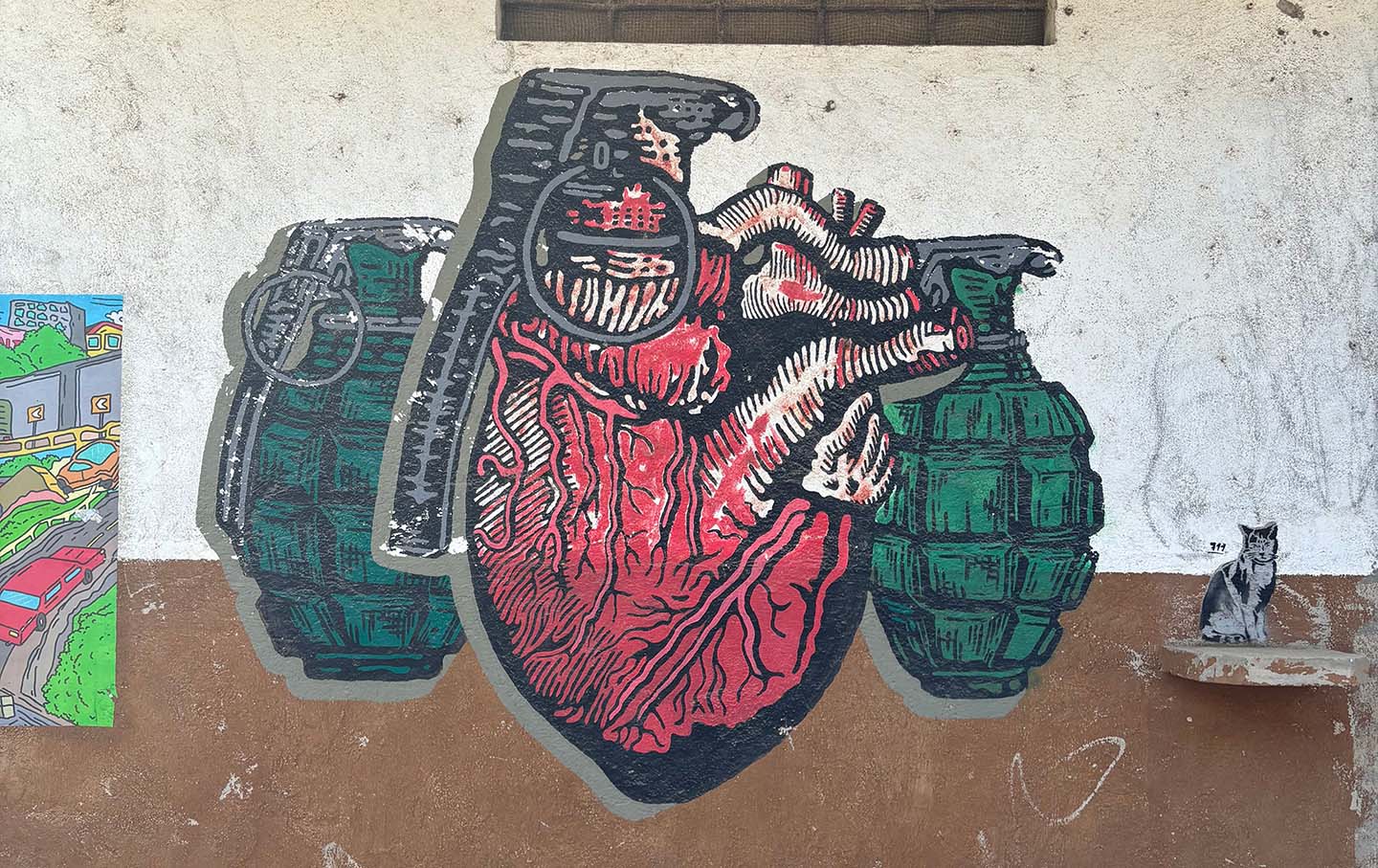
Destruction of Our Heart Destruction of Our Heart
From Gaza to Somalia, around the world people are struggling to survive.
OppArt / Anonymous and Peter Kuper
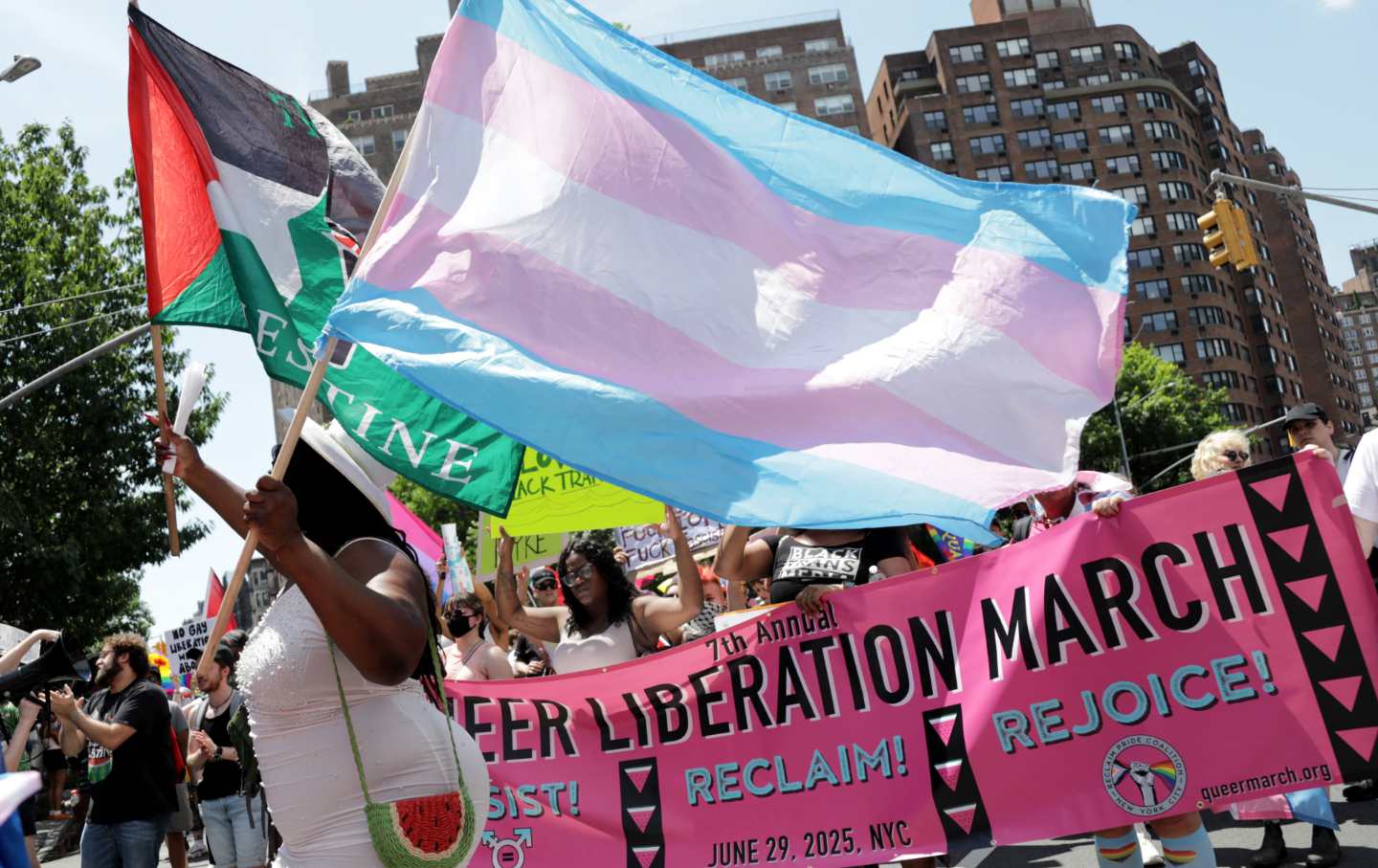
Why Palestine Matters So Much to Queer People Why Palestine Matters So Much to Queer People
Palestinian identity can “upend the whole world order, if done right, if spun right, if we activate it enough. And I think queerness is a very similar kind of identity.”
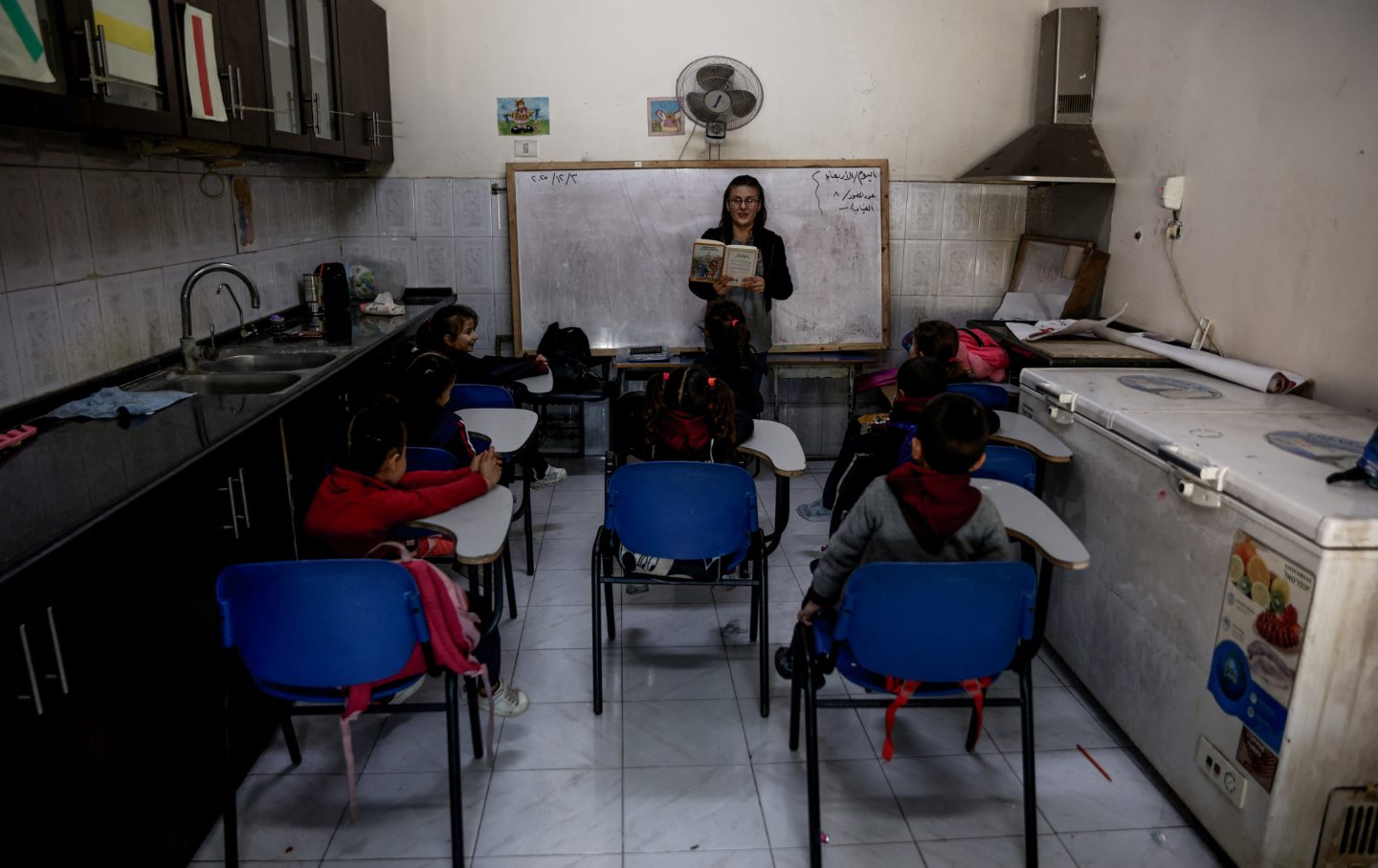
I’m a Teacher in Gaza. My Students Are Barely Hanging On. I’m a Teacher in Gaza. My Students Are Barely Hanging On.
Between grief, trauma, and years spent away from school, the children I teach are facing enormous challenges.

Woman, Life, Freedom Woman, Life, Freedom
Posters in support of the people of Iran displayed at the Palais de Tokyo in Paris, France.

