What Naomi Klein Taught Me About Aaron Rodgers
We all have doppelgängers, and we now know Colin Kaepernick’s is Aaron Rodgers.
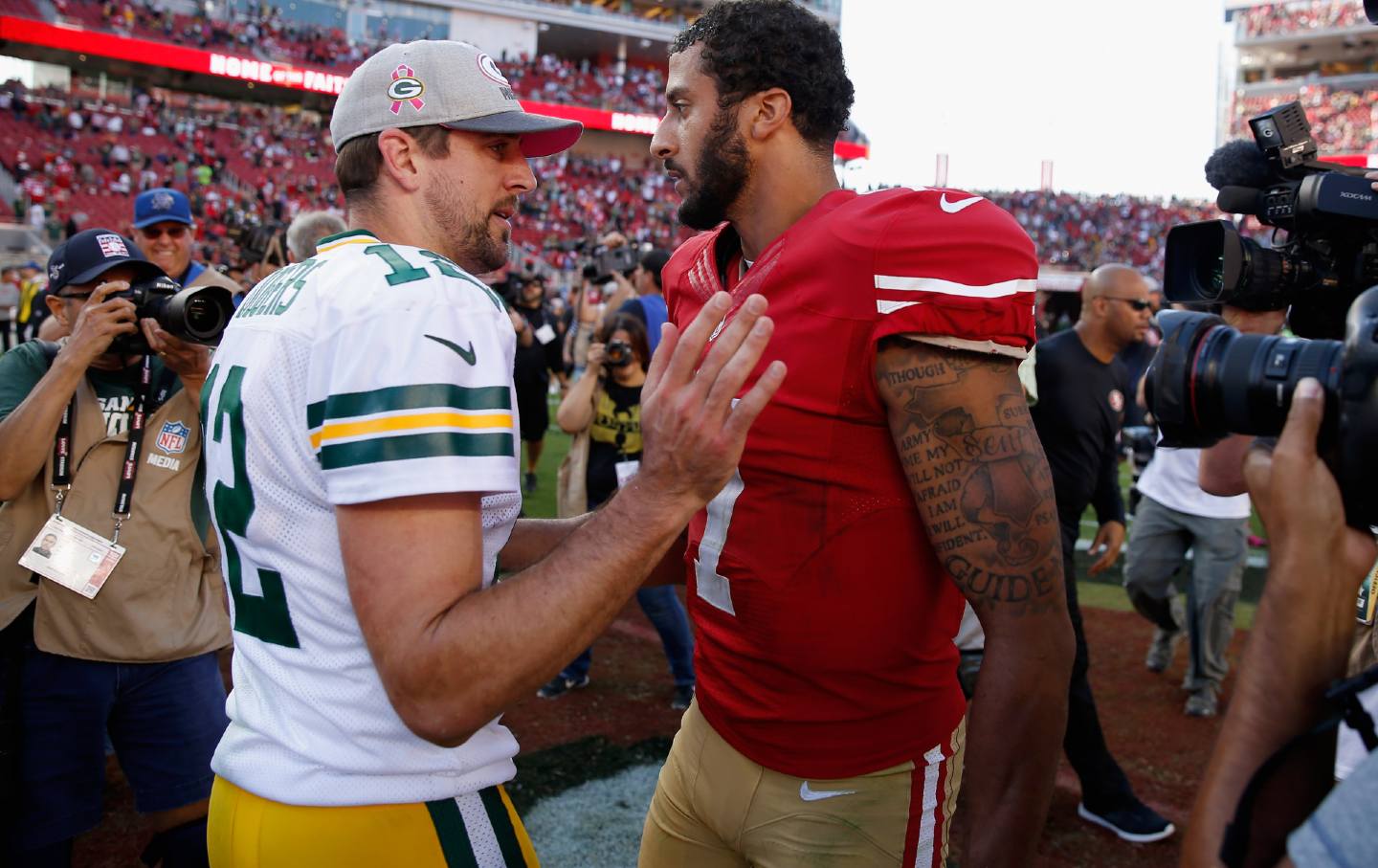
Colin Kaepernick, #7 of the San Francisco 49ers, talks with Aaron Rodgers, #12 of the Green Bay Packers, after their game on October 4, 2015, in Santa Clara, Calif.
(Ezra Shaw / Getty Images)Future Hall of Fame quarterback Aaron Rodgers has morphed over the last several years—in parallel with the sharp decline in his skills as he hits 40—into a troll more comfortable confronting Jimmy Kimmel than NFL linebackers. At first, his ideas don’t seem consistent. He is a proud user of psychedelics. He is perhaps the country’s highest-profile vaccine denier. He has railed against “the alphabet mafia” (that means LGBTQ people—although it’s unclear if he knew that) for trying to silence him. He whinges about the shadowy forces muzzling his genius while making $1 million a year to do weekly interviews on his partner in whiny grievance Pat McAfee’s daily ESPN show.
People like Rodgers abound across social media and in our lives. For all their bleating about “freedom,” these political actors often end up pining for a strongman leader to punish their perceived enemies and offer them, the chosen few, the “freedom” they crave. These kinds of political creatures were just social media annoyances before Covid-19 scrambled our brains and our politics. Now, their reach has expanded, swallowing influencers like Rodgers and becoming part of our dangerous wave toward authoritarianism.
These forces, overwhelmingly white, are also fond of quoting Dr. Martin Luther King Jr., to the offense of his family and the annoyance of the rest of us. True to form, when Rodgers refused to wear a mask during the height of Covid for a media event, he paraphrased Dr. King, saying, “I would add this to the mix as an aside, but the great MLK said you have a moral obligation to object to unjust rules and rules that make no sense.” If not for his celebrity status, Rodgers’s name might as well be @joeroganfan69.
I have been baffled by this stubborn new political weed. Then I read Doppelganger by journalist Naomi Klein and achieved something close to clarity. In Doppelganger, Klein explores the idea that we all have doubles (or more) of people who mirror us in looks or ideas or social position, albeit with at times some disturbing, even lethal, differences. (She discusses her own ghastly doppelgänger—Naomi Wolf—but you’ll have to read to learn more about that.)
Klein shows that humans have always been obsessed with the idea of doubles, and provides examples from the long history of doppelgänger literature, art, and film. Klein also makes the case that in polarizing times when authoritarians on the march, the doppelgängers of people who believe in social justice emerge on the radical right wing, where the language of revolt and change is aped and repurposed. Think about the aforementioned political operators who incessantly quote King—something they do not only to annoy but also because they are consciously borrowing ideas from the left in order to fuel the right. Klein calls the people who do this “diagonalists.” We have all seen a cottage industry of former leftists using social media to rebrand and repackage as diagonalist right-wingers: people who were part of Occupy Wall Street who now want to open fire on immigrants, people who lend their left credibility to fascist platforms either in a cash grab or because years of defeat have made them embittered toward their former allies. The grand architect of this method, Klein makes clear, is former Trump adviser Steve Bannon. Diagonalist provocateurs like Bannon think they have found the secret formula to connect with a majority: speak in the language of social movements and even “revolution” while diverting attention away from corporate power and toward the marginalized as the source of all woe.
We also see doppelgängers emerge of our social movements as the post–January 6 fascist right revels in being on the march, while much of the left finds themselves defending social institutions that in other times they would be mercilessly critiquing. Klein’s analysis, however, stresses that these identities aren’t fixed: that individuals drawn to authoritarian solutions can change. People are malleable—a collective action like a strike or march can make people refocus their blame from thinking that the marginalized are the problem and to realizing the real enemy is corporate power.
Like many diagonalists, Aaron Rodgers thinks he’s a special snowflake walking among us: one of one. But his doppelgänger exists as well. That would be former San Francisco 49er quarterback Colin Kaepernick. It was Kaepernick who in 2016 used the exalted position of NFL quarterback to speak out: the first NFL quarterback to use his platform for any kind of social-justice initiative. Kaepernick used his access to the spotlight to fight racism and police violence. The Trumpian right wing and their underwriters in NFL owners’ boxes lost their minds at the sight of his now iconic nonviolent act of kneeling during the anthem. Kaepernick sacrificed his career to change the world. It was, unlike refusing a vaccine during a public health crisis, an action very much in the tradition of King. Kaepernick was brave; his doppelgänger Rodgers is protected by privilege. Kaepernick was exiled from the league. Rodgers—even with his dalliances with 9/11 trutherism—is seen as the savior of the Jets, a team that represents New York City. (If Kaepernick played in New York and wondered how the towers fell, I shudder to consider the repercussions.) In our alleged cancel culture, Kaepernick was actually canceled; Rodgers only gets amplified.
And yet, as Klein shows in Doppelganger, we also can’t write people off once they enter the mirror world of right-wing diagonalism—not even Rodgers. We would do well to remember that Rodgers, in August 2017, spoke out against the blackballing of Kaepernick, calling people “ignorant” who think that the reason Kaepernick was out of the league had anything to do with his play. Rodgers was the first high-profile white player to lend Kaepernick support.
Rodgers doesn’t have to be content to be Kaepernick’s right-wing doppelgänger. He can still use his fame to say something about unity in the face of division. But he won’t do it by accident or even after sitting in a dark cave. Struggle is not just how we change society. It’s how we change ourselves. But without personal transformation, Rodgers’s personal journey could place him across the barricade from Kaepernick. Let’s hope there are people close to Rodgers who can argue and engage with him, steering him toward a different path.
We all have doppelgängers, and they are not preordained to become champions of authoritarianism. In our personal lives, we can figure out how to embrace them—to move them! If we do that, we can avoid the country falling—divided against ourselves—toward ruin.
Disobey authoritarians, support The Nation
Over the past year you’ve read Nation writers like Elie Mystal, Kaveh Akbar, John Nichols, Joan Walsh, Bryce Covert, Dave Zirin, Jeet Heer, Michael T. Klare, Katha Pollitt, Amy Littlefield, Gregg Gonsalves, and Sasha Abramsky take on the Trump family’s corruption, set the record straight about Robert F. Kennedy Jr.’s catastrophic Make America Healthy Again movement, survey the fallout and human cost of the DOGE wrecking ball, anticipate the Supreme Court’s dangerous antidemocratic rulings, and amplify successful tactics of resistance on the streets and in Congress.
We publish these stories because when members of our communities are being abducted, household debt is climbing, and AI data centers are causing water and electricity shortages, we have a duty as journalists to do all we can to inform the public.
In 2026, our aim is to do more than ever before—but we need your support to make that happen.
Through December 31, a generous donor will match all donations up to $75,000. That means that your contribution will be doubled, dollar for dollar. If we hit the full match, we’ll be starting 2026 with $150,000 to invest in the stories that impact real people’s lives—the kinds of stories that billionaire-owned, corporate-backed outlets aren’t covering.
With your support, our team will publish major stories that the president and his allies won’t want you to read. We’ll cover the emerging military-tech industrial complex and matters of war, peace, and surveillance, as well as the affordability crisis, hunger, housing, healthcare, the environment, attacks on reproductive rights, and much more. At the same time, we’ll imagine alternatives to Trumpian rule and uplift efforts to create a better world, here and now.
While your gift has twice the impact, I’m asking you to support The Nation with a donation today. You’ll empower the journalists, editors, and fact-checkers best equipped to hold this authoritarian administration to account.
I hope you won’t miss this moment—donate to The Nation today.
Onward,
Katrina vanden Heuvel
Editor and publisher, The Nation