
Haiti’s Hour of Deliverance or Despair
Gangs assert their patriotism while the latest international rescue plan teeters between failure and a possible way forward.
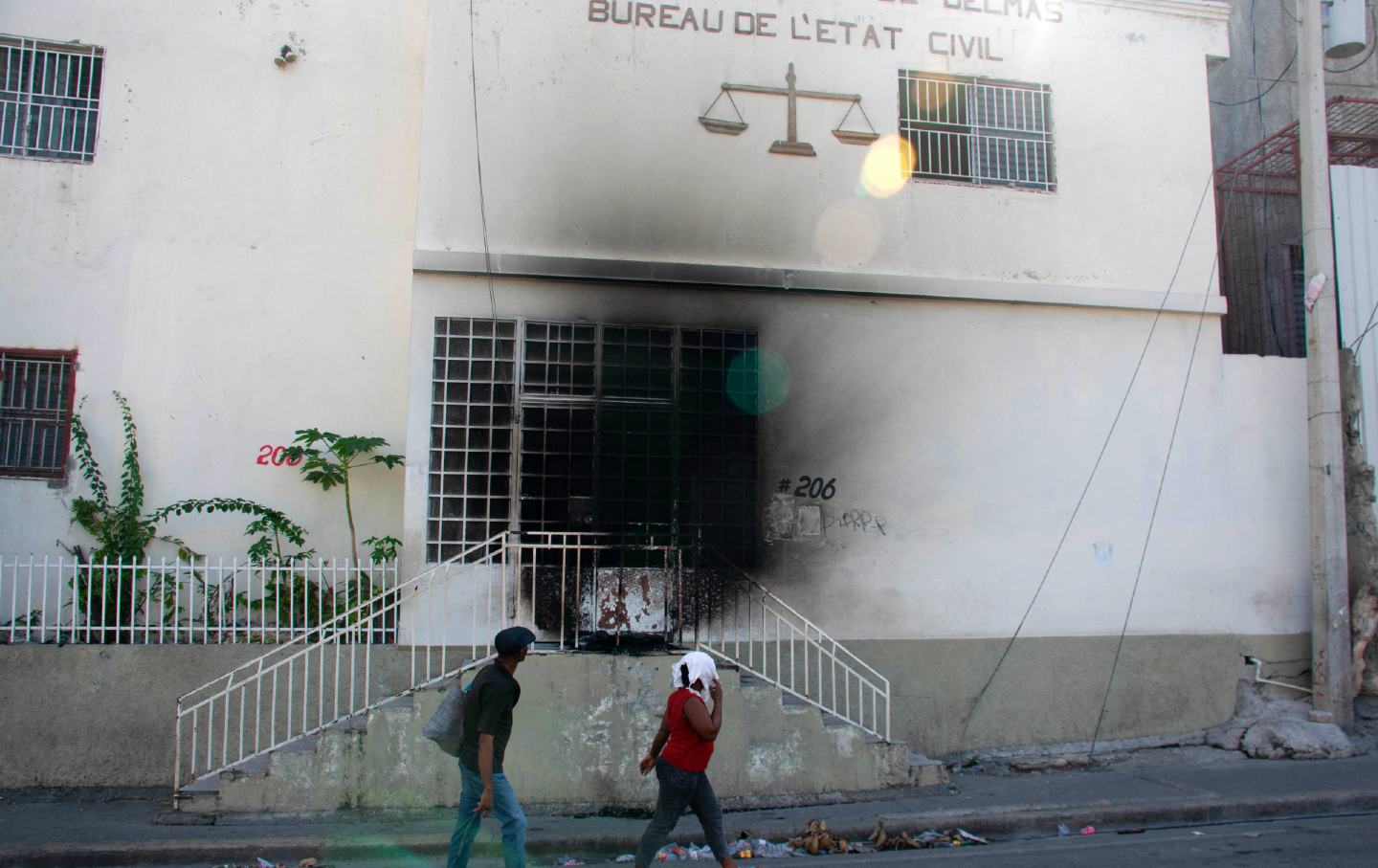
People walk by the tribunal set on fire the previous day by armed gangs in Port-au-Prince, Haiti, on March 6, 2024. Haiti’s capital was largely shut down on March 4, as authorities imposed a state of emergency after an attack on a prison freed thousands of inmates.
(Clarens Siffroy / AFP via Getty Images)This past week, CARICOM, the Caribbean trade group, announced a new “consensus” plan to deliver Haiti from the hands of roving gangs and paramilitary groups and into the tender care of democracy and free and fair elections.
In part because of escalating gang violence in Port-au-Prince, Haiti’s capital, the meeting to put this plan into action was held in Kingston, Jamaica, after talks that included the leaders of the CARICOM states; numerous Haitian stakeholders; US Secretary of State Antony Blinken; the State Department’s head of Western Hemisphere affairs, Brian Nichols; Canadian Prime Minister Justin Trudeau; and other foreign diplomats. As part of the plan, a seven-member transitional presidential council, representing seven Haitian stakeholder groups, will be charged with naming a new interim prime minister.
Shortly after the CARICOM announcement, Haiti’s much-reviled de facto Prime Minister Ariel Henry, subject of mass demonstrations in Haiti this past year calling for his ouster, promised to step aside as soon as the plan was instituted and an interim prime minister had been named. Henry spoke in solemn presidential tones from an undisclosed location in Puerto Rico, where he had made a surprise landing on March 5 after his plane, a private jet, failed to find a welcoming gate anywhere on the island Haiti shares with the Dominican Republic. (Henry was returning home from Kenya, where he’d worked on a long-standing but troubled UN/US plan for a 1,000-officer Kenyan police force to help Haiti reestablish order.)
As one Haitian friend said to me, “How do you step aside when you’re already in Puerto Rico?” Henry’s speech was widely seen as effectively his resignation. The Kenyans have now put the multinational intervention plan on hold until a new interim prime minister is selected.
You should pity the new prime minister—whoever that person may turn out to be. It won’t be fun to preside over the wreckage that Henry leaves behind. In the past two weeks, the Haitian National Penitentiary and another large prison were emptied by the gangs and the University Hospital of Haiti was closed down, while the US Embassy and missions from several other countries, as well as the World Bank, airlifted their remaining staffs off the island, and the gangs fired on and shut down the seaport of Port-au-Prince and the international and domestic airports. Beheadings and street assassinations have continued. In response perhaps to the impending CARICOM announcement, some of the largest gangs have been joining forces and trying to curry favor with the population by releasing kidnap victims and apologizing vaguely for “collateral damage.”
As is often the case in Haitian political disputes, the battles become more intense the less valuable the prize. Henry would probably have much to say about the personal value of sitting at the top of the Haitian powder keg, especially in the next phase—where every political step taken will be momentous and closely scrutinized but is unlikely to bestow the tangible financial perks that customarily accrue to political power in Haiti, whether through corruption or other means.
It’s worth noting that the CARICOM plan is a nonstarter in the opinion of many Haitians—including even some of those who have been accepted as part of the transitional council. Like many rescue plans the international community has been promoting since the assassination of president Jovenel Moise on July 7, 2021, it has a kind of immediate planned obsolescence built in.
Sitting around the CARICOM roundtable—for as long as it lasts—will be members of groups who not only mistrust and dislike one another but who have all been jockeying for power since even before the Moise assassination. It would take a miracle—or a cataclysm—for them to come to any mutual understanding (one likely candidate for cataclysm is the gang warfare against the state, currently under way). The setup seems less like a plausible plan than a device designed to prove that Haitians cannot come to a democratic agreement—even with Grandpa Sam herding them to the table and Barbecue (the nom de crime of gang leader Jimmy Chérizier) at the door.
The original seven groups participating included five associated with political figures, including former president Jean-Bertrand Aristide and Henry, as well as representatives from the Montana Accord (a progressive grassroots coalition) and the Haitian private sector. This was already a fractious assemblage, to put it mildly. One group has already left the table because its members are supporting declared presidential aspirant Guy Philippe, a former Haitian senator and unsuccessful presidential candidate who recently served seven years in a US prison for money laundering for drug traffickers.
Philippe’s story is complicated—a macédoine of political ideologies, folk appeal, shifting alliances, and criminal and political activities. In November, the United States quietly deported him into the confused and violent Haitian political scene, and he immediately began amassing his own paramilitary force and proposing himself as Haiti’s next leader. Unlike Henry—an icy but dignified-seeming 74-year-old who is a neurosurgeon by profession—Philippe is youthful, energetic, and outspoken, and seems to be thought of, especially by young people, as the kind of courageous patriot who stands up to the establishment, like the hero of a narcocorrido. But Philippe’s first claim to fame was helping lead the second coup against President Aristide—a popular leader of an earlier generation.
In any case, the rules of the CARICOM agreement explicitly forbid participation on the council by anyone who has been charged with or convicted of crimes. They also bar a future presidential candidacy for any participant. So Philippe’s supporters were out on two counts, and they have walked away from the council. Philippe rejected the CARICOM solution the morning after it was announced, and a coalition of religious groups stepped up to replace his supporters as one of the seven member groups.
Rather than the beginning of a real rescue, what we’re seeing now from Kingston is the endgame of the failed international plan for Haiti, which has been undermined both by outsiders’ continuing manipulation of Haitian actors and by the international community’s fear of working too visibly alongside a nontraditional Haitian solution that might fail—to say nothing of endless infighting among members of the Haitian political class.
Popular
“swipe left below to view more authors”Swipe →Over the past 30 months, against all advice, it has seemed simpler to the Biden administration to stick with Henry than to encourage the members of, say, the Montana accord—who at least had the distinction of having worked for years to cobble together a large group of grassroots organizations from around the country.
The US had many chances during that time to leave Henry behind and to support inclusive interim government proposals from the Haitian grassroots—but it chose not to. Thus when the gangs threatened civil war if Henry did not step aside, and then he finally did step aside, it was the gangs who took credit for ridding the country of a despised and illegitimate prime minister. Because they effectively were the ones who got it to happen, while the US and friends fiddled.
The CARICOM plan has been a long time gestating, but the international community, as led by the United States, still balks at trying anything novel. Both the US and the UN—who each have an ongoing physical presence in Haiti—seem incapable of imagining new ways for Haiti to move forward. Sometimes it seems that Haiti’s problems can be attributed not—as is usually assumed, at least in the high ranks of the State Department—to the corruption or incapacity of Haitians but to the psycho-political mania of the US, which just can’t seem to let go of the idea that the world’s first Black republic is not equipped to govern itself and must never be allowed to do so. But there are some grounds to hope that this latest version of the international plan for Haiti can work—if only because the pressure from the current explosive and dangerous conflagration on the ground in Port-au-Prince makes it seem like a last chance. Perhaps against their better judgement, groups that might wish to leave the table have not. One item in the CARICOM plan that is particularly galling to the member groups is a requirement to support the Kenyan police intervention, which goes against Haitians’ fierce devotion to their country’s sovereignty, as well as against the political necessity, in this case, to demonstrate that devotion publicly. Many of them are also irked by Henry’s non-resignation resignation. One Haitian whose group is part of the council told me on Tuesday, “Not good. We are probably out.” But two days later, their group was still at the table. We’ll see how long that lasts.
Disobey authoritarians, support The Nation
Over the past year you’ve read Nation writers like Elie Mystal, Kaveh Akbar, John Nichols, Joan Walsh, Bryce Covert, Dave Zirin, Jeet Heer, Michael T. Klare, Katha Pollitt, Amy Littlefield, Gregg Gonsalves, and Sasha Abramsky take on the Trump family’s corruption, set the record straight about Robert F. Kennedy Jr.’s catastrophic Make America Healthy Again movement, survey the fallout and human cost of the DOGE wrecking ball, anticipate the Supreme Court’s dangerous antidemocratic rulings, and amplify successful tactics of resistance on the streets and in Congress.
We publish these stories because when members of our communities are being abducted, household debt is climbing, and AI data centers are causing water and electricity shortages, we have a duty as journalists to do all we can to inform the public.
In 2026, our aim is to do more than ever before—but we need your support to make that happen.
Through December 31, a generous donor will match all donations up to $75,000. That means that your contribution will be doubled, dollar for dollar. If we hit the full match, we’ll be starting 2026 with $150,000 to invest in the stories that impact real people’s lives—the kinds of stories that billionaire-owned, corporate-backed outlets aren’t covering.
With your support, our team will publish major stories that the president and his allies won’t want you to read. We’ll cover the emerging military-tech industrial complex and matters of war, peace, and surveillance, as well as the affordability crisis, hunger, housing, healthcare, the environment, attacks on reproductive rights, and much more. At the same time, we’ll imagine alternatives to Trumpian rule and uplift efforts to create a better world, here and now.
While your gift has twice the impact, I’m asking you to support The Nation with a donation today. You’ll empower the journalists, editors, and fact-checkers best equipped to hold this authoritarian administration to account.
I hope you won’t miss this moment—donate to The Nation today.
Onward,
Katrina vanden Heuvel
Editor and publisher, The Nation
More from The Nation

The US Is Looking More Like Putin’s Russia Every Day The US Is Looking More Like Putin’s Russia Every Day
We may already be on a superhighway to the sort of class- and race-stratified autocracy that it took Russia so many years to become after the Soviet Union collapsed.
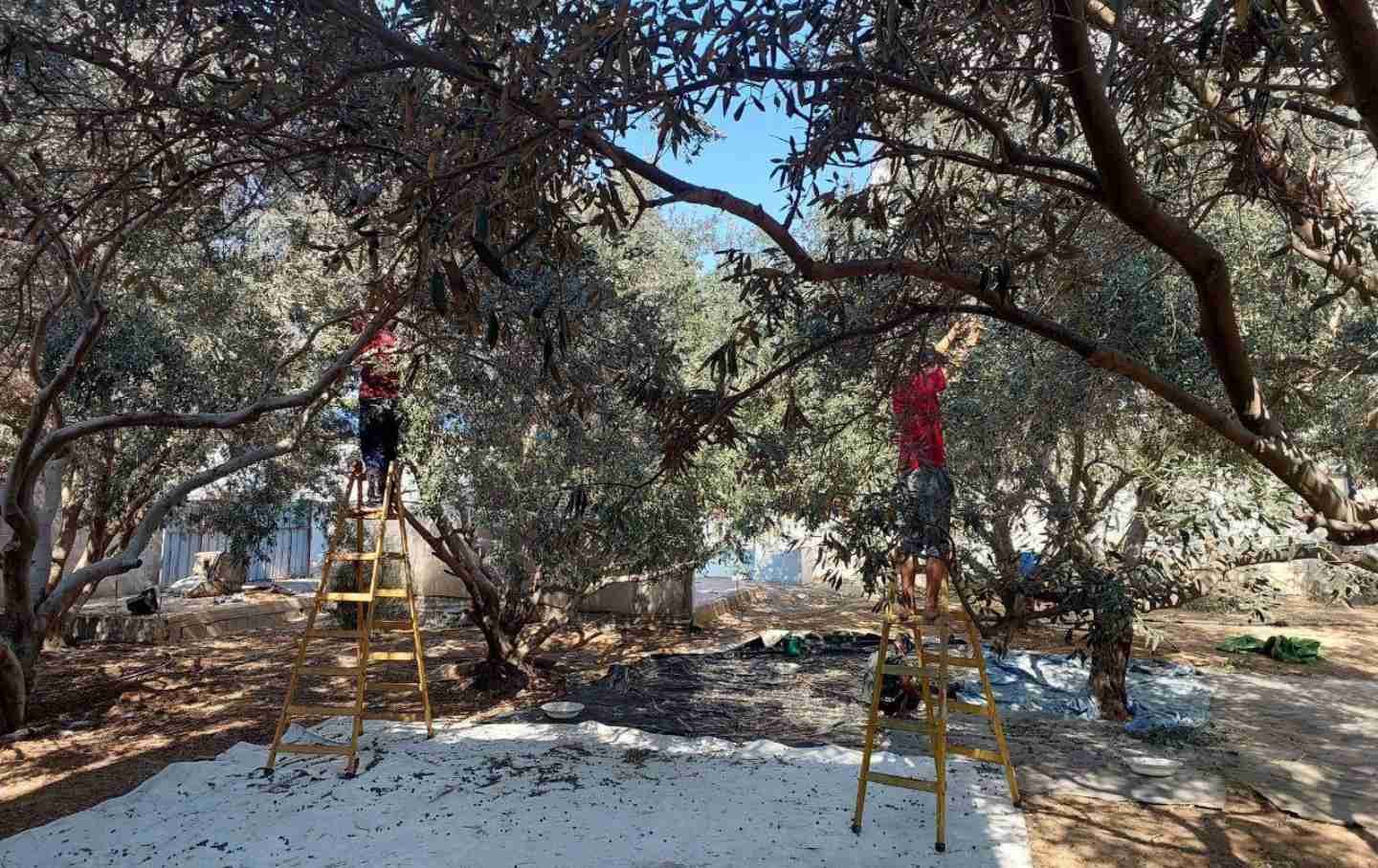
Israel Wants to Destroy My Family's Way of Life. We'll Never Give In. Israel Wants to Destroy My Family's Way of Life. We'll Never Give In.
My family's olive trees have stood in Gaza for decades. Despite genocide, drought, pollution, toxic mines, uprooting, bulldozing, and burning, they're still here—and so are we.
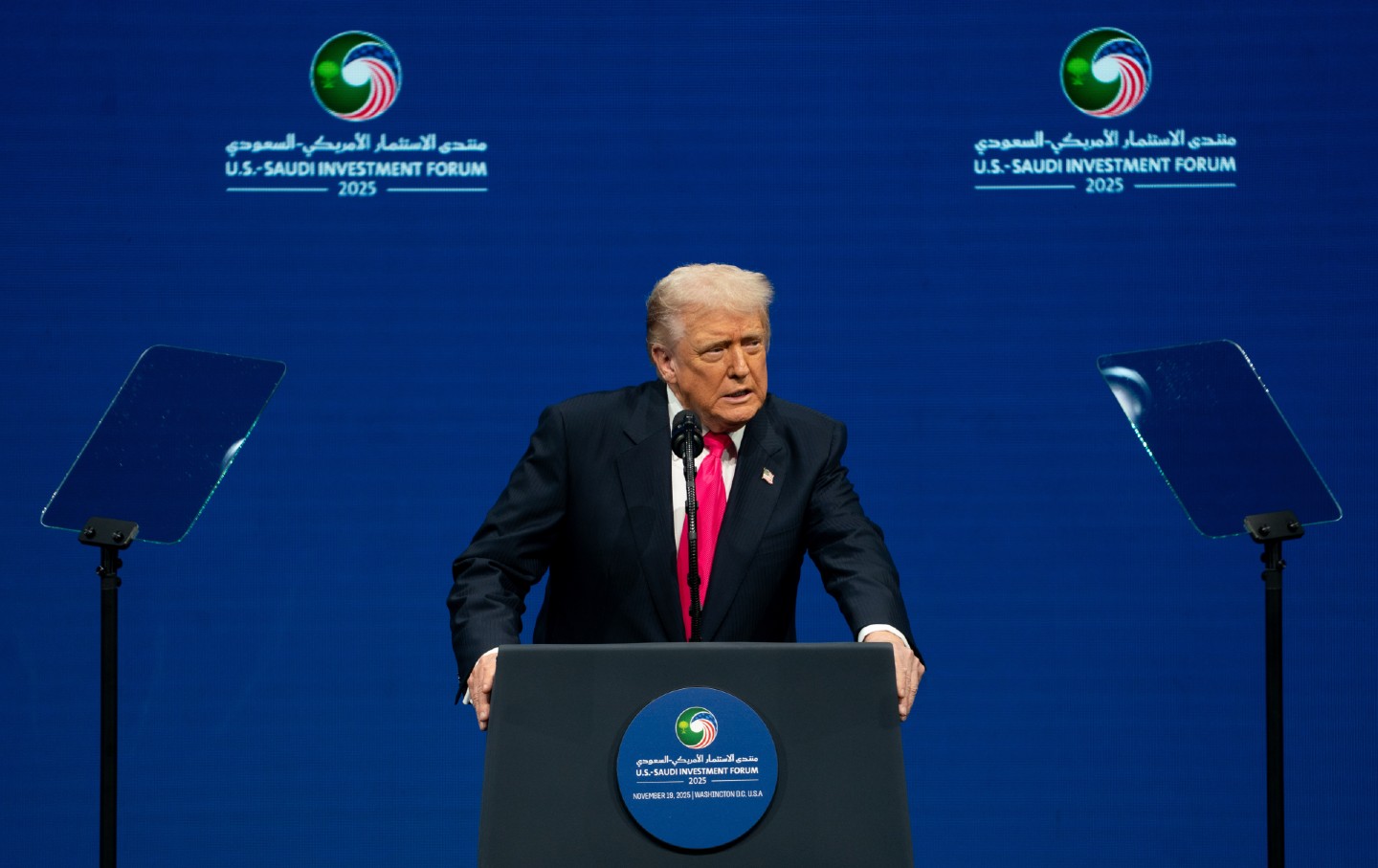
Trump’s National Security Strategy and the Big Con Trump’s National Security Strategy and the Big Con
Sense, nonsense, and lunacy.
Does Russian Feminism Have a Future? Does Russian Feminism Have a Future?
A Russian feminist reflects on Julia Ioffe’s history of modern Russia.
Ukraine’s War on Its Unions Ukraine’s War on Its Unions
Since the start of the war, the Ukrainian government has been cracking down harder on unions and workers’ rights. But slowly, the public mood is shifting.
I’m a Teacher in Gaza. My Students Are Barely Hanging On. I’m a Teacher in Gaza. My Students Are Barely Hanging On.
Between grief, trauma, and years spent away from school, the children I teach are facing enormous challenges.

