
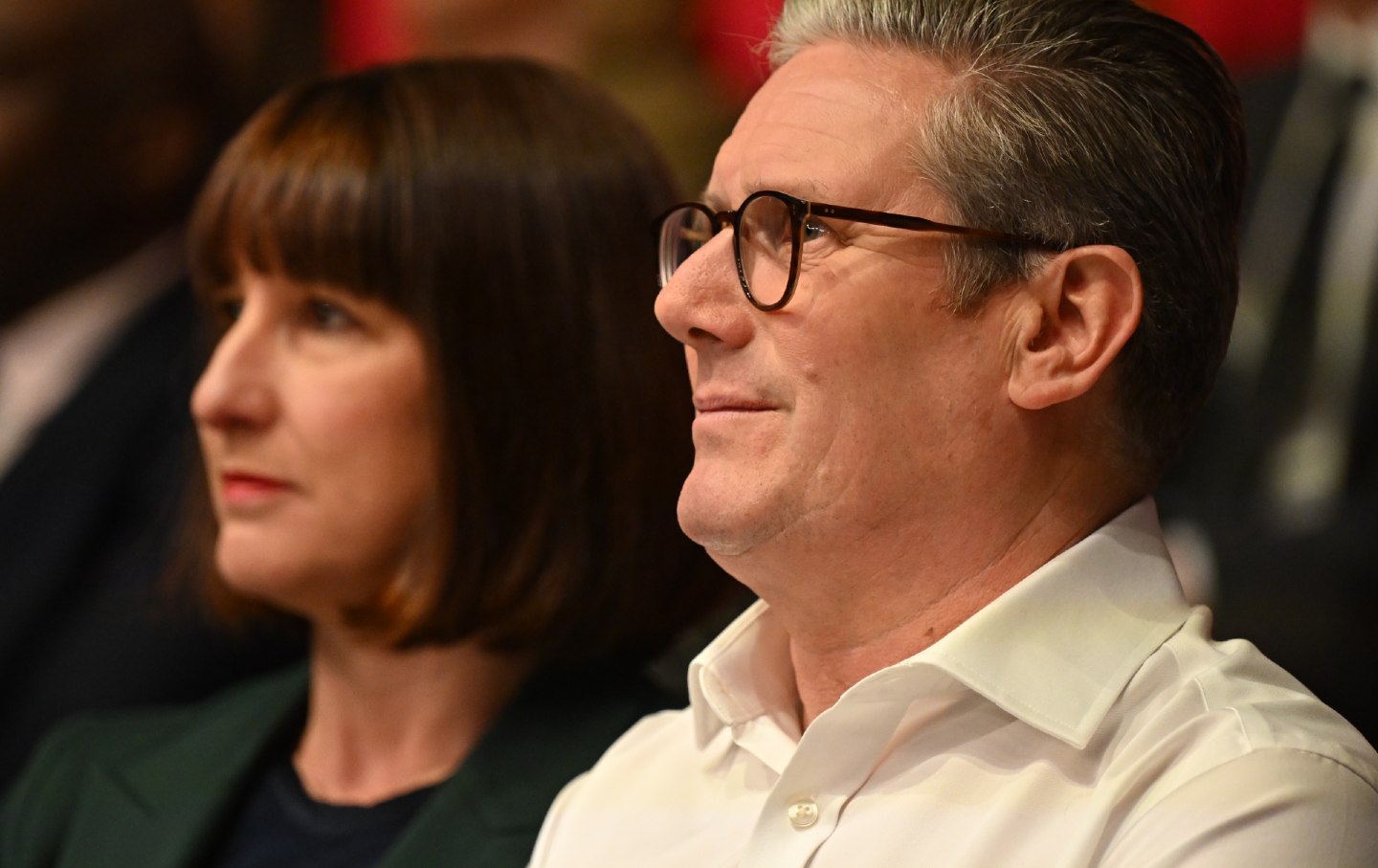
Rishi Sunak’s decision to call a general election six months earlier than required has, to use the prevailing metaphor, all the hallmarks of desperation to save a sinking ship. Britain’s fifth Conservative prime minister in 14 years has failed to restore his party’s credibility after Liz Truss’s chaotic premiership gifted Labour a chance to claim the mantle of “stability.” He has already seen 78 of his current MPs declare that they won’t be standing for reelection. And scores of those staying on as candidates face defeat if Labour’s current 21-point lead holds up.
For Keir Starmer, then, the prime minister’s residence at 10 Downing Street seems within easy reach. But Britain’s political waters are far from calm, and the ship Starmer’s steering has already been badly damaged by the course he has chosen.
Starmer was elected Labour leader in 2020 on the strength of 10 pledges that embodied much of the radical approach of his predecessor Jeremy Corbyn. In the leadership debates, he even praised Corbyn and described him as a friend.
It rapidly became clear, however, that Starmer had no intention of honoring those pledges. After his election, it emerged that he had used a loophole in Labour’s rules to delay declaring that most of the biggest donors to his leadership campaign were wealthy allies of former leader Tony Blair.
Step by relentless step, Starmer then filled his shadow cabinet with Blair acolytes and unashamedly jettisoned most of his 10 pledges. Out went commitments to end outsourcing in the NHS and abolish university tuition fees. In a return to “trickle down” economics, his shadow chancellor, Rachel Reeves, ditched redistributive taxes and said that any money to expand public services would have to come from growth. For good measure, she won Starmer’s backing earlier this year to slash promised annual spending on Labour’s flagship Green Prosperity Plan from £28 billion to a meagre £4.7 billion.
Fiscal conservatism will not, however, apply to the military budget. Starmer’s shadow defense secretary, John Healey, says Labour has an “unshakeable” commitment to NATO and will “always spend what is required” on arms. This return to Blair’s unequivocal Atlanticism has been most painfully demonstrated in Labour’s unwillingness to step outside the Washington consensus on Gaza—even at the cost of alienating millions of its core supporters.
Such is Labour’s rightward lurch that three Conservative MPs have “crossed the floor” to join the party and been welcomed without the slightest hint that they have changed their views on any policy. Times columnist Matthew Parris, a Thatcher-era Conservative MP, summed it up on Saturday, writing that—while he would back Sunak as a “Tory by habit, disposition and default”—it is a “marginal” decision because Labour offered “no mortal threat to anything dear to me.”
After explicitly seeking to position Labour as “the real conservatives,” Parris’s grudging verdict must feel like a moment of arrival for Starmer’s top team whose electoral strategy amounts to little more than convincing Conservative voters that Labour has removed all traces of Corbynism and will deliver stability after the chaos of Truss.
But this relies on two assumptions: firstly, that people who were enthused by Corbyn—who is still viewed favorably by the 55 percent of 2019 Labour voters—have nowhere else to go; and, secondly, that voters who backed Corbyn’s Labour in 2017 but defected to the Tories in 2019 to “get Brexit done” are conservative on other issues. Neither is dependable. Behind Labour’s headline lead in the polls, there is a chronic lack of enthusiasm that could hamper its chances of achieving the parliamentary landslide most pundits are predicting.
To win the 326 seats needed for a bare majority, Labour has to retain the 205 seats it currently holds while making big gains, particularly in Scotland, where it was virtually wiped out in 2015, and in the 52 Brexit-voting “red wall” seats it lost in England and Wales in 2019.
This was always going to be a tall order, given that the party’s geographically concentrated support base translates into proportionately fewer seats in Britain’s first-past-the-post electoral system. The task has been made even harder by boundary changes that pollster Colin Rallings estimates mean that Labour has to win the popular vote by 13.7 points to even secure a majority.
This gives Starmer far less room for slippage than current polling suggests. Labour has started the campaign at 44 percent, while the Conservatives are languishing at 23 percent, having been hit hard by 2019 supporters saying they are undecided or defecting to Reform UK, the revamped Brexit Party, which is currently polling 11 percent. But Rallings expects Reform supporters to return to the Conservative fold as the electoral system “pushes people back into two camps.”
Whether this happens or not depends to a large extent on what impact Reform’s president, Nigel Farage, has on the debate. Evidently caught unprepared for an early election, he isn’t going to stand for a parliamentary seat himself, but he says he will be campaigning around the country “in every conceivable way” before heading across the Atlantic to support Donald Trump.
Popular
“swipe left below to view more authors”Swipe →For the left, on the other hand, Labour’s huge poll lead aids an appeal to voters to follow their convictions rather than settle for the lesser evil. Guardian columnist Owen Jones argues that because “the Tories are toast,” voters can “send Labour a message without risking [the Tories] sneaking back in.” To back that up, he has launched We Deserve Better, a crowdfunding campaign to support “socialist, environmentalist, pro-Palestinian independent and Green candidates.”
Jones points to recent local elections in which Greens and independents made nearly as many gains as Labour. Among the factors in play was Starmer’s dismal standing in ethnically diverse communities where—according to one pollster—he has a net satisfaction rating of minus 31, the lowest any Labour leader has recorded since 1996. In the general election, Starmer’s alienation of Black and South Asian voters will undoubtedly impact Labour, especially as another newly formed campaign, Muslim Vote, is mobilizing support for a list of independents that overlaps substantially with those endorsed by We Deserve Better.
And then there’s the Corbyn factor. Starmer failed to secure his predecessor’s expulsion from Labour in 2020, after Corbyn had argued that antisemitism in the party had been exaggerated by his political enemies, but he did win a vote on Labour’s NEC in March to block his being a candidate on the grounds that Labour’s “electoral prospects” would be “significantly diminished” if he were endorsed.
Undeterred, Corbyn will still defend the Islington North seat he has held since 1983, backed by both We Deserve Better and Muslim Vote, and adding his national profile to the fast-growing band of credible independents. In London, the list includes former Labour MP Emma Dent Coad in Kensington, British Palestinian Leanne Mohamad in Ilford North, and former South African MP Andrew Feinstein, who is standing against Starmer himself in Holborn and St Pancras. Elsewhere, Labour is under threat from the Greens in Bristol Central, several independents in Birmingham, and George Galloway’s Workers Party not only in the Rochdale constituency Galloway currently holds but also from ex-MP Chris Williamson in Derby North.
It’s an eclectic group, with more than a few political differences, but it poses a serious challenge to Labour and will—if nothing else—ensure that Israel’s crimes in Gaza are not sidelined by the Starmer-Sunak consensus on the issue.
Disobey authoritarians, support The Nation
Over the past year you’ve read Nation writers like Elie Mystal, Kaveh Akbar, John Nichols, Joan Walsh, Bryce Covert, Dave Zirin, Jeet Heer, Michael T. Klare, Katha Pollitt, Amy Littlefield, Gregg Gonsalves, and Sasha Abramsky take on the Trump family’s corruption, set the record straight about Robert F. Kennedy Jr.’s catastrophic Make America Healthy Again movement, survey the fallout and human cost of the DOGE wrecking ball, anticipate the Supreme Court’s dangerous antidemocratic rulings, and amplify successful tactics of resistance on the streets and in Congress.
We publish these stories because when members of our communities are being abducted, household debt is climbing, and AI data centers are causing water and electricity shortages, we have a duty as journalists to do all we can to inform the public.
In 2026, our aim is to do more than ever before—but we need your support to make that happen.
Through December 31, a generous donor will match all donations up to $75,000. That means that your contribution will be doubled, dollar for dollar. If we hit the full match, we’ll be starting 2026 with $150,000 to invest in the stories that impact real people’s lives—the kinds of stories that billionaire-owned, corporate-backed outlets aren’t covering.
With your support, our team will publish major stories that the president and his allies won’t want you to read. We’ll cover the emerging military-tech industrial complex and matters of war, peace, and surveillance, as well as the affordability crisis, hunger, housing, healthcare, the environment, attacks on reproductive rights, and much more. At the same time, we’ll imagine alternatives to Trumpian rule and uplift efforts to create a better world, here and now.
While your gift has twice the impact, I’m asking you to support The Nation with a donation today. You’ll empower the journalists, editors, and fact-checkers best equipped to hold this authoritarian administration to account.
I hope you won’t miss this moment—donate to The Nation today.
Onward,
Katrina vanden Heuvel
Editor and publisher, The Nation
More from The Nation

The US Is Looking More Like Putin’s Russia Every Day The US Is Looking More Like Putin’s Russia Every Day
We may already be on a superhighway to the sort of class- and race-stratified autocracy that it took Russia so many years to become after the Soviet Union collapsed.

Israel Wants to Destroy My Family's Way of Life. We'll Never Give In. Israel Wants to Destroy My Family's Way of Life. We'll Never Give In.
My family's olive trees have stood in Gaza for decades. Despite genocide, drought, pollution, toxic mines, uprooting, bulldozing, and burning, they're still here—and so are we.

Trump’s National Security Strategy and the Big Con Trump’s National Security Strategy and the Big Con
Sense, nonsense, and lunacy.

Does Russian Feminism Have a Future? Does Russian Feminism Have a Future?
A Russian feminist reflects on Julia Ioffe’s history of modern Russia.
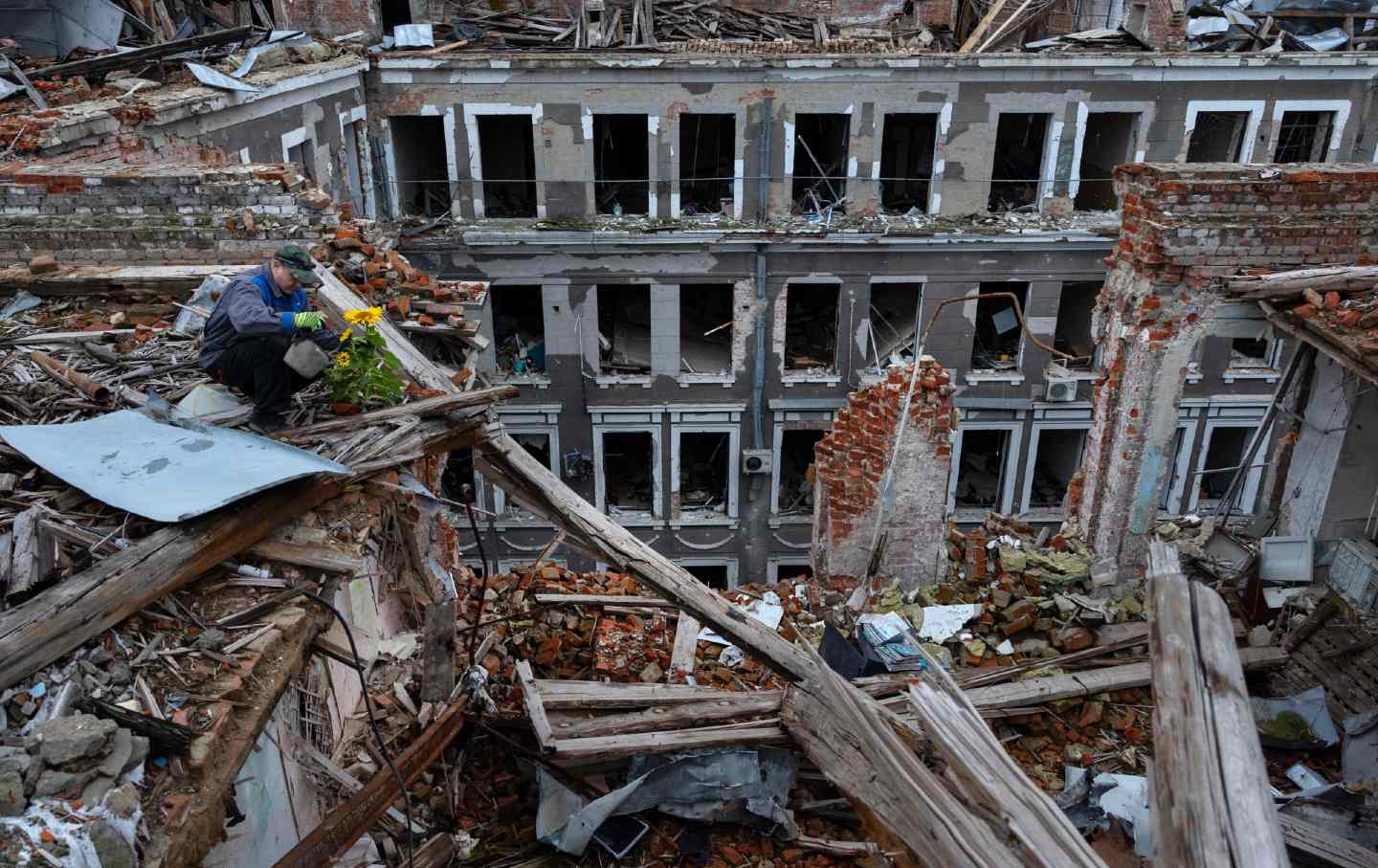
Ukraine’s War on Its Unions Ukraine’s War on Its Unions
Since the start of the war, the Ukrainian government has been cracking down harder on unions and workers’ rights. But slowly, the public mood is shifting.
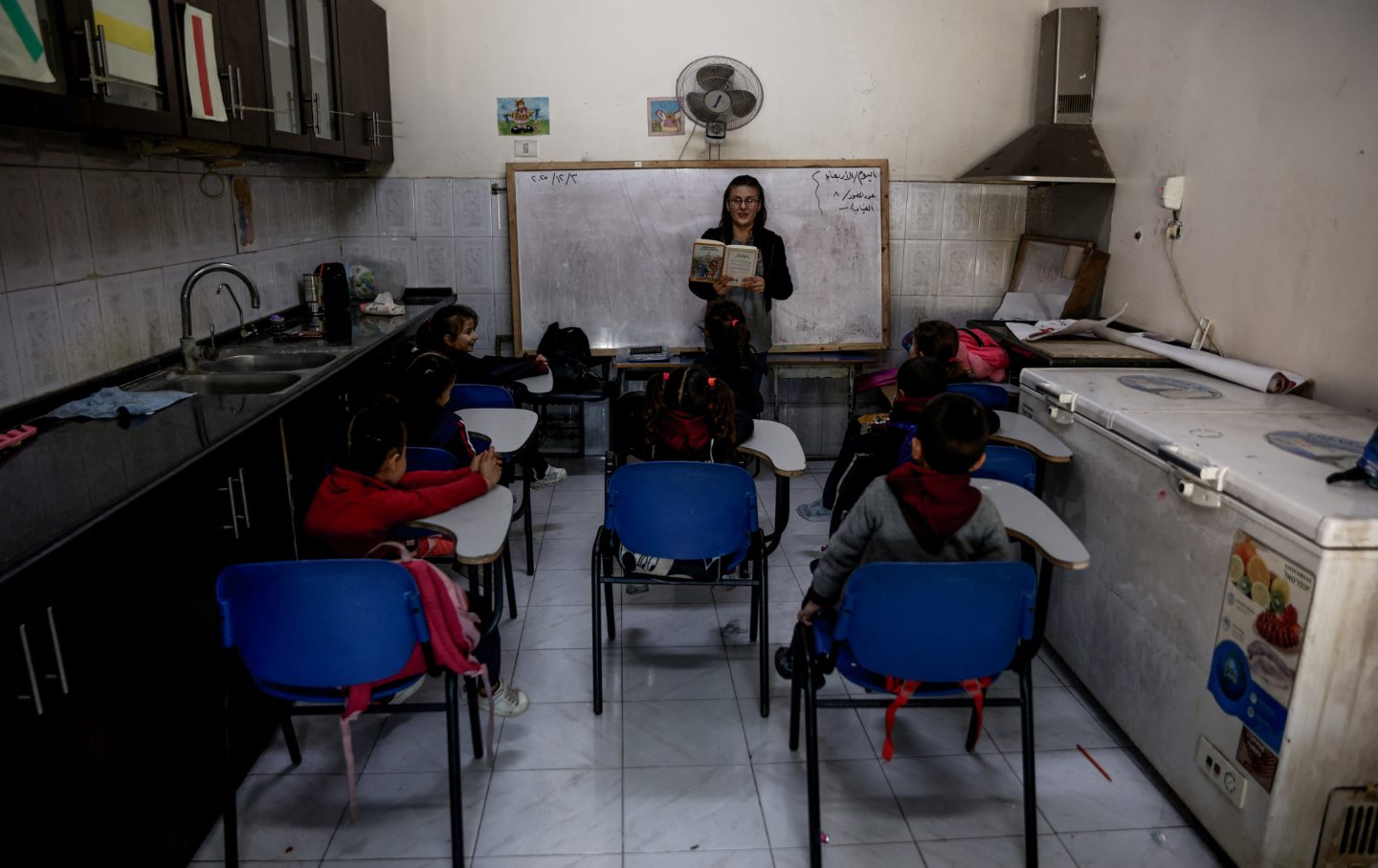
I’m a Teacher in Gaza. My Students Are Barely Hanging On. I’m a Teacher in Gaza. My Students Are Barely Hanging On.
Between grief, trauma, and years spent away from school, the children I teach are facing enormous challenges.

