If Leading CEOs Aren’t Donating to Trump, It’s Because They Don’t Need To
Even as some corporate bigwigs have taken to the sidelines, Trump’s fundraising has outstripped President Biden’s.
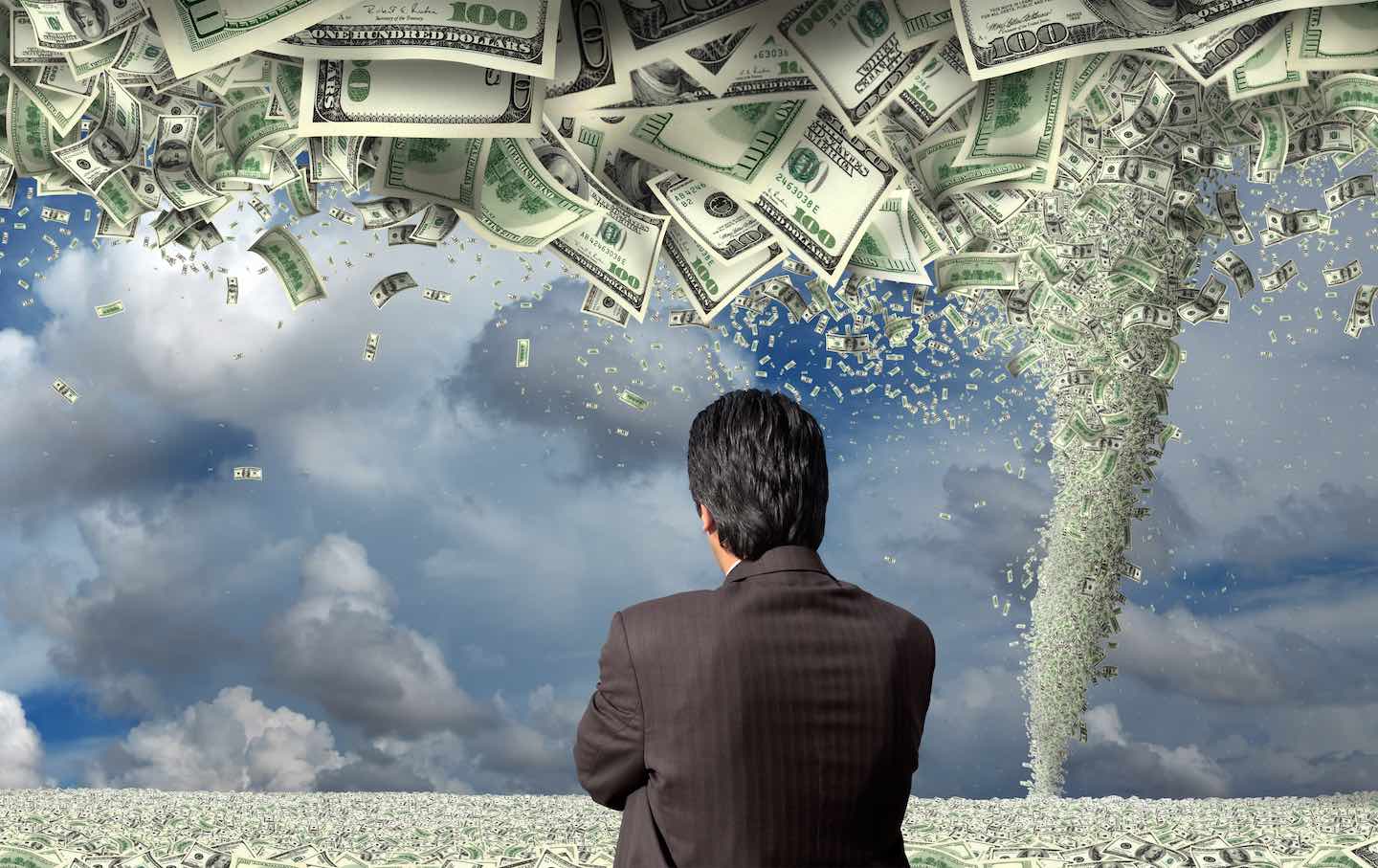
Defenders of America’s flailing experiment in self-governance can breathe a massive sigh of relief: Senior business executives are hostile to a second Donald Trump presidency. That’s the confident appraisal of Jeffrey A. Sonnenfeld, head of the Yale Chief Executive Institute, in The New York Times. While certain billionaires like hedge-fund titans David Sacks and Steven Schwartzman have signed on to Trump’s reelection campaign, the main run of corporate chieftains distrust Trump’s tariff-happy, Fed-destabilizing, dollar-sapping economic platform, Sonnenfeld notes, declaring that Trump’s embrace of an economic nationalist suite of policies has “more in common with Karl Marx than Adam Smith.” To clinch his case, Sonnenfeld cites an unprecedented turn in executive political donations: For the first time in his institute’s tracking of such data, not a single Fortune 100 executive has donated to a Republican presidential campaign.
Yet this data point is less about Trump aversion than it is image-driven political diffidence in an age of acute partisan polarization. As The Wall Street Journal reported, a mere six Fortune 100 CEOs contributed to either the Biden or Trump campaign in the homestretch of the 2020 election, for fear of plunging their global brands into political controversy. That trend appears to be gaining greater traction in this cycle, with Trump drawing fresh notoriety from his recent criminal conviction in Manhattan and Biden seeking to make the election another referendum on the fate of American democracy. As Yahoo! Finance reporter Ben Werkschkul notes, the Center for Political Accountability has documented a broad-based retreat from political giving across the Standard and Poor index: “Of the 345 companies that have been on the S&P 500 since 2015, 270 of them now prohibit or fully disclose spending on candidates or their committees. That’s up from 168 a few years prior, according to CPA’s analysis.” Corporate cash still exerts tremendous influence on our politics, but it now gets disproportionately channeled into state-level races via dark-money 527 groups, which offer virtually no ceilings on company donations, while eluding most conventional forms of campaign disclosure.
One immediate motive for this retreat was to dodge the sustained effort to name and shame corporate funders of the 147 GOP congressional representatives who voted against certification of the 2020 election results. Toyota, which was a major donor to those MAGA quislings, has yet to clock a single campaign donation over the 2024 cycle, Werkschkul writes. And for all the attention-seeking antics of the great woke-mind-virus inquisitor Elon Musk, none of the centibillionaire’s signature properties, from SpaceX to Tesla to the corporate arm of the lamely rebranded Twitter platform, have nudged any cash via PAC donations into Trump’s MAGA kitty.
But political fundraising abhors a vacuum, which means that the role once played by corporate PACs in bankrolling campaigns has now been taken up by individual billionaires, who are far more free to indulge their pet world-conquering fancies in the political arena, especially in the post–Citizens United age of untrammeled oligarch financing. Hence a big slice of the Biden campaign’s former fundraising advantage over Trump got wiped out earlier this month with a single stroke of the pen, when Timothy Mellon, the billionaire grandson of Depression-era omni-villain Andrew Mellon, plowed a cool $50 million into a Trump dark-money PAC. This was after Mellon had already donated $25 million to another MAGA cash sluice; evidently getting a taste for money-driven political mischief, he also donated the same sum to Robert F. Kennedy Jr.’s American Values super PAC. Indeed, the brunt of Sonnenfeld’s argument is readily disproven by a glance at recent campaign headlines, which show that Trump’s reelection effort has now outstripped Biden’s in fundraising numbers, as Fortune 100 CEOs stand wanly on the sidelines.
Sonnenfeld’s essay is less a diagnosis of how business sentiment is taking shape during this year’s campaign than an act of wish-fulfillment fantasy, seeking to summon forth for what feels like the millionth time a sober, realist conservative consensus out of the raging maw of the MAGAfied GOP. This ailment is now so pronounced that Sonnenfeld waxes nostalgic for the grown-ups in the room who presided over Trump’s economic policy after the 2016 election:
Mr. Trump’s primary conduits to the business community in his first term—more-reasonable voices like those of Jared Kushner, Dina Powell, and Steven Mnuchin—are gone, replaced by MAGA extremists and junior varsity opportunists.… With two or three prominent exceptions, most business voices now hanging around the hoop would normally be in the minor leagues of Republican business supporters. The party must long for the days of President Dwight Eisenhower, when there were so many business leaders in support and fully 60 percent of his cabinet were chief executives.
Well, no. Just for starters, the modern Republican Party has spent the past 40 years in ideological flight from the Eisenhower administration’s tax policies, which enacted 90 percent marginal rates on top earners. Sonnenfeld’s op-ed, incredibly, is completely silent on tax policy in the 2024 campaign, even though it is the lead economic issue for members of corporate oligarchy in every election cycle—and the central domestic economic issue separating Trump’s campaign, which again is touting massive corporate tax cuts, from Biden’s. Instead, Sonnenfeld dotes on candidate Trump’s underwhelming reception before the Business Roundtable, a policy klatch that, in the right-skewed playing field of moneyed politics, veers toward the center. In a typically digressive and hard-to- follow speech, Trump received almost no applause—leading Sonnenfeld once again to deduce a universe of false causation from CEO silence: “Chief executives are not protectionist, isolationist or xenophobic, and they believe in investing where there is the rule of law, not the law of rulers.”
Where to begin? For one thing, there’s the entire cold-war history of American foreign investment, which approached the rule of law with militant indifference-to-hostility, plotting literal coups at the behest of corporate players such as United Fruit and Anaconda Copper. Closer to the action in 2024, there’s the Business Roundtable’s far more influential big-brother lobby, the US Chamber of Commerce, which led all K Street concerns with a $70 million lobbying outlay last year. That stalwart right-wing business advocacy group, despite some absurdist MAGA posturing against it in Congress, is poised to mount a major election-year offensive on behalf of, yes, extending the 2017 Trump tax cuts. This is all to say nothing of how the prospect of renewed corporate tax cuts is shaping mainstream media coverage of the campaign, as economist Dean Baker has tirelessly pointed out.
Trump understands these dynamics perfectly well—which is why, in spite of the putative vapors that members of the CEO class experience at the mention of MAGA policy preferences, he continues to pitch generous tax cuts and deregulatory windfalls to them. It’s the same come-on he made to oil industry executives, which yielded an immediate cash boon to Trump’s campaign.
Yet the opinion shop at the country’s paper of record would have you believe that the incorrigible bad manners and culture-war demagogy of the American right has the country’s business elite clamoring to purge the GOP of its authoritarian leader—a claim once more in bald defiance of the business elite’s cozy accord with strongman fascist rule throughout the 20th century. Then again, it’s another form of corporate oligarchy to marshal Ivy League apparatchiks to deliver false refrains of comfort to an embattled democracy in times of crisis. Liberals have long been derided for bringing knives to gunfights; in Sonnenfeld’s case, they are bringing a 6-year-old’s finger painting to an oligarchs’ retreat.
Disobey authoritarians, support The Nation
Over the past year you’ve read Nation writers like Elie Mystal, Kaveh Akbar, John Nichols, Joan Walsh, Bryce Covert, Dave Zirin, Jeet Heer, Michael T. Klare, Katha Pollitt, Amy Littlefield, Gregg Gonsalves, and Sasha Abramsky take on the Trump family’s corruption, set the record straight about Robert F. Kennedy Jr.’s catastrophic Make America Healthy Again movement, survey the fallout and human cost of the DOGE wrecking ball, anticipate the Supreme Court’s dangerous antidemocratic rulings, and amplify successful tactics of resistance on the streets and in Congress.
We publish these stories because when members of our communities are being abducted, household debt is climbing, and AI data centers are causing water and electricity shortages, we have a duty as journalists to do all we can to inform the public.
In 2026, our aim is to do more than ever before—but we need your support to make that happen.
Through December 31, a generous donor will match all donations up to $75,000. That means that your contribution will be doubled, dollar for dollar. If we hit the full match, we’ll be starting 2026 with $150,000 to invest in the stories that impact real people’s lives—the kinds of stories that billionaire-owned, corporate-backed outlets aren’t covering.
With your support, our team will publish major stories that the president and his allies won’t want you to read. We’ll cover the emerging military-tech industrial complex and matters of war, peace, and surveillance, as well as the affordability crisis, hunger, housing, healthcare, the environment, attacks on reproductive rights, and much more. At the same time, we’ll imagine alternatives to Trumpian rule and uplift efforts to create a better world, here and now.
While your gift has twice the impact, I’m asking you to support The Nation with a donation today. You’ll empower the journalists, editors, and fact-checkers best equipped to hold this authoritarian administration to account.
I hope you won’t miss this moment—donate to The Nation today.
Onward,
Katrina vanden Heuvel
Editor and publisher, The Nation