
J.D. Vance’s Phony Populism Thrilled the RNC. The Rest of Us Shouldn’t Be Fooled.
The vice presidential nominee pitched himself as an avatar of the working class. Don’t believe the hype.
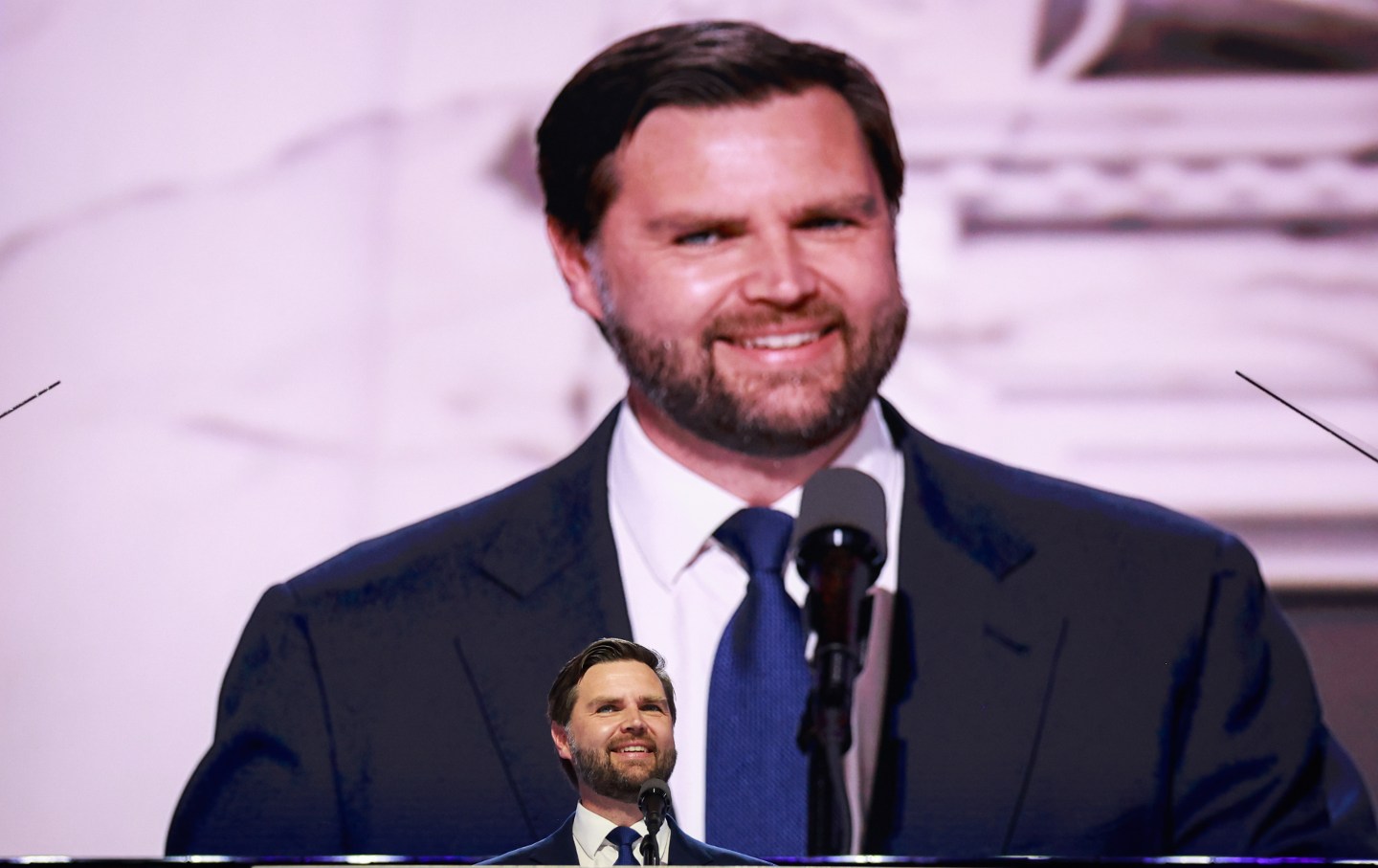
Republican vice presidential candidate US Senator J.D. Vance (R-OH) speaks on stage on the third day of the Republican National Convention at the Fiserv Forum on July 17, 2024, in Milwaukee, Wisconsin.
(Joe Raedle / Getty Images)Milwaukee—As he introduced himself to the national electorate on Wednesday—the day of the Republican National Convention devoted to the theme of “Making America Strong Again”—Republican vice presidential nominee and Ohio senator J.D. Vance lingered on the virtues of tough labor.
The former Silicon Valley venture capitalist leaned into the fulsomely hymned origin story he recounted in his reputation-making 2016 memoir, Hillbilly Elegy, to craft an extended homily about the senseless destruction of working-class America, and its unlikely salvation at the hands of a real-estate developer and reality TV impresario turned pseudo-populist savior.
It was quite a yarn, and Vance, a deft prose stylist and serial self-reinventor, tailored it expertly to the convention crowd.
It began with the heroic setpiece of last week’s assassination attempt on Donald Trump. “Donald Trump didn’t need to run for president,” Vance announced, in what’s become a common refrain for the restorationist 2024 Republican convention. “He chose to endure abuse, slander, and persecution, and he did it because he loved this country.” Then, after nearly being felled by the gunman’s bullet, Trump rose up to vindicate us once more. “Even in his most perilous moment, we were on his mind,” Vance marveled. And then the shared redemptive moral of it all; speaking of Trump’s media detractors and political rivals, Vance declared, “They said he was a tyrant, they said he had to be stopped at all costs. But what did he do? He called for national unity.… And then President Trump got back to work.”
This “great man” reverie follows the standard arc of Vance’s trademark heartland jeremiad. A once-noble and virtuous American yeomanry is led astray by the predations of a remote and all-powerful class of exploiters. Only tough, disciplined leadership and hard work can restore its rightful birthrights and destinies.
Vance’s Midwestern community of Middletown, Ohio, was, he explained, a case in point: A place where “people spoke their minds and loved their God and their country and their community” was “cast aside and forgotten by the American ruling class in Washington.” After faithless liberal one-world interventionists like Joe Biden shipped off manufacturing jobs under NAFTA, appeased communist China’s economic ambitions, and sanctioned “the disastrous invasion of Iraq,” the remedy was clear: “We needed leaders who would put America first.”
Vance’s parable of reclaimed power for working Americans comes with a major disclaimer, though, one he slipped in via a rushed clause: “There is still so much talent and grit in the American heartland, but for these places to thrive, we need a leader who fights for the people who built this country. A leader who answers to the working man, union and nonunion alike.”
Come again? In what was framed as a big-tent rhetorical overture, Vance had cannily diluted the central plank of true working-class political power: workers’ capacity to organize their own productive lives, and collectively bargain for just treatment at the hands of bosses and owners. Indeed, Vance’s blanket condemnation of the “Washington ruling class” omits the actual bad economic actors who have despoiled the Midwestern working class: the corporations and lobbyists who crafted NAFTA and Asian trade accords, and abetted the importation of cheap opioids that fueled the addiction crisis in Appalachia and other stretches of the country’s deindustrializing interior.
In place of a direct confrontation with that ruling class, Vance offers what right-wing politicians have always peddled to downwardly mobile Americans: the quasi-spiritual saga of family-bred individual uplift, which serves to neatly underwrite the broader political fable of great-leader salvation. These themes followed hard upon one another in Vance’s speech.
As “our country was flooded with cheap Chinese goods, cheap foreign labor, and in years to come with cheap Chines fentanyl,” Vance announced with relief, “I had a guardian angel”—his Ohio grandmother, immortalized as “Meemaw” in Hillbilly Elegy. The rapt convention crowd took up the chant of “MEEMAW” in jubilant recognition, and thrilled to Vance’s later parable of Meemaw’s cache of handguns. After she had died in 2005, he related in folksy relish, “we went through her things [and] we found 19 loaded handguns,” strewn throughout various corners of her house.
The convention crowd hooted and applauded in recognition, and then Vance delivered another redemptive moral: As Meemaw contended with the challenges of aging and illness, she made sure that “she was within arm’s length of whatever she needed to protect her family.” Here the crowd plunged into a reflexive chant of “USA!,” which at first blush seemed a non sequitur: What does the domestic arsenal of an aging relative have to do with the glories of our Republic? But of course that is the very lesson of Vance’s American redemption tale: A bellicose citizenry must rally to save and bolster its imperiled birthright by any means necessary—under a great leader’s tutelage, of course.
Lest we somehow overlook it, Vance also made that imperative the centerpiece of his most sonorous evocation of our shared national mission, when he parsed the meaning of the American ideal. “You often hear that ‘America is an idea,’ Vance said. “And to be clear, America was founded on brilliant ideas like the rule of law and freedom of religion.” But in pointed contrast to the past orations of Republican leaders such as Ronald Reagan, who appropriated the old Puritan ideal of a covenant-bound “city on a hill,” Vance’s version of the country’s civic theology took on a pointed blood-and-soil turn. America, he argued, “is, in short, a nation. And when we allow newcomers into our American family, we allow them on our terms.”
It takes no great stretch of the imagination to conjure what those terms may be for Donald Trump’s running mate—particularly on a night when the delegates at Milwaukee’s Fiserve Forum were brandishing placards that read “Mass Deportations Now.” Vance went on to spell out his vision of American civic belonging in that same stark and exclusionary register. After describing the Kentucky graveyard where seven generations of his forebears are buried, Vance built to this high-nationalist gloss: “That’s not just an idea—not just a set of principles. That is a homeland, that is our homeland. People will not fight for abstractions, but they will fight for their home.”
Yet the battle to be joined here, like much of Vance’s seat-of-the-pants critique of the American political economy, is distinctly blurry and self-serving. Vance’s religiously tinged evocations of plain working virtue arrayed against an “out-of-touch” DC ruling class faintly echo the themes plumbed in William Jennings Bryan’s famous “Cross of Gold” speech before the 1896 Democratic Convention, in which Bryan inveighed against the savage inequalities wrought by the gold standard. But Bryan, unlike Vance, was bracingly clear about who the class enemy was, and how they should be confronted. “There are two ideas of government,” he announced:
There are those who believe that if you will only legislate to make the well-to-do prosperous their prosperity will leak through on those below. The Democratic idea, however, has been that if you legislate to make the masses prosperous their prosperity will find its way up through every class which rests upon them.… Having behind us the producing masses of this nation and the world, supported by the commercial interests, the laboring interests, and the toilers everywhere, we will answer their demand for a gold standard by saying to them: You shall not press down upon the brow of labor this crown of thorns; you shall not crucify mankind upon a cross of gold.
Bryan was also, famously, an ardent evangelical Christian, later renowned for his embrace of the fundamentalist crusade against evolution. But his civic theology was expansive and small-d democratic in a way that couldn’t be more alien to the political creed of Vance, who converted to Catholicism in 2019. Bryan was an anti-imperialist who later resigned his post as Woodrow Wilson’s secretary of state over America’s entry into World War I—but his opposition was rooted in Christian humanism, not in crabbed and divisive America First dogma.
This all bears revisiting in some detail, because Vance’s oration is an important phase in the ongoing evolution of right-wing Trumpism. With his nomination, the slapdash and xenophobic excesses of Trump’s prior two campaigns are becoming refined and sharpened into a potent, albeit bastardized, brand of pseudo-populist nationalism. But Donald Trump’s nation will never be a place of unity and worker sovereignty. And J.D. Vance’s homeland is a place that no honest populist would fight for.
Disobey authoritarians, support The Nation
Over the past year you’ve read Nation writers like Elie Mystal, Kaveh Akbar, John Nichols, Joan Walsh, Bryce Covert, Dave Zirin, Jeet Heer, Michael T. Klare, Katha Pollitt, Amy Littlefield, Gregg Gonsalves, and Sasha Abramsky take on the Trump family’s corruption, set the record straight about Robert F. Kennedy Jr.’s catastrophic Make America Healthy Again movement, survey the fallout and human cost of the DOGE wrecking ball, anticipate the Supreme Court’s dangerous antidemocratic rulings, and amplify successful tactics of resistance on the streets and in Congress.
We publish these stories because when members of our communities are being abducted, household debt is climbing, and AI data centers are causing water and electricity shortages, we have a duty as journalists to do all we can to inform the public.
In 2026, our aim is to do more than ever before—but we need your support to make that happen.
Through December 31, a generous donor will match all donations up to $75,000. That means that your contribution will be doubled, dollar for dollar. If we hit the full match, we’ll be starting 2026 with $150,000 to invest in the stories that impact real people’s lives—the kinds of stories that billionaire-owned, corporate-backed outlets aren’t covering.
With your support, our team will publish major stories that the president and his allies won’t want you to read. We’ll cover the emerging military-tech industrial complex and matters of war, peace, and surveillance, as well as the affordability crisis, hunger, housing, healthcare, the environment, attacks on reproductive rights, and much more. At the same time, we’ll imagine alternatives to Trumpian rule and uplift efforts to create a better world, here and now.
While your gift has twice the impact, I’m asking you to support The Nation with a donation today. You’ll empower the journalists, editors, and fact-checkers best equipped to hold this authoritarian administration to account.
I hope you won’t miss this moment—donate to The Nation today.
Onward,
Katrina vanden Heuvel
Editor and publisher, The Nation
More from The Nation
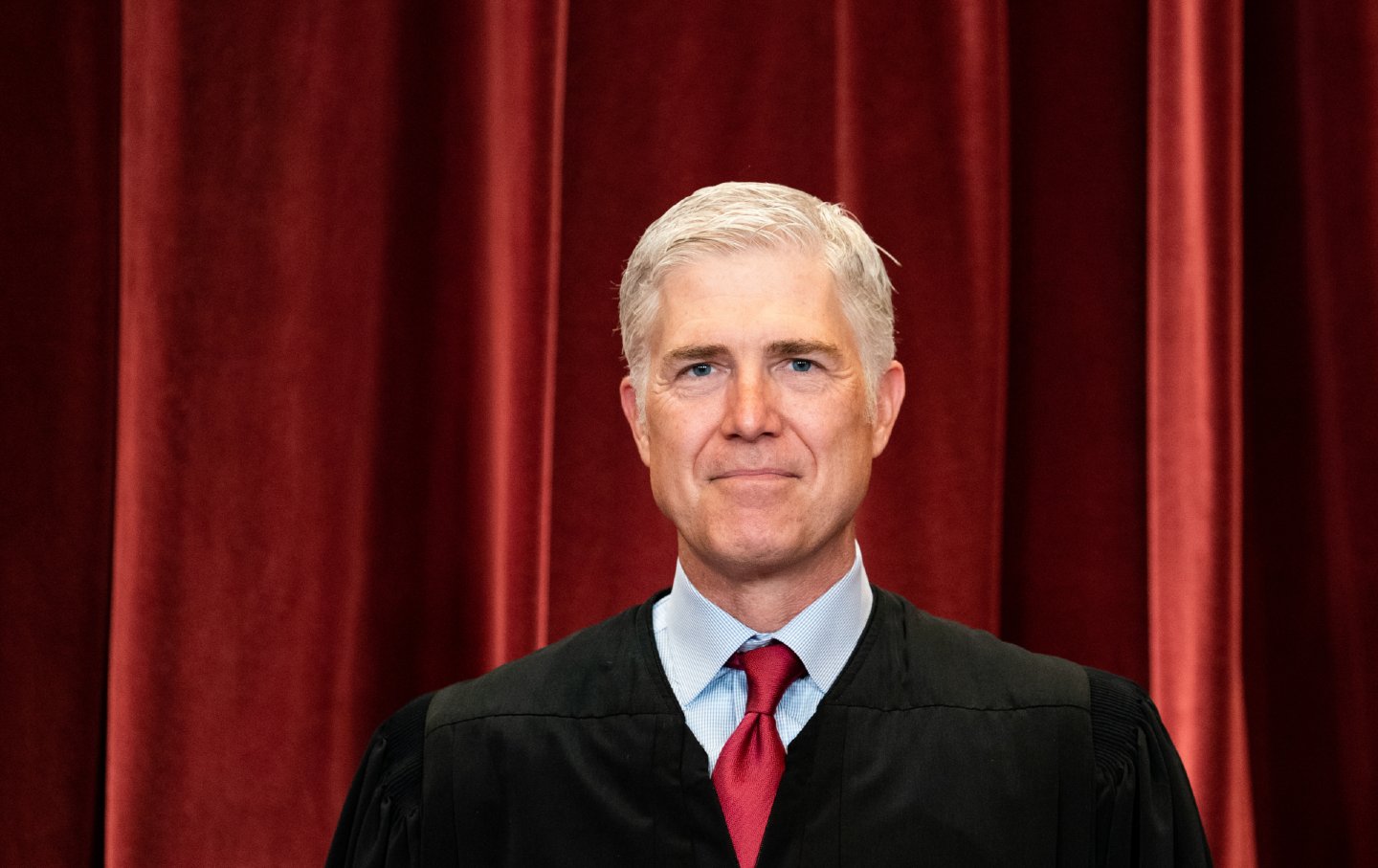
The Supreme Court Has a Serial Killer Problem The Supreme Court Has a Serial Killer Problem
In this week's Elie v. U.S., The Nation’s justice correspondent recaps a major death penalty case that came before the high court as well as the shenanigans of a man who’s angling...
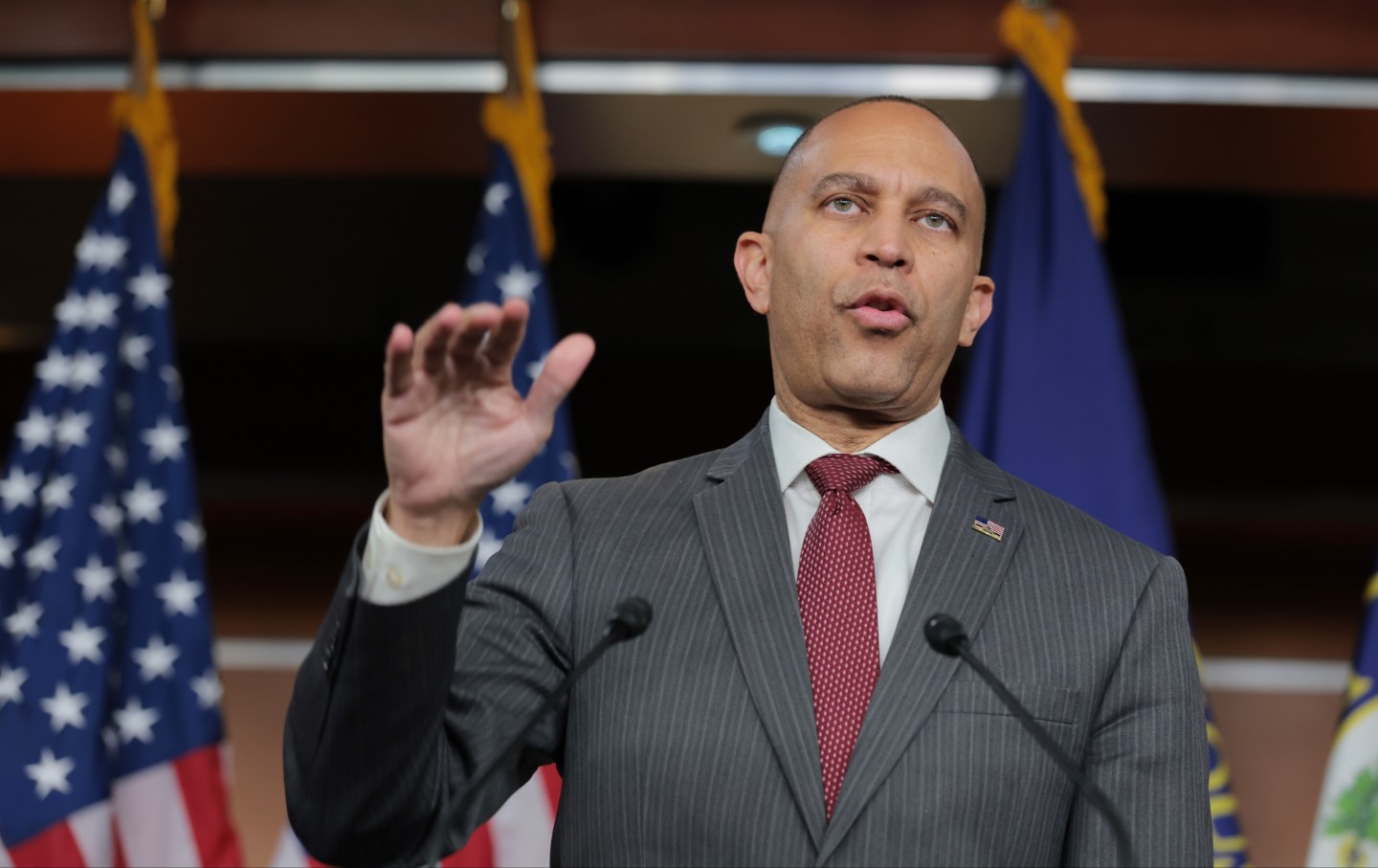
Corporate Democrats Are Foolishly Surrendering the AI Fight Corporate Democrats Are Foolishly Surrendering the AI Fight
Voters want the party to get tough on the industry. But Democratic leaders are following the money instead.
Marching Against a Corrupt Regime Marching Against a Corrupt Regime
People taking to the streets for democracy.
It Would Be Madness to Give Trump and His Toadies Even More Power It Would Be Madness to Give Trump and His Toadies Even More Power
And yet, that’s what the Supreme Court appears prepared to do.
Trump Is Dragging Republicans to Crushing Defeat After Crushing Defeat Trump Is Dragging Republicans to Crushing Defeat After Crushing Defeat
The president is deeply unpopular, his policies are failing, and Republicans are losing—everywhere.

