What Happens to American Healthcare After November?
While Trump’s platform is a serious threat, Harris’s remains uncertain.
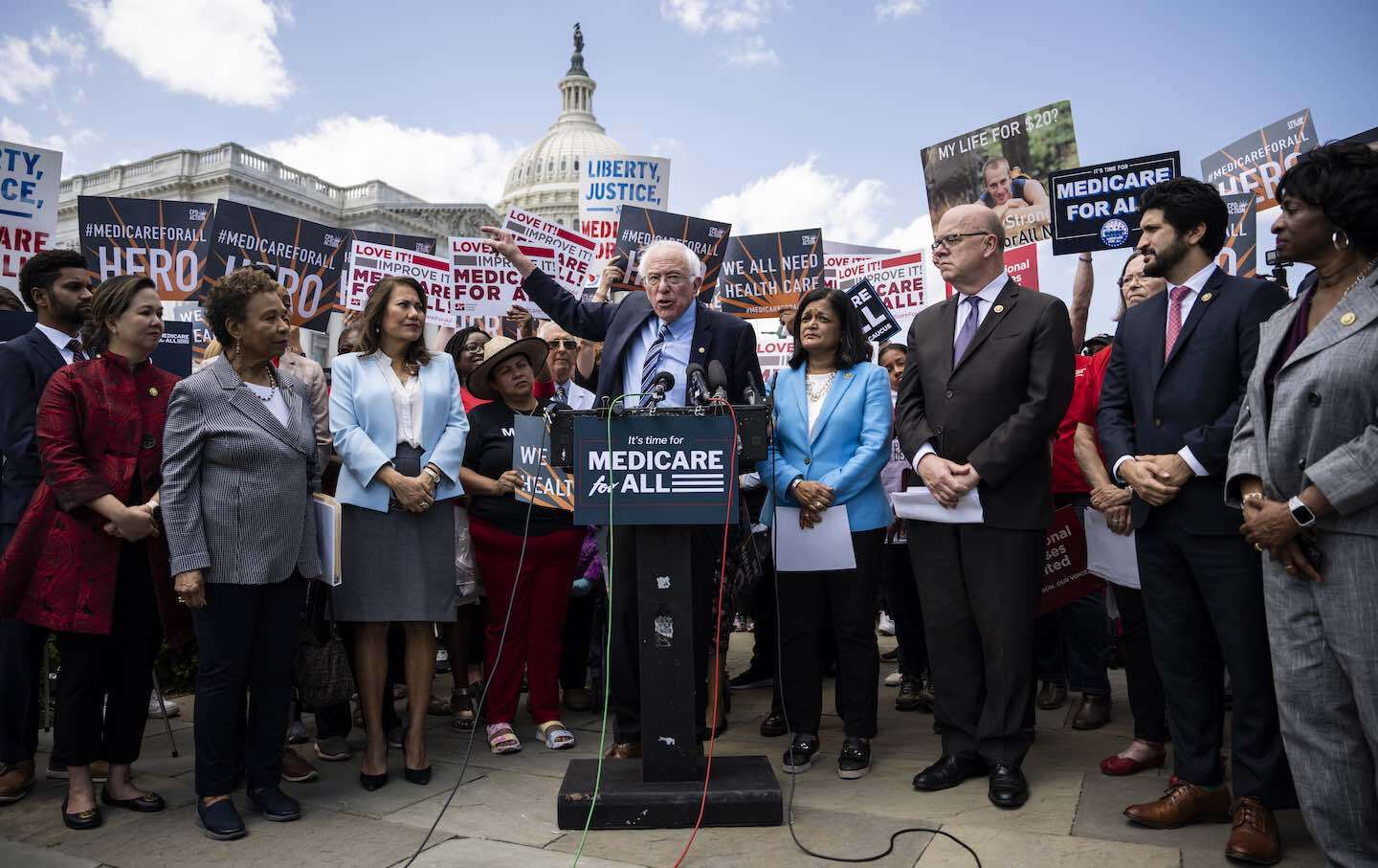
Senator Bernie Sanders (I-VT) speaks during a news conference with House Democrats to announce the reintroduction of the Medicare for All Act, outside the US Capitol on May 17, 2023, in Washington, DC.
(Drew Angerer / Getty Images)
President Biden’s exit from the Democratic ticket and Vice President Kamala Harris’s emergence as the presumptive nominee has, perhaps, escalated the stakes of the November election for healthcare. Trump’s schemes are, of course, unchanged: A unified Republican government could shred the nation’s healthcare safety net, accelerate the (ongoing) privatization of Medicare, and further restrict or even ban abortion nationwide. In contrast, like a second Biden administration would have, a Harris administration might mostly mean continuity—allowing her to consolidate some real gains (like Biden’s landmark Medicare drug negotiation reform) without confronting the broader injustices and galloping corporatization of US healthcare. But in some quarters, hopes are rising that a Harris administration could go a step beyond Biden—and even open the door to a progressive shift on health policy.
Harris has been to Biden’s left on abortion, supporting a measure in 2019 that would have gone beyond Roe by curtailing state-level abortion restrictions; she is also the first vice president to visit an abortion provider. As a California senator, she endorsed Senator Bernie Sanders’s landmark 2017 Medicare for All bill, a far more expansive reform than anything Biden has put his name on. Yet Harris backtracked on Medicare for All, and the political pressure her administration would face in any major reform effort from both right and center would be daunting, particularly without a powerful grassroots movement pushing the cause, once again, to center stage. Such a mobilization is precisely what we need regardless of the election’s outcome—to advance progressive reform if possible and to fight calamitous policies if necessary.
Forecasting the impact of a second Trump administration requires distinguishing his rhetoric from the reality of his rule. Recall that in the 2016 presidential primary, Trump ran on vaguely popularist promises to protect public health insurance programs, while maligning Obamacare and promising to replace it with something better. “They’re gonna cut Social Security, they’re gonna cut Medicare, they’re gonna cut Medicaid,” Trump said of his Republican primary competitors in 2015. “I’m the one saying that’s saying I’m not gonna do that!” He also famously accused pharmaceutical companies of “getting away with murder” in how they priced their products, causing pharma stocks to briefly tumble.
Given the popularity of Medicare and Social Security even among Republican voters, such claims may well have helped pave the road to the White House for Trump. But as we know, once in office, he governed as a hardened healthcare right-winger, joining congressional Republicans’ nearly successful campaign to dismember Medicaid and dismantle preexisting conditions protections. Even after the Obamacare repeal effort failed, Trump’s budgets continued to call for devastating Medicaid cuts.
A second Trump administration could well give us something of a rerun. As in the past, Trump continues to deride Obamacare, but his platform’s healthcare provisions are reminiscent of his prior popularist claims. “FIGHT FOR AND PROTECT SOCIAL SECURITY AND MEDICARE WITH NO CUTS,” it promises, along with nebulous words about competition and transparency and some virulent threats to “protect” Medicare from immigrants. But if history is any guide, once in office, Trump will again serve as a right-wing standard-bearer on healthcare. Indeed, though he has distanced himself from the Heritage Foundation’s Project 2025 blueprint, his administration’s actions seem more likely to be guided by this conservative wish list—whose contributors include numerous members of his last administration, including six cabinet secretaries—than by his hazy populism. The document calls for sweeping conservative change, including gutting cuts to Medicaid via block grants and lifetime caps on benefits (i.e., kicking people out of the program even if they remain poor) “to disincentivize permanent dependence.” The Center for American Progress estimated that as many as 18.6 million enrollees could be at risk of losing coverage if the latter provision were to become reality. Project 2025 also proposes making privatized Medicare Advantage the “default enrollment option” for seniors, which would no doubt be the death knell for public Medicare.
Yet if Trump’s designs seem plain as day, the meaning of a Harris administration for healthcare seems underdetermined. “We believe in a future…where every person has affordable health care,” Harris said at a recent speech, without further details. The party’s platform has yet to be released, and Harris’s prior stances on healthcare issues have varied significantly. Her aforementioned cosponsorship of Sanders’s 2017 Medicare for All bill was no small thing; the senator’s last single-payer bill prior to the 2017 bill was launched with precisely zero cosponsors. But the progressive energies unleashed by his campaign, years of single-payer activism, and the galvanizing effect of Trump’s ascent to the White House (along with his attack on Obamacare) brought not just Harris but a historic 16 senators on board for the 2017 bill. (Similarly, Representative Pramila Jayapal’s 2019 Medicare for All bill, reintroduced last year, was ultimately cosponsored by two-thirds of House Democrats.) Yet, after endorsing Sanders’s bill, Harris backtracked, putting out her own plan that would give insurance companies a major role in providing universal coverage—an approach many of us criticized at the time for its accommodation of corporate interests. On Wednesday, a Harris spokesperson told NBC News that “The VP will not push single payer as President.”
Those years were something of a high watermark for M4A: The arrival of the Covid pandemic and the end of the Democratic primaries saw the issue’s prominence fade. But as we look ahead to the November election, it’s critical to realize that the dynamics that drove it to the forefront of the national political discussion are no less pressing today. A Trump administration would cruelly degrade healthcare coverage for the sick and working class, while accelerating the corporate corruption of care. Yet, even without such a regressive shift, US healthcare remains deeply inequitable and under siege from corporate power: The number of uninsured fell during the pandemic but is predicted to rise 32.8 million by 2032; one in four adults go without needed medical care, and one in five without a prescription drug, because they cannot afford it; private equity firms are strip-mining the nation’s hospitals; private insurance companies are gobbling up Medicare; and vertically integrated insurer-pharmacy-provider behemoths like UnitedHealth are increasingly subordinating the healing mission of medicine to their corporate bottom lines.
Harris is no doubt aware of these issues: As attorney general of California, she helped block a merger between two massive insurance giants, and, though she backtracked, her endorsement of Medicare for All demonstrated that she was responsive to the progressive constituencies that mobilized behind it. A Trump victory, make no mistake, would be a deadly disaster for our nation’s health—and something we must be prepared to fight. But it is important to be clear-eyed about a Harris victory: It will be an opening if and only if a progressive grassroots movement is able, once again, to put real universal healthcare back on center stage.
NOTE: This story has been updated with a statement from a spokesperson for Vice President Harris.
Disobey authoritarians, support The Nation
Over the past year you’ve read Nation writers like Elie Mystal, Kaveh Akbar, John Nichols, Joan Walsh, Bryce Covert, Dave Zirin, Jeet Heer, Michael T. Klare, Katha Pollitt, Amy Littlefield, Gregg Gonsalves, and Sasha Abramsky take on the Trump family’s corruption, set the record straight about Robert F. Kennedy Jr.’s catastrophic Make America Healthy Again movement, survey the fallout and human cost of the DOGE wrecking ball, anticipate the Supreme Court’s dangerous antidemocratic rulings, and amplify successful tactics of resistance on the streets and in Congress.
We publish these stories because when members of our communities are being abducted, household debt is climbing, and AI data centers are causing water and electricity shortages, we have a duty as journalists to do all we can to inform the public.
In 2026, our aim is to do more than ever before—but we need your support to make that happen.
Through December 31, a generous donor will match all donations up to $75,000. That means that your contribution will be doubled, dollar for dollar. If we hit the full match, we’ll be starting 2026 with $150,000 to invest in the stories that impact real people’s lives—the kinds of stories that billionaire-owned, corporate-backed outlets aren’t covering.
With your support, our team will publish major stories that the president and his allies won’t want you to read. We’ll cover the emerging military-tech industrial complex and matters of war, peace, and surveillance, as well as the affordability crisis, hunger, housing, healthcare, the environment, attacks on reproductive rights, and much more. At the same time, we’ll imagine alternatives to Trumpian rule and uplift efforts to create a better world, here and now.
While your gift has twice the impact, I’m asking you to support The Nation with a donation today. You’ll empower the journalists, editors, and fact-checkers best equipped to hold this authoritarian administration to account.
I hope you won’t miss this moment—donate to The Nation today.
Onward,
Katrina vanden Heuvel
Editor and publisher, The Nation