
How Teaching Shaped Tim Walz’s Politics
From classrooms to campaign trails, the vice presidential nominee has continually drawn on his experience as an educator to influence his priorities in office.
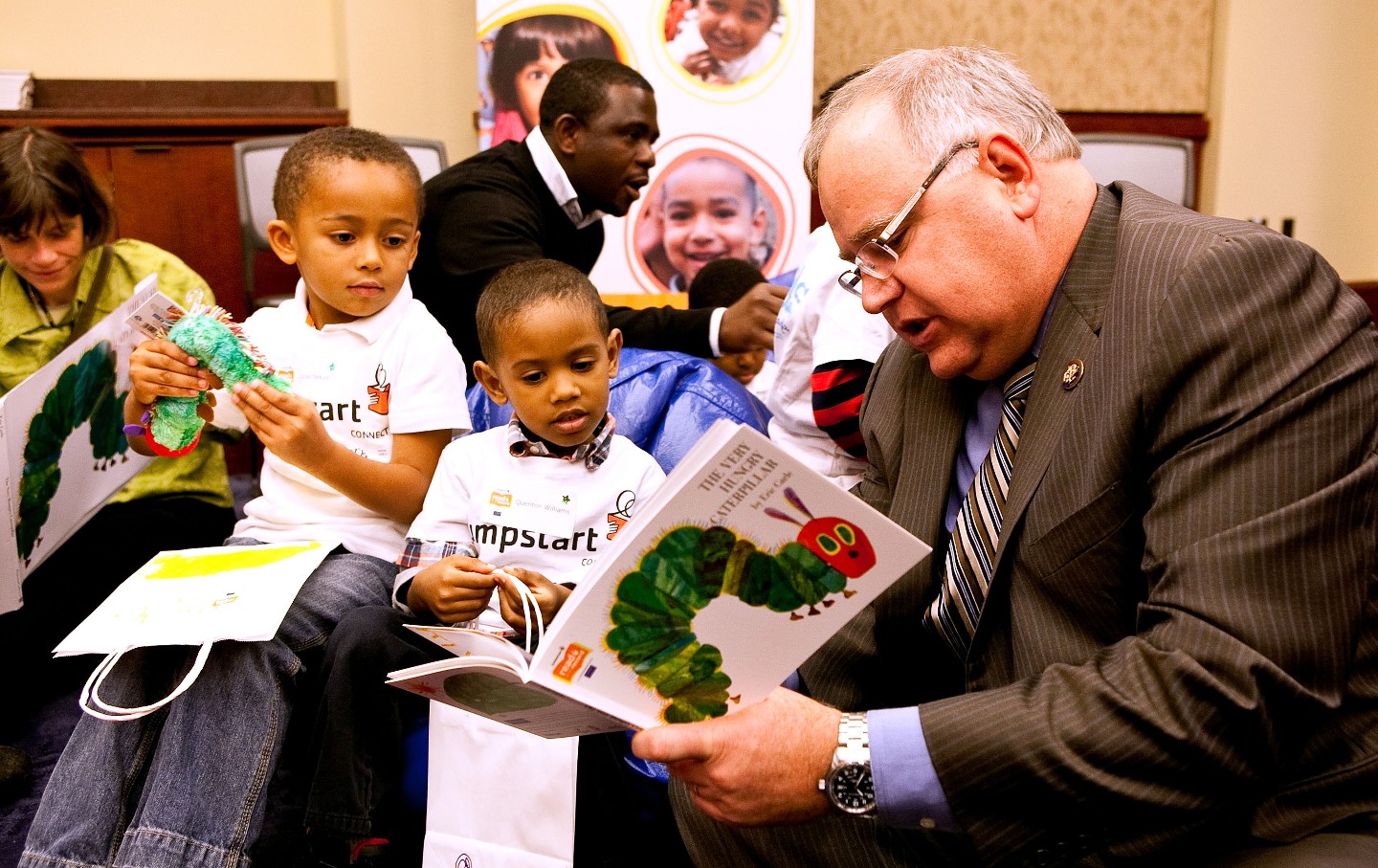
Then-Representative Tim Walz reads to children at Jumpstart’s “Read for the Record” at Capitol Hill in 2009.
(Paul Morigi / Getty)
On August 6, the newly minted Harris-Walz campaign raised $36 million in just 24 hours. The most common profession among these donors? Teachers.
Before entering politics, Tim Walz was known as Mr. Walz, a high school social studies and geography teacher. “It was my experience as a teacher and my passion for education that led me to run for governor,” the Minnesota Democrat said during his gubernatorial inaugural address in 2023, highlighting his two decades as an educator that fundamentally shaped his approach to politics.
After graduating from public university in 1989, Walz accepted a one-year position teaching high school in China. He then returned to his home state of Nebraska and met his wife, Gwen, a fellow educator. The couple married two years later before moving to Minnesota and accepting teaching positions at Mankato West High School, where Walz remained for 20 years.
When Noah Hobbs, one of Walz’s former students, received his school schedule in 2004, he looked at his slated classes and saw Walz listed as the instructor for his global geography class. “It was very well known that you wanted to have Walz,” Hobbs said in an interview with The Nation.
“I think I learned more about other countries and cultures in his class than I maybe did in any other,” Rachel Lohn Schuler, another former student of Walz, told The Nation. “His class taught me to think about other perspectives, other people on this planet, to think about other people’s experiences and how they walk through life.”
At MWHS, Walz became the first faculty adviser for the school’s Gay-Straight Alliance in 1999—just three years after Democratic President Bill Clinton signed a law that defined marriage as solely between a man and a woman. At the time, Walz said his leadership of the club sent a message of acceptance to the rest of the school. “It really needed to be the football coach, who was the soldier and was straight and was married,” he said during a 2018 interview with the Star Tribune.
Facing bullying because of his sexuality, Jacob Reitan, the first openly gay student at MWHS, established the school’s first GSA in tandem with Tim and Gwen Walz. “The ’90s was a time when the word ‘gay’ meant stupid,” he said on CNN, and called the support Tim and Gwen offered “important.”
In 2004, Walz took some of his students to a rally for then-President George W. Bush’s campaign. When attempting to enter the event, some of his students were questioned by security after seeing a sticker for Bush’s opponent, John Kerry, on one of the student’s wallets.
Frustrated with what he saw as intensifying division in American politics, Walz began to volunteer for the Kerry campaign. The next year, he made a bold move: He would run for Congress as a Democrat in a district held by a Republican incumbent seeking reelection.
His motivation was rooted in his time in education: “It was my students,” Walz said at his first campaign rally alongside Harris. “They encouraged me to run for office.”
Over the course of his congressional run, the teacher in him never relented. Three of the most senior roles in his campaign—the communications, finance, and political directors—all attended MWHS, according to Minnesota Public Radio. When he won what was widely seen as one of the largest political upsets of the 2006 election cycle, his students were in the front row during his victory speech, and he thanked them for the youthful energy and optimism that propelled him across the finish line. His first stop the day after the election was the place that inspired him to run in the first place: Mankato West High School.
On Capitol Hill, Walz focused predominantly on veteran’s issues as he served as the highest-ranking Democrat on the House Veterans Affairs Committee, but he still maintained close ties with the school. During his first term, he returned to speak to some of his former students at MWHS, including Hobbs. “It was the first Wednesday of the month. And so in Minnesota, on the first Wednesday of the month at one o’clock, the tornado sirens go off,” Hobbs recalled. While huddled in the basement with now-Representative Walz, Hobbs said, “you could just feel his energy. He loved being back, and we loved having him back.”
In 2018, after six terms in the House, he ran to be Minnesota’s governor. A focal point of his campaign platform was increasing funding for public education, often declaring that “we must make Minnesota the ‘Education State’ for all children.”
“Education is the great equalizer of society. Education unleashes untapped potential. Education conjures the magic of promising beginnings and the grace of second chances,” he said.
After being elected governor, Walz brought many of his legislative dreams to reality. With the help of the Minnesota legislature, Walz signed bills that implemented universal free breakfasts and lunches for school children, mandated free menstrual supplies in nearly all school bathrooms, prohibited book bans, allocated $2.3 billion in education funding (the largest in the state’s history), guaranteed free tuition at public state universities for those from households making less than $80,000 per year, earmarked $8 million in statewide teacher mentorship grants, and expanded loan repayment programs for teachers.
Perhaps his proudest legislative accomplishment was the marked increase in public school funding—a move that he consistently boasts of while campaigning. Minnesota Republicans criticized the decision, claiming that it would expand state bureaucracy without improving school performance.
This increase in funding has also been used to provide universal meals for students.“As a former teacher, I know that providing free breakfast and lunch for our students is one of the best investments we can make to lower costs, support Minnesota’s working families, and care for our young learners and the future of our state,” Walz said when signing the bill guaranteeing universal meals into law. The most memorable moment from the event was captured in a viral photo that showed dozens of school children embracing Walz, with a wide smile across his face.
Popular
“swipe left below to view more authors”Swipe →Minnesota State Representative Laurie Pryor, who serves as the House’s Chair of the Education Policy Committee, said that Walz’s office isn’t one that clings to formality, adding that he prioritized the mentality of “show up and work, and you get the job done.” Pryor has worked closely with Walz’s office to pass early childhood education expansion. “Tim and his team have been a part of all of our conversations,” said fellow Minnesota State Representative Josiah Hill. “Tim is intimately involved. He’s deeply interested and clearly understands the issues.” Denise Specht, the president of the union Education Minnesota, echoed this, saying, “I think that that’s one of the things that I appreciate most about the governor: the spirit of collaboration. He listens to others and he really does take a team approach.”
Specht recalled a funding fight during Walz’s first term, when the Republican Senate majority leader prioritized school vouchers, allowing parents to use the public funding set aside for their child’s education at a private school. Critics of school vouchers argue that they take funding away from public education institutions. In the final leg of the negotiations, Walz stood fast against it, a move appreciated by Specht and her members. “That’s one of the things that I will really remember the most.”
President of the National Education Association Rebecca Pringle singled out Walz’s assistance during the Covid-19 pandemic, saying he “worked collaboratively with our union to provide the resources and safety measures,” as well as vaccinations. During the pandemic, Pringle said it was not a question whether “this country has the wealth to ensure that every student succeeds” but “whether we have the will. And Governor Walz had the will.”
As governor, Walz continued to nurture his connections with former students. Hobbs, who later became a city councillor, started an initiative where he aimed to have a 100 cups of coffee with 100 of his constituents. For Hobbs’s final cup of coffee, Walz drove up from St. Paul to join him. “We talked about how life is as a governor, and now me, as an adult, from having been a teenager and now a councilor,” said Hobbs. “We had an hour-long coffee, kind of just reconnecting.”
In late July, as Harris searched for a running mate, Walz’s on-air auditions for the position continually made references to his background in teaching. He used it to draw contrast with Trump, asserting that the former president “likes to demonize public education, but as someone who learned and taught in rural schools, I know that public schools are the heart of small towns.” Responding to online trolling insulting his appearance, he said that he “supervised the lunchroom for 20 years. You do not leave that job with a full head of hair. Trust me.”
On August 6, Walz accepted Harris’s offer to join her on the ticket.
Hobbs said he was eating breakfast when he learned that Walz was named as Harris’s running mate. Running up the stairs, Hobbs shouted to his wife, “It’s Tim! It’s Tim!” Schuler began telling her coworkers, “That’s my high school teacher!” Some former students of Mankato West High have even started a new group rooted in their shared identity: “Alumni for Harris-Walz.”
“I’m just smiling because with all the challenges we have in this moment, from separation of church and state, from looking at our Constitution and interpreting it, from the three branches of government, from civic duty and responsibility—these are the things that he talked about and taught about,” said Pringle. “How more perfect could it be than a social studies teacher as a vice president of the United States?”
Pryor attended a neighborhood dinner the night Walz was nominated, talking with neighbors from across the political spectrum. She said all of them were “excited.”
“It’s the talk of the town right now,” Hobbs said.
Even after he was named the Democratic nominee for vice president, his students were front and center in his mind, according to Pringle, who spoke with Walz shortly after he was selected. “He is as excited as the rest of us that he has this opportunity,” she said. “And he doesn’t see it as an opportunity for himself. He sees it as an opportunity for his students and for his fellow educators.”
“People have been posting pictures on their social media of them with the governor,” Specht said of her union members. “It definitely shows who he is: approachable.” Pryor has been asked whether Walz has undergone “a transformation” into the affable figure now alongside Harris. “No, this is the Tim Walz that we know in Minnesota,” she responds. Among the former students The Nation spoke with, each of them said the same thing: the Tim Walz on the national stage is the same one they’ve seen for years. “He’ll forever be known to me as Mr. Walz,” said Hobbs, “my favorite high school teacher.”
Disobey authoritarians, support The Nation
Over the past year you’ve read Nation writers like Elie Mystal, Kaveh Akbar, John Nichols, Joan Walsh, Bryce Covert, Dave Zirin, Jeet Heer, Michael T. Klare, Katha Pollitt, Amy Littlefield, Gregg Gonsalves, and Sasha Abramsky take on the Trump family’s corruption, set the record straight about Robert F. Kennedy Jr.’s catastrophic Make America Healthy Again movement, survey the fallout and human cost of the DOGE wrecking ball, anticipate the Supreme Court’s dangerous antidemocratic rulings, and amplify successful tactics of resistance on the streets and in Congress.
We publish these stories because when members of our communities are being abducted, household debt is climbing, and AI data centers are causing water and electricity shortages, we have a duty as journalists to do all we can to inform the public.
In 2026, our aim is to do more than ever before—but we need your support to make that happen.
Through December 31, a generous donor will match all donations up to $75,000. That means that your contribution will be doubled, dollar for dollar. If we hit the full match, we’ll be starting 2026 with $150,000 to invest in the stories that impact real people’s lives—the kinds of stories that billionaire-owned, corporate-backed outlets aren’t covering.
With your support, our team will publish major stories that the president and his allies won’t want you to read. We’ll cover the emerging military-tech industrial complex and matters of war, peace, and surveillance, as well as the affordability crisis, hunger, housing, healthcare, the environment, attacks on reproductive rights, and much more. At the same time, we’ll imagine alternatives to Trumpian rule and uplift efforts to create a better world, here and now.
While your gift has twice the impact, I’m asking you to support The Nation with a donation today. You’ll empower the journalists, editors, and fact-checkers best equipped to hold this authoritarian administration to account.
I hope you won’t miss this moment—donate to The Nation today.
Onward,
Katrina vanden Heuvel
Editor and publisher, The Nation
More from The Nation

The Supreme Court Has a Serial Killer Problem The Supreme Court Has a Serial Killer Problem
In this week's Elie v. U.S., The Nation’s justice correspondent recaps a major death penalty case that came before the high court as well as the shenanigans of a man who’s angling...
Corporate Democrats Are Foolishly Surrendering the AI Fight Corporate Democrats Are Foolishly Surrendering the AI Fight
Voters want the party to get tough on the industry. But Democratic leaders are following the money instead.

Marching Against a Corrupt Regime Marching Against a Corrupt Regime
People taking to the streets for democracy.
It Would Be Madness to Give Trump and His Toadies Even More Power It Would Be Madness to Give Trump and His Toadies Even More Power
And yet, that’s what the Supreme Court appears prepared to do.
Trump Is Dragging Republicans to Crushing Defeat After Crushing Defeat Trump Is Dragging Republicans to Crushing Defeat After Crushing Defeat
The president is deeply unpopular, his policies are failing, and Republicans are losing—everywhere.


