Palestinian Exclusion Shows the Limits of Kamala Harris’s Politics of Joy
The Democratic convention’s giddy vibe shift is shadowed by ongoing war and a failure to hear Palestinian voices.
This year’s Democratic National Convention is more likely to be remembered for its giddy mood than for any memorable turns of phrase or innovative policy ideas. Democrats have been on an emotional high ever since Joe Biden withdrew his presidential bid and Kamala Harris was elevated as the party’s presumptive nominee. Suddenly, all the anxiety of the last year—much of it based on a realistic fear that Biden was not up to the job of defeating Donald Trump—evaporated, practically overnight. Biden in the last few months had rapidly lost his ability to speak clearly, so that, even before his disastrous debate with Trump on June 28, it was often painful to watch Biden, since he was so clearly struggling with his words. At least that was my experience—and I don’t think I was alone in this. With every public appearance, Biden seemed less and less a leader. Instead, he became a walking memento mori—a disturbing reminder of the frailty of our existence.
If Biden was clearly in the twilight of his life, Harris had the full spark of youth in her gait and persona. She was vivacious, engaged, quick to laugh, and clearly someone who enjoyed the gift of existence. This feeling of revitalization was reinforced when she picked as her running mate Minnesota Governor Tim Walz, a hearty man quick to make amusing jabs at Republicans.
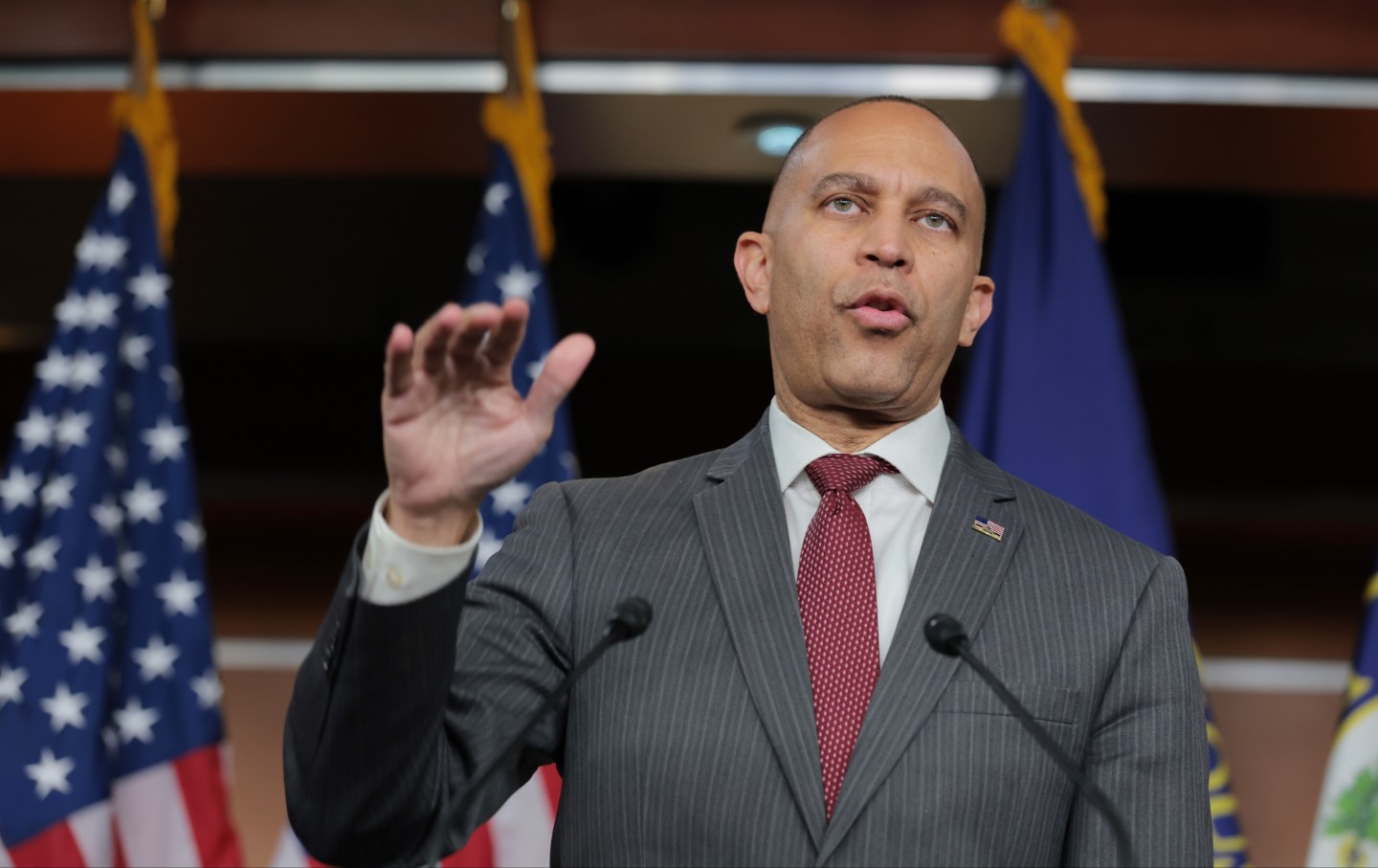
The theme of “joy” has been repeatedly brought up during the DNC. Doug Emhoff, Harris’s spouse, described her as a “joyful warrior.” Hakeem Jeffries, the House minority leader, quoted the Book of Psalms, which teaches that “weeping may endure during the long night, but joy will come in the morning.” Jeffries promised that working to elect Harris will ensure that “joy, joy, joy comes in the morning.” Former president Bill Clinton, although nearly as ravaged by age as Biden and Trump, got caught up in the mood of the convention and said he also wanted “an America that is more joyful, more inclusive, more future-focused.”
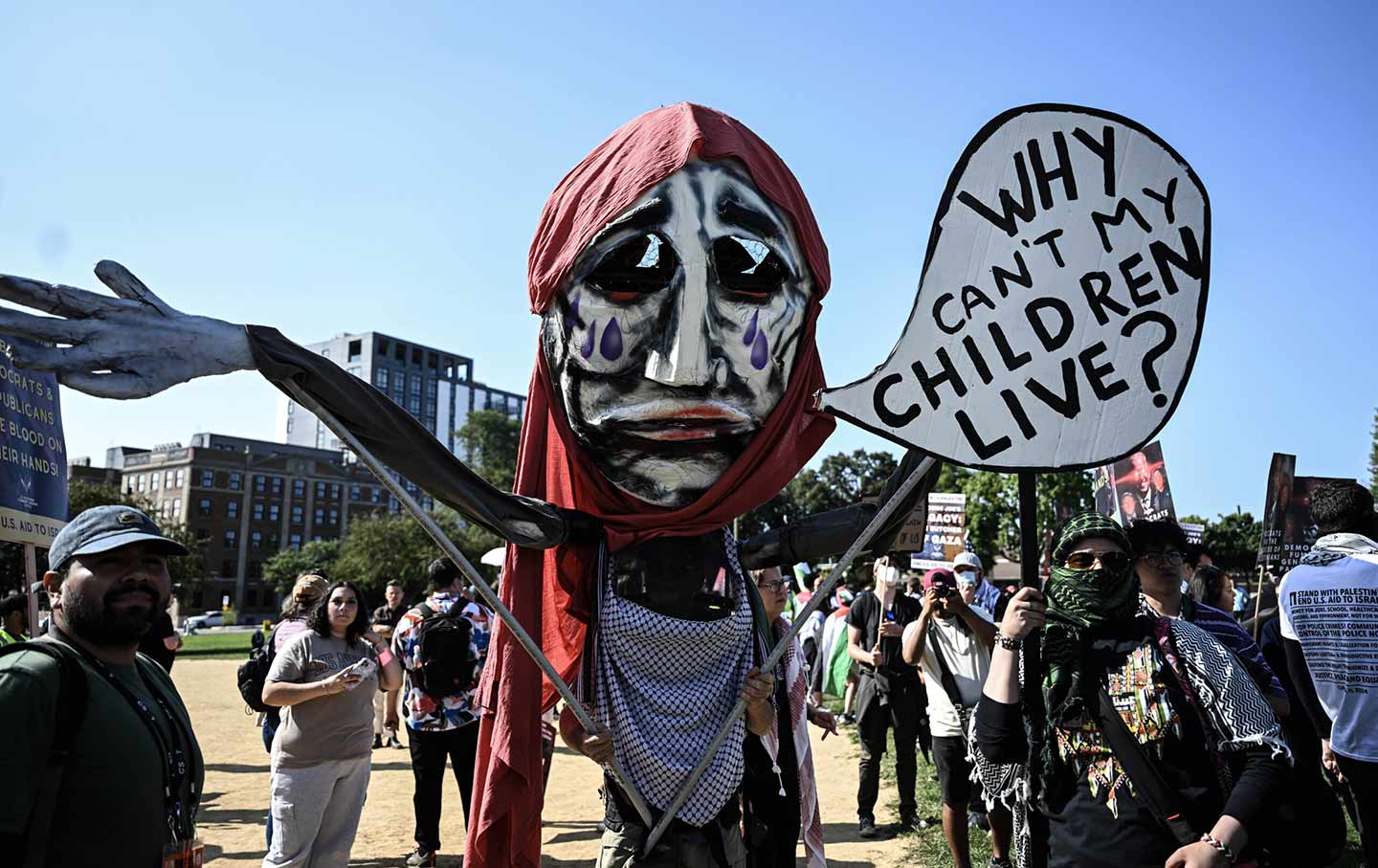
But it’s hard to take this joyful mood seriously when it is based on a denial of the ongoing Israeli assault on Gaza, which has seen at least 40,000 people, mostly civilians, killed. (That figure is a very conservative estimate, and there are grounds to think causalities could be three or four times higher). This horrific war is being funded by the United States, which is giving full diplomatic protection to the Israeli government even as international organizations offer credible evidence of ongoing systematic war crimes. Within the sheltered precincts of the DNC, doctors who had recently been in Gaza offered testimony of soul crushing war crimes.
So far, the Harris campaign has failed to give any evidence that she plans to change Biden’s “bear hug” strategy of unconditional support for Israel, which has enabled this ongoing carnage. Further, the DNC is excluding any Palestinian voices from the stage.
Writing in Vanity Fair on Wednesday, the noted essayist Ta-Nehisi Coates acutely observed that although the Democrats are otherwise proud of showcasing their diversity, the party draws the line at Palestinian-Americans:
At some point during the first evening of the Democratic National Convention, somewhere between the land acknowledgements and the Jesse Jackson tribute, it occurred to me how relatively few white people I was seeing on the program. They were there, of course, and by the end of the night, white speakers seemed, if not a majority, then at least a plurality. I don’t know if that first day looked like America, but it certainly looked like what people who use the phrase “look like America” imagine the country to be. A wave of edgy jokes flooded my various group chats. I was happy to contribute, but the truth is I’m a lover not a fighter, and thus sincerely believe in the meaning of the symbolic as something beyond cynical political manipulation. In the case of the DNC, the symbols communicated the breadth of the Democratic Party’s coalition, as well as its limits. Perhaps that’s why I’ve spent the past two days sweating the one major omission of the party that claims diversity as its strength.
The host city for the DNC is Chicago, whose metro area is home to more Palestinian Americans than anywhere else in the country. But you would not know this looking at that stage. Despite the appeals of Palestinian American delegates and activists, no Palestinian American is scheduled to address the convention from the main stage.
On Wednesday, the issue of Palestinian exclusion started to boil over, as members of the Uncommitted National Movement staged a sit-in demanding one Palestinian speaker. They were even willing to have that speaker’s words be vetted. But the Harris campaign is resisting even this very modest request.
Commenting on the exclusion of Palestinians, Mehdi Hasan of Zeteo News, noted, “There are plenty of Dem delegates at this Convention here in Chicago who I am sure support an arms embargo and are against what’s happening in Gaza BUT they don’t want it to get in the way of pro-Kamala party atmosphere. It’s an inconvenient genocide.” Representative Rashida Tlaib offered an even pithier summary: “To hear what we’ve done to generations of families shatters the false narrative of hope and joy.”
The current politics of joy are a specific response to a contingent series of events: Biden’s diminished presence created a feeling of dread, as a winnable election looked like it was doomed. Then the party was rapidly able to mobilize to switch Biden for Harris, with a quick consensus forming in support of her. This emotional whiplash led to joy.
But that joy will inevitably be transitory, since elections are about not just mood but also actual policy, which is a contentious matter. The shadow cast by Gaza on the DNC is an early sign that the Democrats have to start getting serious about politics. Joy can’t be used to evade the hard tasks ahead—including the job of moving beyond Biden’s failed Middle East policy.
Disobey authoritarians, support The Nation
Over the past year you’ve read Nation writers like Elie Mystal, Kaveh Akbar, John Nichols, Joan Walsh, Bryce Covert, Dave Zirin, Jeet Heer, Michael T. Klare, Katha Pollitt, Amy Littlefield, Gregg Gonsalves, and Sasha Abramsky take on the Trump family’s corruption, set the record straight about Robert F. Kennedy Jr.’s catastrophic Make America Healthy Again movement, survey the fallout and human cost of the DOGE wrecking ball, anticipate the Supreme Court’s dangerous antidemocratic rulings, and amplify successful tactics of resistance on the streets and in Congress.
We publish these stories because when members of our communities are being abducted, household debt is climbing, and AI data centers are causing water and electricity shortages, we have a duty as journalists to do all we can to inform the public.
In 2026, our aim is to do more than ever before—but we need your support to make that happen.
Through December 31, a generous donor will match all donations up to $75,000. That means that your contribution will be doubled, dollar for dollar. If we hit the full match, we’ll be starting 2026 with $150,000 to invest in the stories that impact real people’s lives—the kinds of stories that billionaire-owned, corporate-backed outlets aren’t covering.
With your support, our team will publish major stories that the president and his allies won’t want you to read. We’ll cover the emerging military-tech industrial complex and matters of war, peace, and surveillance, as well as the affordability crisis, hunger, housing, healthcare, the environment, attacks on reproductive rights, and much more. At the same time, we’ll imagine alternatives to Trumpian rule and uplift efforts to create a better world, here and now.
While your gift has twice the impact, I’m asking you to support The Nation with a donation today. You’ll empower the journalists, editors, and fact-checkers best equipped to hold this authoritarian administration to account.
I hope you won’t miss this moment—donate to The Nation today.
Onward,
Katrina vanden Heuvel
Editor and publisher, The Nation