
The Fight for a Higher Minimum Wage Continues in 2024
With the federal minimum wage stagnant for over 15 years, voters in Alaska, California, Missouri, and Massachusetts will decide on ballot measures to raise their wages.
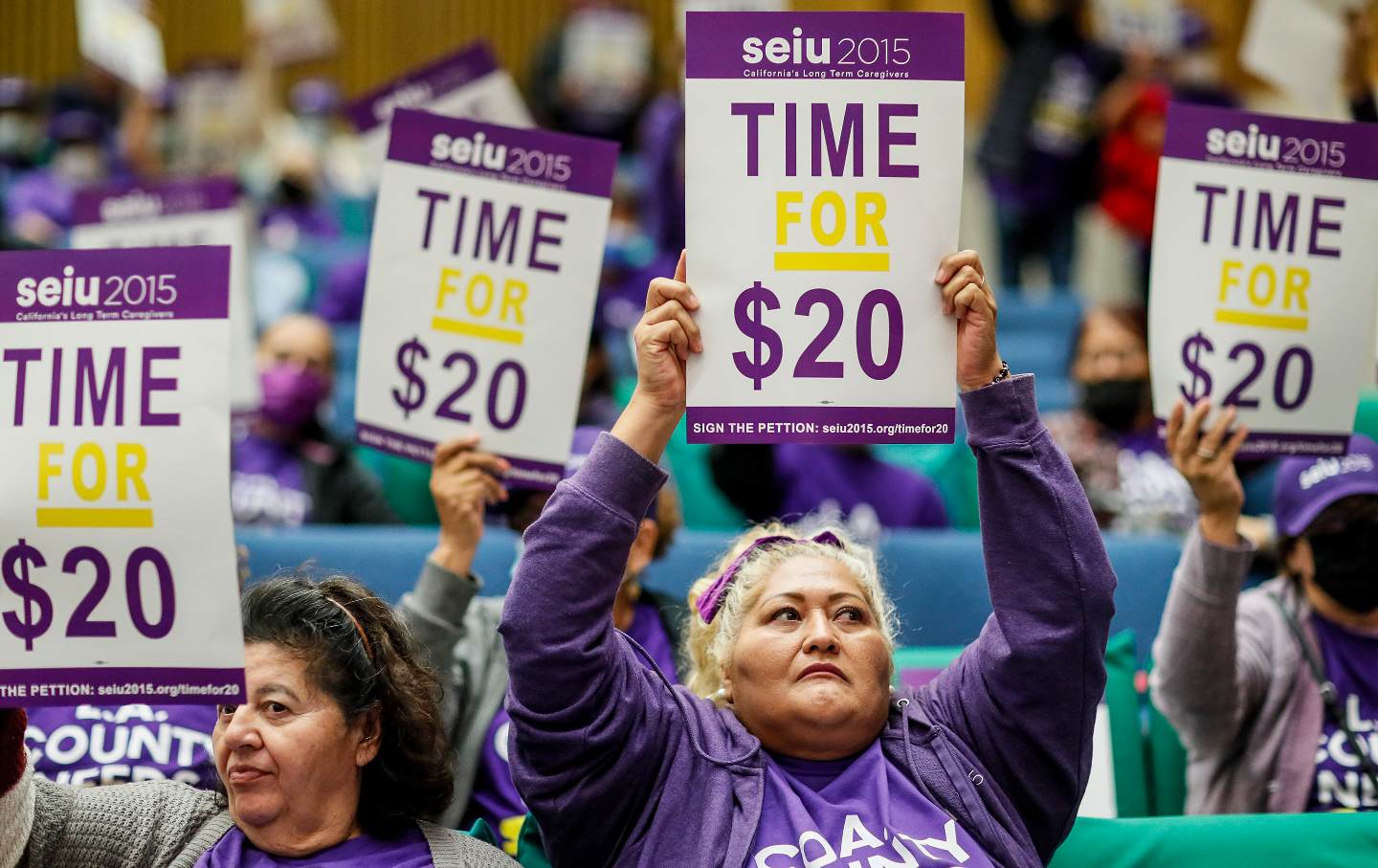
Protesters at a meeting of the Los Angeles County Board of Supervisors calling for increased pay.
(Robert Gauthier / Getty)
On July 24, 2009, Congress set the federal minimum wage to $7.25 an hour. It has not been raised since.
Because wages are not pegged to inflation, minimum-wage workers across the United States often find their purchasing power reduced year after year, and a wage that was “livable” in 2009 is not nearly enough to get by on in 2024. Earlier this month, vice president Kamala Harris advocated for increasing the minimum wage to $15 an hour during an interview with NBC, calling the current rate “poverty wages.”
This November, voters in Alaska, California, Missouri, and Massachusetts will decide on ballot measures to create higher minimum wages in their states. Between 1996 and 2023, there were 28 ballot measures across the country that proposed raising the minimum wage, and only two were voted down.
In California, Proposition 32 would set the state minimum wage to $18 an hour—making it the highest statewide minimum wage in the US. In its endorsement of Prop 32, the San Francisco Chronicle editorial board noted that $18 an hour, while “still below the cost of living in the state’s cheapest county,” would nevertheless be a step in the right direction.
“Restaurant workers, delivery workers, homecare workers are just some of the more than 2 million workers who will benefit from Prop 32,” wrote the “Yes On Proposition 32” group backing the initiative. “People who work full-time should get paid enough to live on and not have to take on second and third jobs just to keep a roof over their heads and feed their families.”
Joe Sanberg, an entrepreneur in Los Angeles and the committee’s top funder, emphasized the urgency of an increase in an interview with NBC. “Millions of Californians are working more than full-time and still can’t afford life’s basic needs,” he said. “We need to fix that—and in fixing that and raising the wage, create economic prosperity that lifts the tide for all Californians.”
In Massachusetts, voters will also consider additional wage protections for tipped workers. Traditionally, these workers rely on tips to supplement the minimum wage, which can lead to deductions from their paychecks. Question 5 would ensure that tipped workers receive the state minimum wage of $15 an hour—in addition to any tips earned—and introduce a gradual wage increase for tipped workers.
One Fair Wage plus Tips MA is leading the initiative, noting the decline in workers in the state’s restaurant industry. “Thousands of tipped workers in Massachusetts are leaving the restaurant industry and are not willing to return without One Fair Wage, and nearly 250 Massachusetts employers are now paying One Fair Wage to recruit staff and seek a level playing field.”
Missouri and Alaska are also voting on initiatives that would push the minimum wage to $15 an hour. The referendum would also stipulate required paid sick leave for workers, which was previously at the discretion of individual employers.
Alaska’s Ballot Measure 1 is in the tradition of a long history of progressive workplace laws in the state. After being the first state to pass a minimum wage higher than the federal requirement, Alaska maintained the highest rate for more than 30 years. Along with raising the minimum wage, the measure would also forbid employers from forcing employees to participate in meetings about religion and politics unrelated to their jobs.
In Missouri, Proposition A would require employers to provide one hour of paid sick leave for every 30 hours worked and raise the wage to $15 an hour by 2026. The last time the wage was increased in Missouri was in 2018 with Proposition B,which passed with over 62 percent of the vote.
“As a working parent myself, I understand what it means when my kid gets sick, and I have to call in and wonder what that means for my job and my security,” said Missouri state Representative Crystal Quade during a gubernatorial debate in September sponsored by the Missouri Press Association. “I’ve had good jobs, but not everybody has that affordability where their employer is flexible with them.”
Read the rest of StudentNation’s dispatches on the 2024 election here.
Disobey authoritarians, support The Nation
Over the past year you’ve read Nation writers like Elie Mystal, Kaveh Akbar, John Nichols, Joan Walsh, Bryce Covert, Dave Zirin, Jeet Heer, Michael T. Klare, Katha Pollitt, Amy Littlefield, Gregg Gonsalves, and Sasha Abramsky take on the Trump family’s corruption, set the record straight about Robert F. Kennedy Jr.’s catastrophic Make America Healthy Again movement, survey the fallout and human cost of the DOGE wrecking ball, anticipate the Supreme Court’s dangerous antidemocratic rulings, and amplify successful tactics of resistance on the streets and in Congress.
We publish these stories because when members of our communities are being abducted, household debt is climbing, and AI data centers are causing water and electricity shortages, we have a duty as journalists to do all we can to inform the public.
In 2026, our aim is to do more than ever before—but we need your support to make that happen.
Through December 31, a generous donor will match all donations up to $75,000. That means that your contribution will be doubled, dollar for dollar. If we hit the full match, we’ll be starting 2026 with $150,000 to invest in the stories that impact real people’s lives—the kinds of stories that billionaire-owned, corporate-backed outlets aren’t covering.
With your support, our team will publish major stories that the president and his allies won’t want you to read. We’ll cover the emerging military-tech industrial complex and matters of war, peace, and surveillance, as well as the affordability crisis, hunger, housing, healthcare, the environment, attacks on reproductive rights, and much more. At the same time, we’ll imagine alternatives to Trumpian rule and uplift efforts to create a better world, here and now.
While your gift has twice the impact, I’m asking you to support The Nation with a donation today. You’ll empower the journalists, editors, and fact-checkers best equipped to hold this authoritarian administration to account.
I hope you won’t miss this moment—donate to The Nation today.
Onward,
Katrina vanden Heuvel
Editor and publisher, The Nation
More from The Nation
The Supreme Court Has a Serial Killer Problem The Supreme Court Has a Serial Killer Problem
In this week's Elie v. U.S., The Nation’s justice correspondent recaps a major death penalty case that came before the high court as well as the shenanigans of a man who’s angling...
Corporate Democrats Are Foolishly Surrendering the AI Fight Corporate Democrats Are Foolishly Surrendering the AI Fight
Voters want the party to get tough on the industry. But Democratic leaders are following the money instead.
Marching Against a Corrupt Regime Marching Against a Corrupt Regime
People taking to the streets for democracy.
It Would Be Madness to Give Trump and His Toadies Even More Power It Would Be Madness to Give Trump and His Toadies Even More Power
And yet, that’s what the Supreme Court appears prepared to do.
Trump Is Dragging Republicans to Crushing Defeat After Crushing Defeat Trump Is Dragging Republicans to Crushing Defeat After Crushing Defeat
The president is deeply unpopular, his policies are failing, and Republicans are losing—everywhere.

