DEI Was Never Going to Save Us
Trump’s racist attacks on diversity initiatives must be resisted—but that shouldn’t prevent an honest conversation about the limits of what DEI can actually achieve.

Donald Trump’s baseless attacks on diversity, equity, and inclusion (DEI) programs in the wake of the catastrophic midair collision that killed dozens of people in late January capped off a chaotic, and caustic, start to the president’s second term.
The comments—in which Trump claimed, with no evidence, that diversity initiatives might have contributed to the crash—followed a series of anti-DEI executive orders that the president rolled out in the first few days of his return to the White House. Among other provisions, the orders overturn affirmative action regulations and empower the DOJ to identify (and likely investigate) publicly traded corporations and other private industries, including legal and medical associations, that continue “egregious” DEI practices.
This hostility to diversity programs is nothing new; after all, much of the right has been itching to resegregate America ever since Brown v. Board of Education, and policies like affirmative action were already dead or on life support thanks to decades-long efforts from conservative politicians and judges. But Trump’s targeting of DEI is a particularly direct attack—one that serves many political purposes.
For one, the focus on DEI provides an energizing boogeyman for the GOP base, like the attacks on critical race theory and “wokeness” in recent years and affirmative action and “political correctness” before that. It also gives legal cover to employers and industries that discriminate against Black, Latino, and women job applicants. In addition, by overturning affirmative action regulations, DEI bans limit the real, material progress of non-white men in the workforce and in higher education.
Implicit in the Republican project is that white men have suffered primarily because of an increasingly diverse population and job market, and there’s only so much prosperity that can go around. Right-wing attacks are an attempt to keep us (including myself, a Black woman) in our rightful place, rolling back the clock to a Jim Crow era when discrimination was legal in the United States, it was socially acceptable for majority-white spaces to be antagonistic to non-white people, and material progress was limited for people of color. No one with a sense of justice wants that.
Yet even as we rightly condemn this patently racist right-wing agenda, that shouldn’t prevent us from taking a hard look at what DEI has and has not achieved.
There’s a sound argument that, even with all its limits, having DEI, at least in some sectors, is better than not having it. The lack of diversity in some historically anti-Black professional service industries, like law and medicine, could mean life or death for Black men and women who are unfairly subject to capital punishment and are more likely to die from pregnancy, with racial bias among lawyers, judges, and doctors often a contributing factor.
But civil rights advocates know that, while DEI, and affirmative action more broadly, is a tool that could give groups who have been subjected to America’s racism and sexism a fair shot at being successful (and, in some cases, staying alive), it is not a panacea that should be defended uncritically. We can’t avoid the reality of many diversity initiatives, particularly in corporate America: they often allow institutions to performatively support “equity” with little substance behind it, advancing a nominal percentage of Black, women, and Latino professionals while working-class peers continue to be left behind by exploitative corporate practices.
Despite the Republican fearmongering around the term, DEI is a relatively modern phrase for long-standing diversity practices in American institutions. There are instances of the term in academia in the 2000s, when predominantly white colleges and universities created offices of Diversity, Equity, and Inclusion.
These schools weren’t catering to unqualified students and professors. They were attempting to address historical practices that frequently excluded qualified Black applicants and other marginalized groups. They offered programs and support for students, staffers, and academics who may have felt adrift in a sea of “good ol’ boy” social networks, legacy admissions, and underqualified student-athletes that make professional jobs, leadership positions, and higher education at elite schools disproportionately white and male.
That emphasis on elite spaces meant that, when the Black Lives Matter movement peaked after the murder of George Floyd, corporate America found DEI initiatives to be a handy way to both performatively commit to diversity and help suppress more radical pushes for change.
While left activists called for police defunding and carceral abolition, corporate America shifted to DEI, watering down the calls for a fundamental transformation of America’s police state to focus on diversifying the C-suite. Racial diversity in corporate boards would not have saved George Floyd, or the millions of Black people who have seen the racial wealth gap widen, income inequality persist, and incarceration rates nearly triple since the civil rights movement.
Popular
“swipe left below to view more authors”Swipe →Even assuming that corporations were well-intentioned by scrambling to support diversity in the racial “reckoning” that followed 2020’s social unrest, DEI has still shown limited utility. Despite Trump’s hand-wringing about “dangerous” and “pernicious” diversity programs dooming the country, Fortune 500 board seats for underrepresented racial and ethnic groups grew by less than 5 percentage points from 2020 to 2022 (17.5 percent to 22.2), even though these groups represented 41 percent of the population. In 2024, only 1.6 percent of Fortune 500 companies had a Black CEO.
The real bottom line? Diversifying a small segment of the professional managerial class may be good PR, but it can’t be confused with one key element of DEI: equity.
Rainbow capitalism, something even Richard Nixon supported, is not liberation. Having a Black or Latino business leader oversee a publicly traded company doesn’t make it any less exploitative. Having a woman CEO doesn’t mean companies will shift from exploitative gig work that fosters poor working conditions and poverty wages for the Black and brown workers overrepresented in the sector. Creating more shelf space for a handful of Black business owners doesn’t mean companies will suddenly implement living wages for their disproportionately female and POC retail workers. It is the requirement of corporations to maximize shareholder value, no matter how harmful their practices are to the masses of workers. Diversifying the leaders of those corporations doesn’t change that reality.
Donald Trump obviously isn’t attacking DEI with these considerations. The president, like many of his Republican colleagues, is evidently more animated by identity-based grievances and focused on exacting revenge on political enemies than doing anything real about the cost of living for the lower-income voters who voted for him.
But it’s not enough simply to hope for a reversal of Trump’s executive orders. We have to push for more. While poor and working-class Americans of all races will suffer under this administration, corporate America can’t be left off the hook for the harms they’ve exacted upon workers long before Trump came to power. Any real commitment to diversity promotion will address both the politicians who weaponize DEI to fire off their racist political agenda and private industries that performatively use it to shield themselves from critiques of their widespread, anti-worker business practices.
Disobey authoritarians, support The Nation
Over the past year you’ve read Nation writers like Elie Mystal, Kaveh Akbar, John Nichols, Joan Walsh, Bryce Covert, Dave Zirin, Jeet Heer, Michael T. Klare, Katha Pollitt, Amy Littlefield, Gregg Gonsalves, and Sasha Abramsky take on the Trump family’s corruption, set the record straight about Robert F. Kennedy Jr.’s catastrophic Make America Healthy Again movement, survey the fallout and human cost of the DOGE wrecking ball, anticipate the Supreme Court’s dangerous antidemocratic rulings, and amplify successful tactics of resistance on the streets and in Congress.
We publish these stories because when members of our communities are being abducted, household debt is climbing, and AI data centers are causing water and electricity shortages, we have a duty as journalists to do all we can to inform the public.
In 2026, our aim is to do more than ever before—but we need your support to make that happen.
Through December 31, a generous donor will match all donations up to $75,000. That means that your contribution will be doubled, dollar for dollar. If we hit the full match, we’ll be starting 2026 with $150,000 to invest in the stories that impact real people’s lives—the kinds of stories that billionaire-owned, corporate-backed outlets aren’t covering.
With your support, our team will publish major stories that the president and his allies won’t want you to read. We’ll cover the emerging military-tech industrial complex and matters of war, peace, and surveillance, as well as the affordability crisis, hunger, housing, healthcare, the environment, attacks on reproductive rights, and much more. At the same time, we’ll imagine alternatives to Trumpian rule and uplift efforts to create a better world, here and now.
While your gift has twice the impact, I’m asking you to support The Nation with a donation today. You’ll empower the journalists, editors, and fact-checkers best equipped to hold this authoritarian administration to account.
I hope you won’t miss this moment—donate to The Nation today.
Onward,
Katrina vanden Heuvel
Editor and publisher, The Nation
More from The Nation

The Supreme Court Has a Serial Killer Problem The Supreme Court Has a Serial Killer Problem
In this week's Elie v. U.S., The Nation’s justice correspondent recaps a major death penalty case that came before the high court as well as the shenanigans of a man who’s angling...
Corporate Democrats Are Foolishly Surrendering the AI Fight Corporate Democrats Are Foolishly Surrendering the AI Fight
Voters want the party to get tough on the industry. But Democratic leaders are following the money instead.
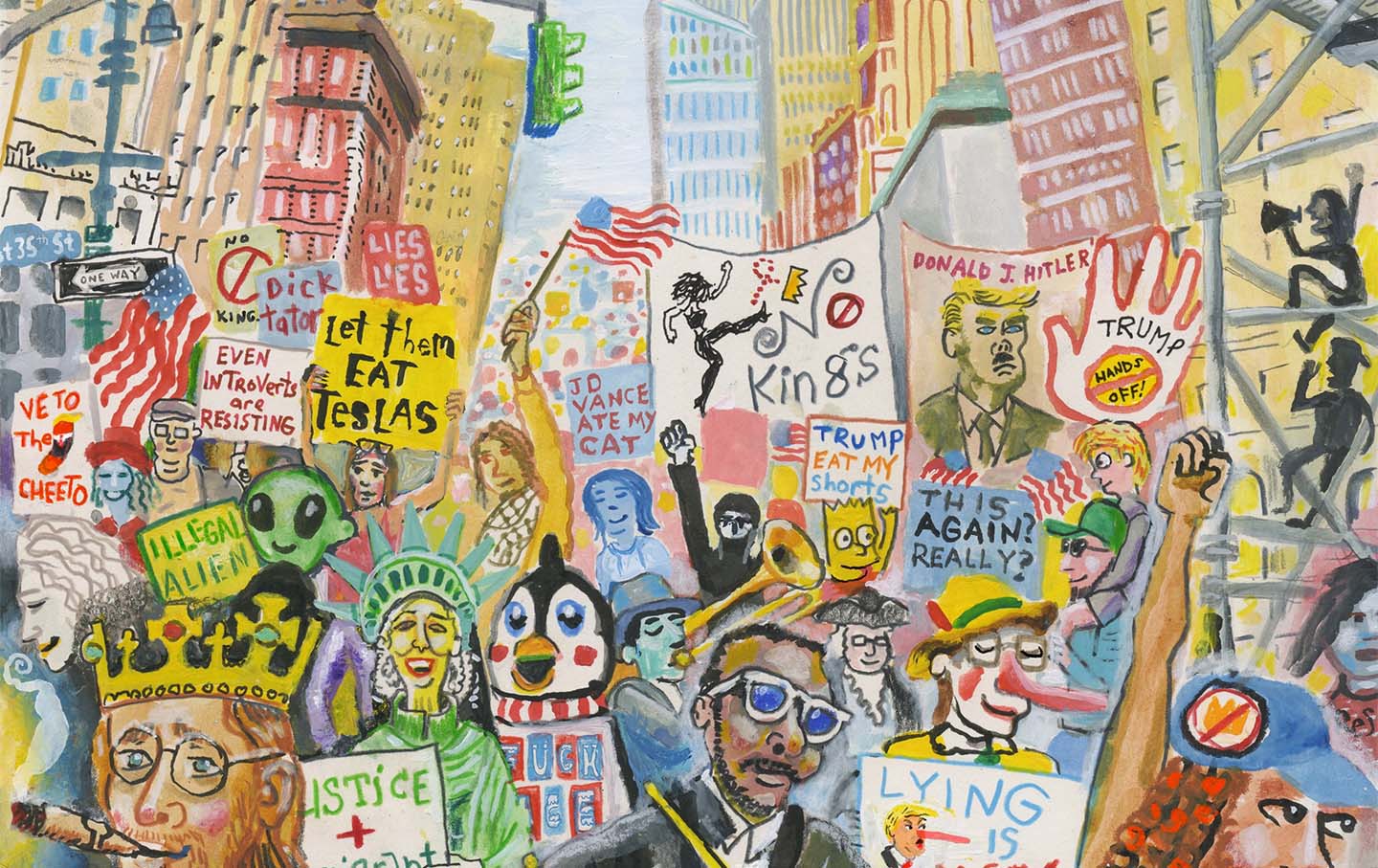
Marching Against a Corrupt Regime Marching Against a Corrupt Regime
People taking to the streets for democracy.
It Would Be Madness to Give Trump and His Toadies Even More Power It Would Be Madness to Give Trump and His Toadies Even More Power
And yet, that’s what the Supreme Court appears prepared to do.
Trump Is Dragging Republicans to Crushing Defeat After Crushing Defeat Trump Is Dragging Republicans to Crushing Defeat After Crushing Defeat
The president is deeply unpopular, his policies are failing, and Republicans are losing—everywhere.

