Trump’s 51st-State Plan Would Be a Literal Death Sentence for Canadians
Canadians have a universal healthcare system and significantly longer life expectancy than Americans.
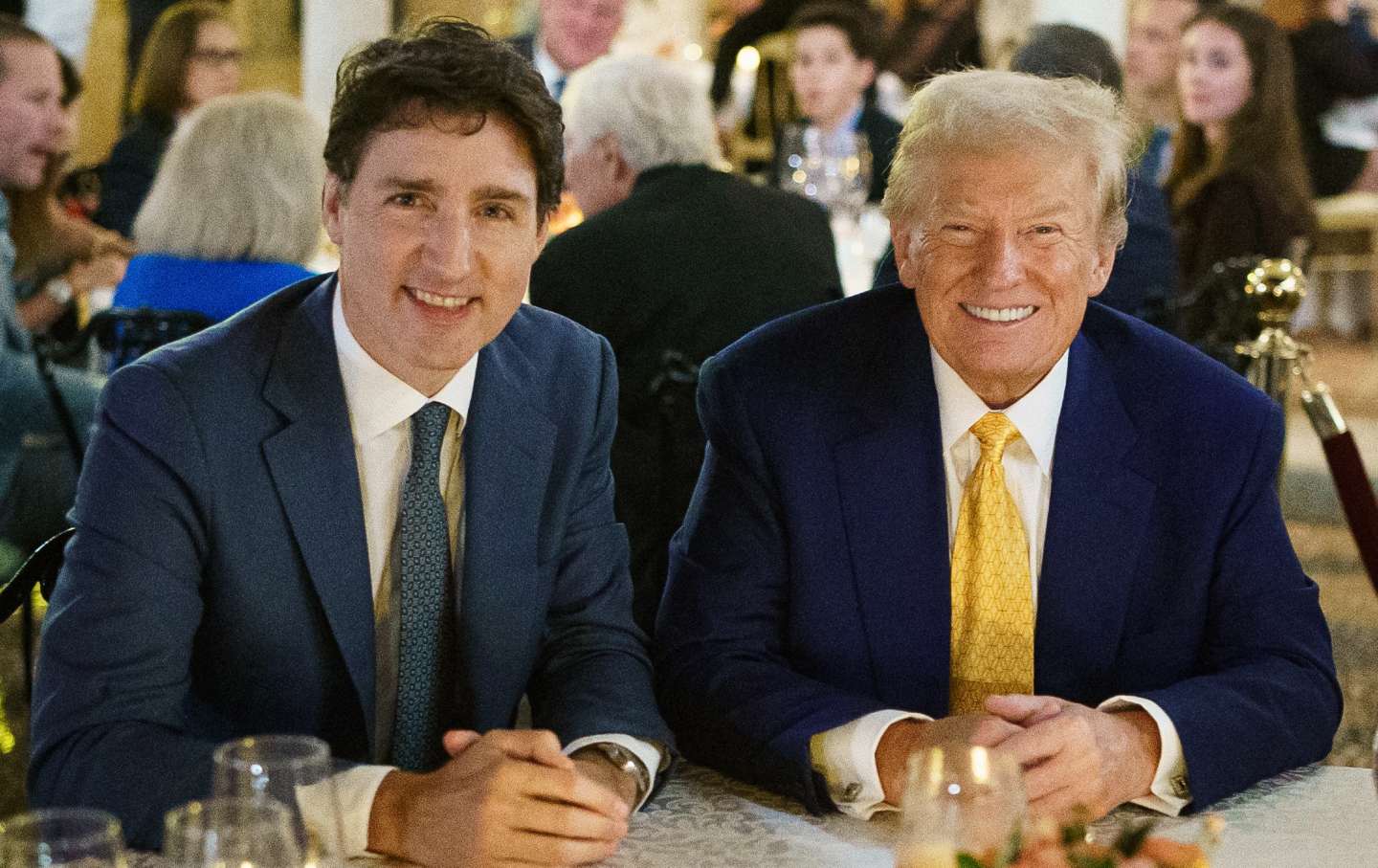
Justin Trudeau and Donald Trump at Mar-a-Lago on November 29, 2024.
(Justin Trudeau / X)Donald Trump thinks Canadians should become Americans. For weeks, he has called for Canada to become the 51st American state—one that would stretch from the Atlantic to the Pacific and as far north as the Arctic.
Trump seems serious about this idea. But Canadians are equally serious about rejecting it.
“The Angus Reid poll conducted a survey of both Canadians and Americans. For one question, Canadians were asked how they would vote in a referendum on whether Canada should become part of the U.S.,” the Canadian Broadcasting Corporation explained after Trump proposed the idea in January. “That survey found just a small minority, one out of 10 Canadians surveyed, would support the idea of Canada joining the U.S., but that the vast majority, 90 per cent, were opposed.”
“Canada Hates Trump!” social media spaces are also proliferating at a dramatic rate.
But Trump does not take “no” for an answer. In his Super Bowl Sunday interview with Fox News’s Bret Baier, the president was asked if his assertion that Canada should become the 51st state was “a real thing”— as Canadian Prime Minister Justin Trudeau warned after talking with the president. Trump said, “Yeah, it is.” And he did not stop there, saying, “I think Canada would be much better off being the 51st state.”
Then, Trump took his fantasy to even more ludicrous heights. He claimed that, as citizens of the US, “Canadian citizens would…have much better medical [care].”
Seriously?
Unlike the United States, where our for-profit healthcare system regularly fails to provide quality care for all Americans, Canada has a publicly funded healthcare system that provides “universal coverage for medically necessary healthcare services provided on the basis of need, rather than the ability to pay.”
According to an assessment of scholarly research on the healthcare systems in the US and Canada, which was produced by the group Physicians for a National Health Care Program, “The Canadian single payer healthcare system produces better health outcomes, with substantially lower administrative costs than the United States.”
At the heart of the Canadian system is its guarantee of universal coverage. That contrasts dramatically with the United States where, according to a 2024 study of “The State of Health Insurance Coverage in the U.S.” by the Commonwealth Fund, “Nine percent of adults were uninsured, 12 percent had a gap in coverage over the past year, and 23 percent were underinsured, meaning they had coverage for a full year that didn’t provide them with affordable access to health care.” And that’s even with the expansion of coverage under the Affordable Care Act.
The lack of affordable access to care in the United States has profound consequences that would undoubtedly shock Canadians.
For instance, according to the Commonwealth Fund, in the United States:
Nearly three of five (57%) underinsured adults said they avoided getting needed health care because of its cost; 44 percent said they had medical or dental debt they were paying off over time.
Delaying care has health consequences: two of five (41%) working-age adults who reported a cost-related delay in their care said a health problem had worsened because of it.
Nearly half of adults (48%) with medical debt are paying off $2,000 or more; half of those with debt said it stemmed from a hospital stay.
Popular
“swipe left below to view more authors”Swipe →But the starkest distinction between Canada and the United States involves the ultimate health outcome: life expectancy.
There are many groups that compare life-expectancy rates by country. All of them conclude that Canadians live longer than Americans—in some cases, a lot longer. The World Bank Group’s comprehensive survey found in 2022 that Canadian life expectancy was 81.3 years versus 77.4 for Americans. Other surveys, such as the CIA World Factbook (2024 estimate: 84.2 years for Canada versus 80.9 years for the Americans) describe slightly different gaps. But the bottom line is consistent: Canadians outlive Americans—and this pattern was especially evident during and after the period when the Covid-19 pandemic highlighted the life-and-death consequences of universal access to quality care.
There are, of course, many factors that can influence life expectancy—including wealth disparity, the relative development of broader social safety nets, and health and diseases patterns. But access to quality healthcare is widely accepted as a vital factor and, as Senator Bernie Sanders says, that has benefited Canadians—tremendously. “A single payer system does not mean having a lower quality system,” says the Vermont independent. “Canada has longer life expectancy than in the U.S. and better health outcomes.”
Indeed, when Trump spoke in January about making Canada a part of the United States—with a claim that “they’d have much better health coverage”—Sanders dismissed the scheme with a question and answer:
Better health coverage? If Canadians became US citizens they would lose their free health care, pay nearly three times more for their prescription drugs, and many of them wouldn’t be able to get coverage at all. Something tells me they won’t be interested.
Factor in the life-expectancy differential and, for Canadians, the whole 51st-state plan seems less like a promise and more like a threat.
Disobey authoritarians, support The Nation
Over the past year you’ve read Nation writers like Elie Mystal, Kaveh Akbar, John Nichols, Joan Walsh, Bryce Covert, Dave Zirin, Jeet Heer, Michael T. Klare, Katha Pollitt, Amy Littlefield, Gregg Gonsalves, and Sasha Abramsky take on the Trump family’s corruption, set the record straight about Robert F. Kennedy Jr.’s catastrophic Make America Healthy Again movement, survey the fallout and human cost of the DOGE wrecking ball, anticipate the Supreme Court’s dangerous antidemocratic rulings, and amplify successful tactics of resistance on the streets and in Congress.
We publish these stories because when members of our communities are being abducted, household debt is climbing, and AI data centers are causing water and electricity shortages, we have a duty as journalists to do all we can to inform the public.
In 2026, our aim is to do more than ever before—but we need your support to make that happen.
Through December 31, a generous donor will match all donations up to $75,000. That means that your contribution will be doubled, dollar for dollar. If we hit the full match, we’ll be starting 2026 with $150,000 to invest in the stories that impact real people’s lives—the kinds of stories that billionaire-owned, corporate-backed outlets aren’t covering.
With your support, our team will publish major stories that the president and his allies won’t want you to read. We’ll cover the emerging military-tech industrial complex and matters of war, peace, and surveillance, as well as the affordability crisis, hunger, housing, healthcare, the environment, attacks on reproductive rights, and much more. At the same time, we’ll imagine alternatives to Trumpian rule and uplift efforts to create a better world, here and now.
While your gift has twice the impact, I’m asking you to support The Nation with a donation today. You’ll empower the journalists, editors, and fact-checkers best equipped to hold this authoritarian administration to account.
I hope you won’t miss this moment—donate to The Nation today.
Onward,
Katrina vanden Heuvel
Editor and publisher, The Nation
More from The Nation

The US Is Looking More Like Putin’s Russia Every Day The US Is Looking More Like Putin’s Russia Every Day
We may already be on a superhighway to the sort of class- and race-stratified autocracy that it took Russia so many years to become after the Soviet Union collapsed.

Israel Wants to Destroy My Family's Way of Life. We'll Never Give In. Israel Wants to Destroy My Family's Way of Life. We'll Never Give In.
My family's olive trees have stood in Gaza for decades. Despite genocide, drought, pollution, toxic mines, uprooting, bulldozing, and burning, they're still here—and so are we.

Trump’s National Security Strategy and the Big Con Trump’s National Security Strategy and the Big Con
Sense, nonsense, and lunacy.

Does Russian Feminism Have a Future? Does Russian Feminism Have a Future?
A Russian feminist reflects on Julia Ioffe’s history of modern Russia.
Ukraine’s War on Its Unions Ukraine’s War on Its Unions
Since the start of the war, the Ukrainian government has been cracking down harder on unions and workers’ rights. But slowly, the public mood is shifting.
I’m a Teacher in Gaza. My Students Are Barely Hanging On. I’m a Teacher in Gaza. My Students Are Barely Hanging On.
Between grief, trauma, and years spent away from school, the children I teach are facing enormous challenges.

