
Trump’s Tantrum Tariffs Will Not Renew US Manufacturing
Gimmicks like Trump’s economically ignorant, politically jingoistic, and personally self-serving tariff agenda won’t help workers in the US or abroad.
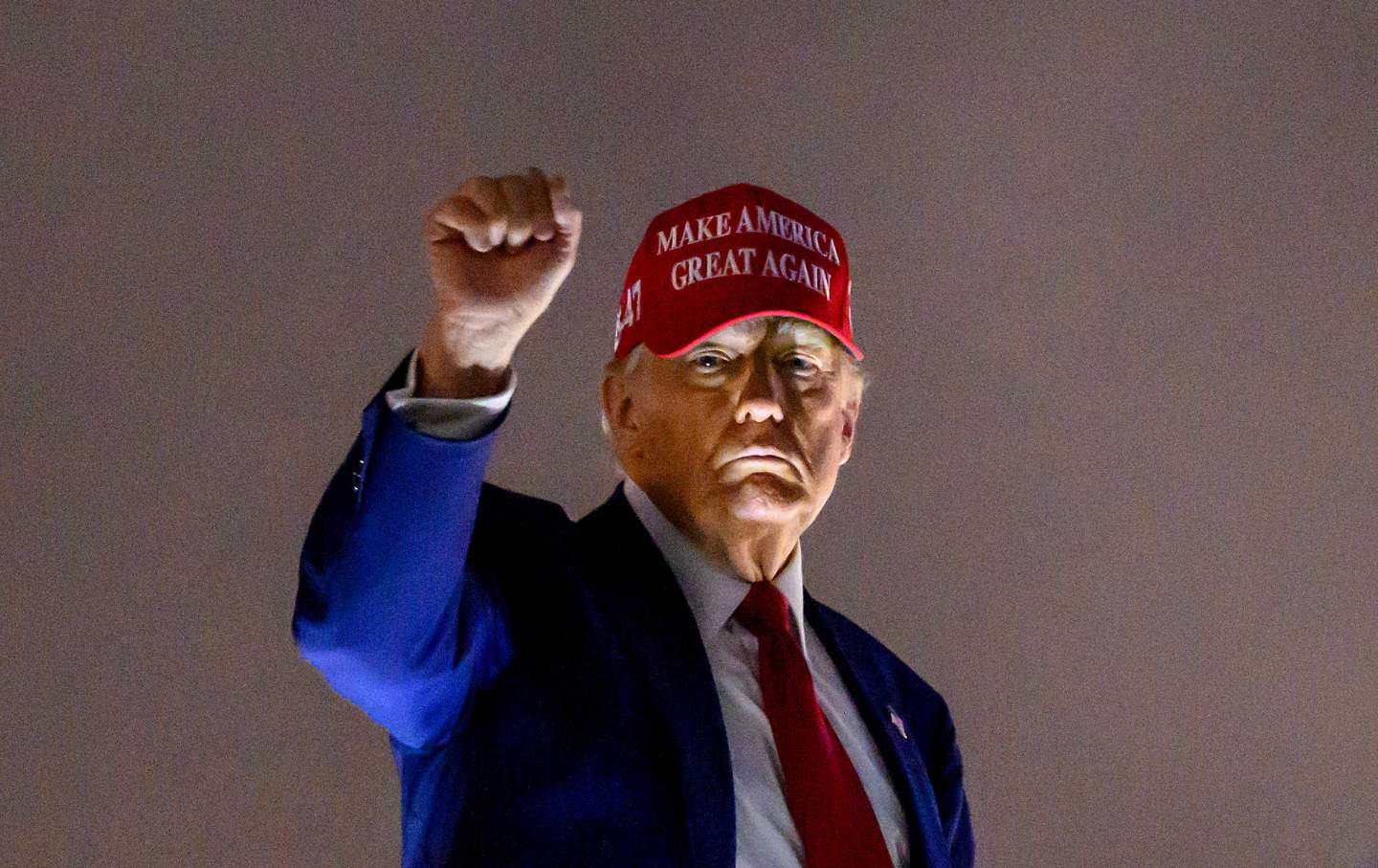
Donald Trump boards Air Force One before departing Miami International Airport, in Miami, Florida, on April 3, 2025.
(Mandel Ngan /AFP via Getty Images)The free-trade deals that Democratic and Republican presidents negotiated in the 1990s and 2000s devastated American manufacturing. Hundreds of thousands of industrial workers lost their jobs after the approval of the North American Free Trade Agreement and most-favored-nation trading status for China. Tens of thousands of factories were shuttered. Communities across this country witnessed the collapse of historic economic engines. Hope for the future crumbled.
The fallout from the free-trade frenzy sparked immense anger toward the leadership of both political parties—an anger that was still there for Donald Trump to exploit as part of his cynical—and successful—strategy to win the 2016 and 2024 elections. Trump was a New York City real estate developer with little or no genuine regard for the manufacturing industries that built America, the factory towns that sustained our economy for generations, or the union workers who took pride in smelting steel, bending copper, building cars, and making microchips.
With no evidence to back up his claims, Trump campaigned on the promise that across-the-board tariffs—applied with casual disregard for the realities of globalized manufacturing systems on which US and foreign industries now rely—would reopen shuttered American factories.
The ploy worked. Plenty of working-class voters in states such as Wisconsin, Michigan, and Pennsylvania, who were desperate for new economic policies, embraced his candidacy.
Yet Trump never bothered to learn the first thing about how tariffs work. As a result, as he announced a sweeping program of tariffs on countries all over the world last week, he did not just destabilize the American economy and cause one of the most dramatic stock market selloffs in US history. He advanced the lie that simply slapping tariffs on US trading partners is going to put people back to work in Janesville, Wisconsin, and Youngstown, Ohio, and Tonawanda, New York, and the steel towns of western Pennsylvania.
To actually revitalize those areas, explains Democratic US Representative Chris Deluzio, an Iraq War veteran, voting rights attorney, and union organizer who represents the historic manufacturing region around Pittsburgh, requires a dramatically smarter approach—and a dramatically more pro-worker approach than that of politicians like Trump who for too long have done the bidding of Wall Street speculators.
Deluzio says the way forward begins with a crucial recognition:
Two things can be true at the same time. Donald Trump’s chaotic use of tariffs alone won’t kickstart American manufacturing and the old unfair “free trade” regime shipped our jobs away to enrich huge corporations. We can’t go back to that. There’s a better way to supercharge American manufacturing: strategic tariffs alongside renegotiated trade deals, muscular industrial investments, and pro-worker policies.
In effect, Deluzio is arguing for an industrial policy that is rooted in respect for American workers and the communities where they live, as opposed to Trump’s political gamesmanship and outright lies, the “free trade” fantasies of the speculators, and the race-to-the-bottom mentality of multinational corporations. It’s important to listen to members of Congress like Deluzio, who actually know what they are talking about, as opposed to the political posers who have jumped into the debate from all sides with political sloganeering—rather than facts and experience on the ground in working-class communities.
Deluzio explained on Wednesday, after Trump announced 10 percent tariffs on countries around the world, as well as individualized reciprocal tariffs on countries that have trade deficits with the US:
“I want to be clear about what I support and what I don’t: I support using tariffs as a tool against bad actors and trade cheats—like Communist China. I support using tariffs strategically alongside muscular industrial and pro-worker policies to protect American jobs and consumers. And I support renegotiating—aggressively—trade deals like the USMCA [United States-Mexico-Canada Agreement] to get the best possible deal for hardworking Americans like us in Western Pennsylvania.
“I do not support the decades-long Washington consensus on free trade that has crushed American industry and jobs and given us far-flung supply chains that too often fail. It has been a bad deal for us in the Rust Belt and beyond. And I do not support allowing foreign trade cheats to exploit their workers to undercut American jobs.
“The Trump Administration’s trade approach has been chaotic, inconsistent, and incomplete: you need more than just tariffs to rebalance trade and kickstart American manufacturing. And we should not treat close economic allies like Canada the same as mercantilist trade cheats like China. Moreover, American workers and consumers should not be the ones paying for the necessary transition away from a broken trade system; the businesses that profiteered from that old regime should bear the cost. The President has the power to stop corporations from using the cover of tariffs to price gouge people—why won’t he use it?”
That’s just one of the fundamental questions that must be asked in this moment of crisis, as the stock market collapses and workers begin to recognize that Trump’s approach is not focused on helping them but on enriching the billionaire class. As US Representative Mark Pocan, a Wisconsin Democrat who grew up in the automaking city of Kenosha, and who has always been an advocate for policies that benefit workers in the US, reminds us, “Trump’s across-the-board tariffs are simply taxes on the average American.” We need to see ill-thought tariffs as Trump is now implementing them not as pro-worker policies, explains Pocan, but as “taxes you and I will pay to cover the cost of the $4.5 trillion tax cut for his billionaire buddies like Elon Musk.”
It is no secret that in economically volatile times, there will be plenty of politicians and pundits who peddle easy “answers.” But the easy answers are almost always wrong. The right answers are the smart, nuanced ones that respect both the history and the promise of places like Western Pennsylvania where, as a statement last year from Deluzio’s team explained, “workers made the steel and materials that built this nation’s infrastructure, defended the free world from fascism, and laid the foundation of the American middle class,” and recognize the reality that, faced with growing international competition, “free market idealists in Washington and Wall Street prospectors looking to make a quick buck chose to strip our communities for parts, leaving workers and our communities behind. These policies sold out communities like those in Western Pennsylvania: undercutting American workers, entire industries and their way of life in favor of growing corporate power and boosting profits at all costs.”
There has to be a response to that pain, that loss. But it can’t be gimmicky in the form of Trump’s economically ignorant, politically jingoistic, and personally self-serving tariff agenda.
Recalling lessons from former presidents on the right and the left, Ronald Reagan and Franklin Delano Roosevelt, US Representative Ro Khanna (D-CA) said Thursday, “Blanket tariffs sound patriotic but are not. They drive inflation up and innovation down.” Speaking of the across-the-board tariffs that were initiated this week, Khanna asked, “Has any other President done more to sabotage our nation’s wealth in a single act than Trump?”
His answer, the correct one, is that Trump is harming the very workers he claims to be helping. ”The saddest thing about Trump’s incoherent tariff policy is it will betray the working-class voters who have seen 90,000 factories shut down [under failed trade policies],” says Khanna, a tech-savvy economic realist who recognizes that, while targeted tariffs can benefit specific industries in specific circumstances, Trump’s across-the-board tariffs are a destructive, blunt instrument backed up by false promises. “The left does not need to embrace economic nonsense to rebuild,” he says. “FDR rejected high tariffs and relied on massive domestic investment.” What’s needed, say those who understand the steps that must be taken to build a pro-worker, pro-community American manufacturing economy, is an economic focus that rejects the empty promises of Donald Trump, and understands that, as Khanna says, “What we need is smart trade, strategic trade, not tantrum trade!”
Disobey authoritarians, support The Nation
Over the past year you’ve read Nation writers like Elie Mystal, Kaveh Akbar, John Nichols, Joan Walsh, Bryce Covert, Dave Zirin, Jeet Heer, Michael T. Klare, Katha Pollitt, Amy Littlefield, Gregg Gonsalves, and Sasha Abramsky take on the Trump family’s corruption, set the record straight about Robert F. Kennedy Jr.’s catastrophic Make America Healthy Again movement, survey the fallout and human cost of the DOGE wrecking ball, anticipate the Supreme Court’s dangerous antidemocratic rulings, and amplify successful tactics of resistance on the streets and in Congress.
We publish these stories because when members of our communities are being abducted, household debt is climbing, and AI data centers are causing water and electricity shortages, we have a duty as journalists to do all we can to inform the public.
In 2026, our aim is to do more than ever before—but we need your support to make that happen.
Through December 31, a generous donor will match all donations up to $75,000. That means that your contribution will be doubled, dollar for dollar. If we hit the full match, we’ll be starting 2026 with $150,000 to invest in the stories that impact real people’s lives—the kinds of stories that billionaire-owned, corporate-backed outlets aren’t covering.
With your support, our team will publish major stories that the president and his allies won’t want you to read. We’ll cover the emerging military-tech industrial complex and matters of war, peace, and surveillance, as well as the affordability crisis, hunger, housing, healthcare, the environment, attacks on reproductive rights, and much more. At the same time, we’ll imagine alternatives to Trumpian rule and uplift efforts to create a better world, here and now.
While your gift has twice the impact, I’m asking you to support The Nation with a donation today. You’ll empower the journalists, editors, and fact-checkers best equipped to hold this authoritarian administration to account.
I hope you won’t miss this moment—donate to The Nation today.
Onward,
Katrina vanden Heuvel
Editor and publisher, The Nation
More from The Nation
The Supreme Court Has a Serial Killer Problem The Supreme Court Has a Serial Killer Problem
In this week's Elie v. U.S., The Nation’s justice correspondent recaps a major death penalty case that came before the high court as well as the shenanigans of a man who’s angling...
Corporate Democrats Are Foolishly Surrendering the AI Fight Corporate Democrats Are Foolishly Surrendering the AI Fight
Voters want the party to get tough on the industry. But Democratic leaders are following the money instead.
Marching Against a Corrupt Regime Marching Against a Corrupt Regime
People taking to the streets for democracy.
It Would Be Madness to Give Trump and His Toadies Even More Power It Would Be Madness to Give Trump and His Toadies Even More Power
And yet, that’s what the Supreme Court appears prepared to do.
Trump Is Dragging Republicans to Crushing Defeat After Crushing Defeat Trump Is Dragging Republicans to Crushing Defeat After Crushing Defeat
The president is deeply unpopular, his policies are failing, and Republicans are losing—everywhere.

