“A Matter of Survival”: Germany’s New Coalition Government
Is the country’s latest grand coalition a shaky marriage of convenience—or “democracy’s last bullet”?
Berlin—“It could have been worse,” said Kai Arzheimer, when I asked him about his reaction to the German election results. Arzheimer, a professor of political science at the University of Mainz, was articulating the response of many progressives following the February 23 snap German elections.
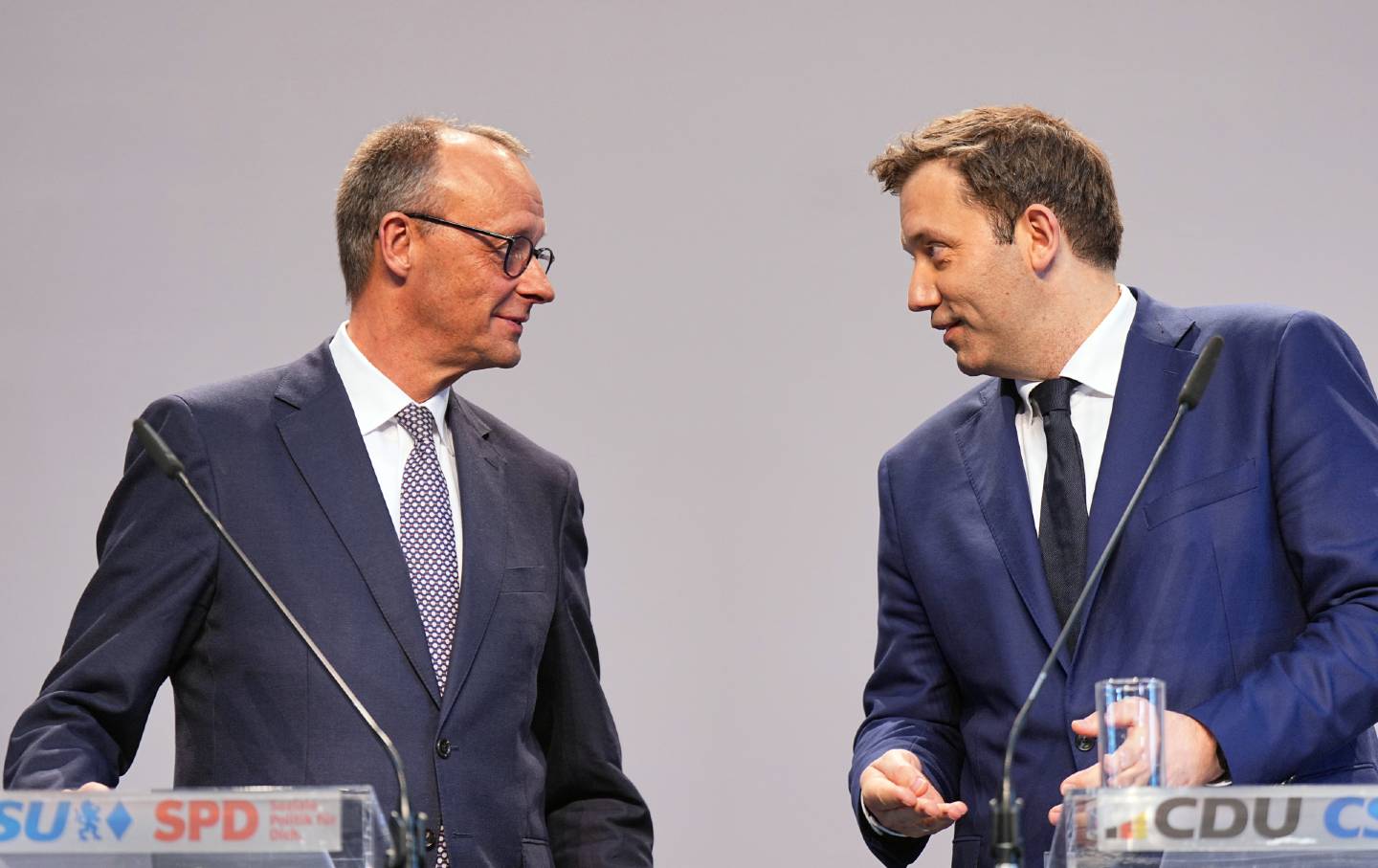
The center right CDU/CSU alliance (with 208 seats) and the center left SPD (with 120 seats) each managed to get just enough seats to form a ruling coalition with each other. The far-right AfD (with 152 seats) got more support than it should have, but not more than was expected. Die Linke, the Left Party, rallied in the weeks just before the election and did better than expected. And the Greens had a poor showing, but ultimately will form part of a progressive block in Parliament.
Meanwhile, some of the smaller parties that could have complicated coalition negotiations didn’t reach the 5 percent threshold needed to enter the Bundestag this time at all. The pro-business FDP, who played a pivotal role in the breakdown of Germany’s recent coalition government, is now out. Likewise, the BSW, considered left-wing on economic issues and right-wing on immigration, which formed when Sahra Wagenknecht (who named the new party for herself) and her supporters broke away from Die Linke, also failed to make it in. So Germany now has another Grand Coalition, or GroKo, with the country’s two largest mainstream parties.
You can find any number of articles asking, “Who is Friedrich Merz?” Sixty-nine years old, reedy in his dark business suits, and seemingly never doubting he was meant to be in a leadership role, the CDU leader failed to become chancellor during several previous tries and felt sidelined when Angela Merkel succeeded in doing so instead. He left parliament for a time, focusing on his work in corporate law. He reportedly wants to pull the CDU to the right; his anti-migration stance sometimes drifts into outright xenophobia, and compared to Merkel on social matters he has been regressive.
It is the coalition—and the need to work alongside the SPD—that might keep his worst tendencies from translating into policy.
And, right now, in a time of some terrible leaders, Merz appears to be ready to stand up against them. Historically a passionate transatlantacist, he announced shortly after the elections that his “absolute priority will be to strengthen Europe as quickly as possible so that, step by step, we can really achieve independence from the USA.” He never imagined before that he would have to say this. “We are under such massive pressure from two sides that my absolute priority now really is to create unity in Europe,” he added.
The kind of partnership that would be hard to imagine in countries where two opposed political parties duke it out to see who rules has lately become the norm in Germany. While all but one of Germany’s postwar governments have been coalitions, it is in more recent years that mainstream parties on opposite sides of the political spectrum have regularly had to join together, agreeing on both policy decisions and the distribution of cabinet posts.
“We have a grand coalition which is not that grand anymore,” observed Danny Schindler, director of the Institute for Parliamentarism Research, when we spoke on Zoom. “And the AfD has almost one quarter of seats.… The AfD will try to do things that the CDU does not like. They will emphasize migration policy again and again.”
A grand coalition can be a kind of grudging partnership, formed with the recognition that, while the situation might not be ideal, it is better than the alternatives. But, as political scientist Eva Heidbreder noted 2017, “coalition governments work by agreeing to cross-party compromises, which in turn can sow disenchantment among the people.”
“This really is democracy’s last bullet,” said CSU leader Markus Söder. While he was referring to the threat from the far right if the coalition fails, Germany in 2025 has a long list of dangers to address, including the war in Ukraine, aggression from Russia, and betrayal by a onetime ally—the United States.
Yet, despite Söder’s eloquence in assessing the dangers ahead, both he and Merz have been less than adept at strategizing to counter those dangers—in particular those presented by the AfD. Even among other far-right political parties, the AfD is considered too extreme; in 2024, it was expelled from a far-right coalition in the European Parliament. In Germany, the Federal Office for the Protection of the Constitution (Bundesamt für Verfassungsschutz, or BfV), has designated the AfD as “partly right-wing extremist,” while three of the AfD’s state branches are “proven right-wing extremist.”
A political “firewall”—the refusal by other parties to include the AfD in any coalitions or agreements—is meant to keep the AfD’s proposals from entering the mainstream. Yet on January 29, after campaigning for the new elections had begun, Merz introduced an anti-migrant resolution in the Bundestag that he realized could only pass with support from the AfD. When protesters and politicians from nearly all political parties—including the CDU/CSU—condemned the move, Merz seemed chastened. The legislation ultimately failed when members of Merz’s own party refused to support it a few days later.
Still, the CDU/CSU campaigned on a change to migration regulations, and though many of the more extreme regulations they supported have been dropped during coalition negotiations, the coalition treaty proposes suspending voluntary refugee admissions programs as well as family reunification for people with subsidiary protection status (that is, people who have not been granted refugee status). Most controversially, as well as questionable in legal terms, it proposes blocking the admission of asylum-seekers at Germany’s borders.
“I’m afraid that the new government is trying the same old recipe,” said Arzheimer, “talking about immigration all the time and announcing things they know they can’t do because it clashes with [EU law]. And all that comes out of this is that the AfD is getting more attention.… But AfD support is quite divorced from real immigration numbers.“
As Arzheimer has noted in another interview, “If you focus on immigration and backlash against progressive policies, people will vote for the original and not for the center-right parties, let alone the center-left moving in the same direction.”
The coalition treaty, published on May 9 and titled “Responsibility for Germany,” is 144 pages long. In some ways, it is not as bad as many feared it would be, notes the left-wing daily taz: The right to dual citizenship wasn’t rolled back; some asylum seekers will have the right to work after three months; and residence requirements will be relaxed for female asylum seekers who need to flee domestic violence. The coalition plans to “invest more in the resilience of our democracy,” with funding for nonprofits and civil society. Compulsory military service won’t be returning, nor will nuclear power, nor fossil fuels.
Popular
“swipe left below to view more authors”Swipe →But there is also much criticism of what is included in it—and what is not. The youth wing of the SPD, the Jusos, has said it objects to the coalition’s asylum policy as well its financial and tax policies. Die Linke notes that the agreement does not address the high cost of living and the breakdown of community cohesion. The Greens have pointed out that climate targets are being watered down and the phaseout of coal will be delayed. Despite the fact that an estimated 5.5 million Muslims live in Germany, “the words Muslims and Islam don’t appear once. It’s all about Islamism.” said Naika Foroutan, the head of the German Center for Integration and Migration Research at Humboldt University.
Especially in comparison to other places in more dire circumstances though, Germany’s problems seem surmountable—if they can be addressed with enough focus and will. And they especially seem surmountable in comparison to the United States’ plight right now, which stands as a burning warning to the vast majority of democracies in the world, showing how many ways there are for a system to collapse, with an endless stream of news alerts announcing all the brutal and irrevocable things that happen when it does.
In Germany, Schindler observed, “We saw this old coalition collapse, and now have a new coalition.… Some in Germany framed it as a kind of a big crisis. It is not. It shows that the constitutional system works.”
So will this coalition be a stable one?
“I think it will be quite stable,” Arzheimer said, “because [the parties] have a lot of experience in governing together.… And also, they know it’s a matter of survival for them.”
Disobey authoritarians, support The Nation
Over the past year you’ve read Nation writers like Elie Mystal, Kaveh Akbar, John Nichols, Joan Walsh, Bryce Covert, Dave Zirin, Jeet Heer, Michael T. Klare, Katha Pollitt, Amy Littlefield, Gregg Gonsalves, and Sasha Abramsky take on the Trump family’s corruption, set the record straight about Robert F. Kennedy Jr.’s catastrophic Make America Healthy Again movement, survey the fallout and human cost of the DOGE wrecking ball, anticipate the Supreme Court’s dangerous antidemocratic rulings, and amplify successful tactics of resistance on the streets and in Congress.
We publish these stories because when members of our communities are being abducted, household debt is climbing, and AI data centers are causing water and electricity shortages, we have a duty as journalists to do all we can to inform the public.
In 2026, our aim is to do more than ever before—but we need your support to make that happen.
Through December 31, a generous donor will match all donations up to $75,000. That means that your contribution will be doubled, dollar for dollar. If we hit the full match, we’ll be starting 2026 with $150,000 to invest in the stories that impact real people’s lives—the kinds of stories that billionaire-owned, corporate-backed outlets aren’t covering.
With your support, our team will publish major stories that the president and his allies won’t want you to read. We’ll cover the emerging military-tech industrial complex and matters of war, peace, and surveillance, as well as the affordability crisis, hunger, housing, healthcare, the environment, attacks on reproductive rights, and much more. At the same time, we’ll imagine alternatives to Trumpian rule and uplift efforts to create a better world, here and now.
While your gift has twice the impact, I’m asking you to support The Nation with a donation today. You’ll empower the journalists, editors, and fact-checkers best equipped to hold this authoritarian administration to account.
I hope you won’t miss this moment—donate to The Nation today.
Onward,
Katrina vanden Heuvel
Editor and publisher, The Nation
More from The Nation

The US Is Looking More Like Putin’s Russia Every Day The US Is Looking More Like Putin’s Russia Every Day
We may already be on a superhighway to the sort of class- and race-stratified autocracy that it took Russia so many years to become after the Soviet Union collapsed.

Israel Wants to Destroy My Family's Way of Life. We'll Never Give In. Israel Wants to Destroy My Family's Way of Life. We'll Never Give In.
My family's olive trees have stood in Gaza for decades. Despite genocide, drought, pollution, toxic mines, uprooting, bulldozing, and burning, they're still here—and so are we.
Trump’s National Security Strategy and the Big Con Trump’s National Security Strategy and the Big Con
Sense, nonsense, and lunacy.
Does Russian Feminism Have a Future? Does Russian Feminism Have a Future?
A Russian feminist reflects on Julia Ioffe’s history of modern Russia.
Ukraine’s War on Its Unions Ukraine’s War on Its Unions
Since the start of the war, the Ukrainian government has been cracking down harder on unions and workers’ rights. But slowly, the public mood is shifting.
I’m a Teacher in Gaza. My Students Are Barely Hanging On. I’m a Teacher in Gaza. My Students Are Barely Hanging On.
Between grief, trauma, and years spent away from school, the children I teach are facing enormous challenges.

