
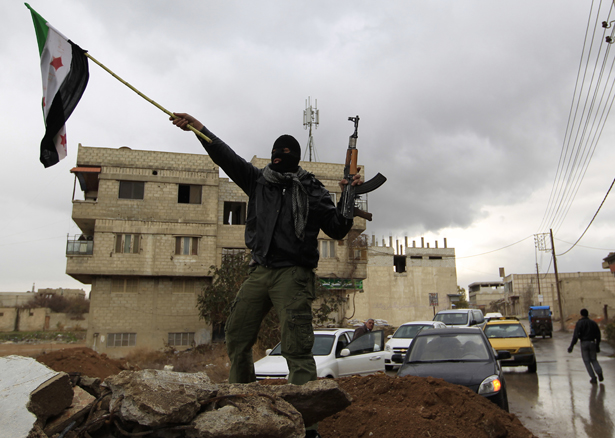
A Syrian soldier, who has defected to join the Free Syrian Army, holds up his rifle and waves a Syrian independence flag in the Damascus suburb of Saqba January 27, 2012. REUTERS/Ahmed Jadallah
The term “Arab Spring” never accurately conveyed the grim conditions of protest in Syria, even before last year’s mostly peaceful demonstrations turned increasingly to armed resistance in response to brutal repression by the government of Bashar al-Assad. But now—after a killing rate so high that human rights observers can give only rough estimates, after protracted government bombardment of Homs and with reports of growing arms supplies to the resistance from neighboring Lebanon and Iraq—the crisis has become truly ominous. As if that isn’t bad enough, the failure of the Arab League’s observer mission, followed by the Russian and Chinese veto of the United Nations Security Council resolution calling for a transitional government and elections, seems to have stymied diplomatic solutions.
Up to now, the Obama administration has rightly deferred to regional actors. But the frustration so far of regional and UN diplomacy poses the question, Where should US policy go from here? Not surprisingly, Senator John McCain and other neoconservatives have called for the United States to arm and lend logistical support to the Free Syrian Army. So have some former British officials and other self-designated “friends” of Syria in the region. This is presented as a reasonable alternative to direct military intervention, for which there is little appetite.
The impulse to do something to stop the government repression and aid the opposition is understandable, but arming the resistance is a dangerous idea the administration should reject. Given Syria’s deep sectarian divisions, such a move would intensify an incipient civil war and further marginalize the nonviolent democratic opposition. Worse, it could set the stage for a dangerous proxy war in arguably the most volatile region of the world, with Russia and Iran backing the Assad regime and the United States and its European and Arab allies—perhaps joined by Qaeda-affiliated Sunni jihadis—supporting the rebels.
Because of the unspeakable horrors of a full-scale civil war, the administration should proceed with great caution. Some who favor arming the opposition cite last year’s Libyan intervention as a positive example. Not only does the continuing chaos in Libya call such claims into question; the Syrian crisis is vastly different from Libya’s. A protracted war in Syria would be almost impossible to contain, and would thus destabilize Lebanon, Jordan, Turkey, Israel and Iraq, setting democratization back decades. The Libyan intervention also set a disastrous diplomatic precedent: by violating the narrowly tailored UN resolution and openly fighting for regime change, the Western powers infuriated Russia, China and other countries, sowing the seeds of their mistrust and their resistance to Security Council measures on Syria.
The administration is in a difficult position: there are no good options for stopping the violence and bringing an end to the Assad regime. Since Syria is so intertwined with its neighbors, the White House needs a broad regional policy to help contain the crisis, complemented by a longer-term strategy of encouraging democracy. Whether Washington likes it or not, Russia holds one of the keys to such a strategy, for only Moscow has the leverage and influence with Damascus to persuade Assad to constrain the violence and allow a democratic transition.
The State Department has blamed Russia for the latest setback, with Secretary of State Hillary Clinton calling its UN veto a travesty. But the administration must put aside its frustrations and re-engage Moscow as a full partner. Such an approach would attempt to build on the latest Russian mission to Damascus, reportedly aimed at encouraging Assad to open negotiations with the opposition over political reform and a new Constitution. In the short term, the top priority must be an all-out effort to reduce the violence. Moscow could help press the case for a cease-fire and for the return of Arab League observers, perhaps supplemented by UN human rights observers. This would give the opposition time to regroup and to rethink its move away from nonviolence.
It may be too late to put the genie of civil war back in the bottle. But a renewed diplomatic offensive is a better course of action than the alternatives.

