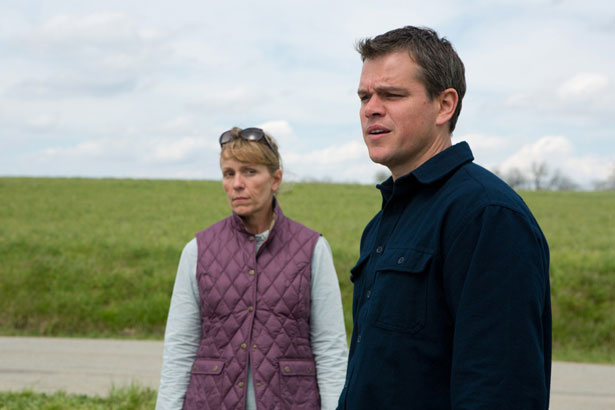
Frances McDormand and Matt Damon in Promised Land.
Promised Land, the Matt Damon fracking movie recently released nationwide, has had somewhat of a lukewarm critical reception. But it’s definitely getting bad reviews from the natural gas industry.
The film, in which Damon plays an energy company representative trying to convince small-town farmers to lease their land for fracking, is the target of a ongoing misinformation campaign by natural gas industry-backed groups. The organizations, which bill themselves as independent and broad-based, are bankrolled by some of the biggest names in oil and gas, and have a history of bashing organizations and initiatives that question the safety of fracking, an environmentally hazardous process that involves blasting millions of gallons of water, sand and industrial chemicals into shale wells to fracture rock and push out oil and gas.
Even though Promised Land, directed by Gus Van Sant and produced by Focus Features, doesn’t spook the industry as much as Gasland, the 2010 Josh Fox documentary about the eco-damage natural gas drilling can do, gas companies are not taking any chances. Back in October, The Wall Street Journal reported that “the energy industry already [was] preparing for battle,” with the Independent Petroleum Association of America, an association of energy producers, planning to distribute pro-fracking flyers at movie theaters, send out scientific studies to film reviewers and launch a social media campaign.
Energy in Depth, a PR group created by IPAA set up a website, called “The Real Promised Land,” where readers are treated to pronouncements on the environmental safety and economic potential of fracking by, among others, President Obama and outgoing EPA chief Lisa Jackson, who is quoted as saying that “in no case have we made a definitive determination that the [fracturing process] has caused chemicals to enter groundwater.” (A large body of research, by the likes of the EPA, Duke University and the National Academy of Sciences have linked groundwater contamination to fracking.)
Popular
"swipe left below to view more authors"Swipe →
The group also has a Facebook page and a Twitter account. “Do you like apples?” EID tweeted snarkily on Tuesday. “Real Promised Land passes Promised Land film in ‘likes’ on Facebook. How you like them apples?”
And after Promised Land’s writer John Krasinski appeared on David Letterman’s show last month, Energy in Depth’s website posted a blog “fact-checking” their discussion of hydraulic fracturing.
“We’ve been surprised at the emergence of what looks like a concerted campaign targeting the film,” James Schamus, chief executive of Focus Features, told the Journal in October.
Jeff Eshelman, a spokesman for IPAA told the Journal, “We have to address the concerns that are laid out in these types of films.”
And for good reason. Fracking brings in billions of dollars for the multinational corporations behind the group. IPAA and its PR arm EID claim to represent a broad coalition of small, independent natural gas groups, “but really it’s the big boys,” says Kert Davies, research director at Greenpeace.
IPAA’s website says it was “founded…by a small group of determined independents, [and] has grown to an organization of many thousands today.” EID calls itself “a research, education and public outreach campaign…that benefits directly from the support, guidance and technical insight of a broad segment of America’s oil and natural gas industry.”
But in a 2009 memo announcing the creation of EID to “combat new environmental regulations,” IPAA notes that “the ‘Energy In Depth’ project would not be possible without the early financial commitments” of oil giants that now dominate the gas industry like XTO Energy (a subsidiary of ExxonMobil), BP, Anadarko, Chevron and Haliburton. In 2010, IPAA had revenues of more than $8 million, and spent about the same.
EID has “a pretty well-oiled machine doing these counter ops,’” Davies says. “This is just the latest.”
Besides the backlash against Gasland through EID’s rebuttal film Truthland, other misinformation efforts by the PR group have included attacks on anti-fracking environmental groups like Food and Water Watch and the Park Foundation, and news outlets like The New York Times, ProPublica and the Associated Press, which have published investigations on the environmental dangers of fracking. EID slammed a recent Bloomberg poll that found an increase in public support for more fracking regulation, and took it upon themselves to “fact-check” the statement Vermont Gov. Peter Schumlin made when he signed into law the country’s first statewide fracking ban.
IPAA and EID aren’t the only industry-backed outfits scared of the growing anti-fracking movement, embodied in Promised Land. The Marcellus Shale Coalition, which represents drilling companies and drilling equipment manufacturers, is running short ads before the movie in 75 percent of theaters in Pennsylvania, instructing theatergoers to visit learnaboutshale.org, where they are informed that drinking water will not be affected by fracking “if companies properly construct wells” and that Pennsylvania boasts some of the strongest natural gas drilling regulations in the country. (Pennsylvania’s regulations were actually tightened in 2012, because of an increased understanding of the potential for groundwater supply contamination.)
Shell Oil itself is planning to use the film’s publicity to bring attention to their collection of short films called “The Rational Middle,”, about the essential role of natural gas in any “sustainable energy future.”
And the Heritage Foundation, which labels itself an “independent, tax-exempt institution [that] relies on the private financial support of the general public,” but receives hundreds of thousands of dollars a year from Koch Foundations and ExxonMobil, launched a smear campaign against Promised Land too. The film is partially funded by Image Nation Abu Dhabi, a state media company of the United Arab Emirates, which Heritage alleges is a way for the oil-producing UAE to discredit natural gas and enrich themselves. (This theory doesn’t quite work out because Image Nation Abu Dhabi also helped fund Deepwater Horizon’s Final Hour.)
Schamus told ABC News he was “impress[ed]” by “the kind of propaganda specialists the fracking industry has sent after our little movie.”
The industry is “concerned that [the anti-fracking movement] may permeate the mainstream more deeply than it already has,” said Emily Wurth, a policy analyst at Food and Water Watch.
That’s exactly what Damon’s industry rep character is worried about in the film. As Sharon Kelly of DeSmog blog put it, “The irony here, of course, is that the industry’s plan for taking on the movie runs parallel at times to the movie itself. It a case where art imitates life imitates art.”

