
After a Chemical Attack on Pro-Palestine Protesters, Columbia Students Won’t Back Down
“Despite the clear dangers we face at Columbia, CUAD remains committed to Palestinian liberation.”
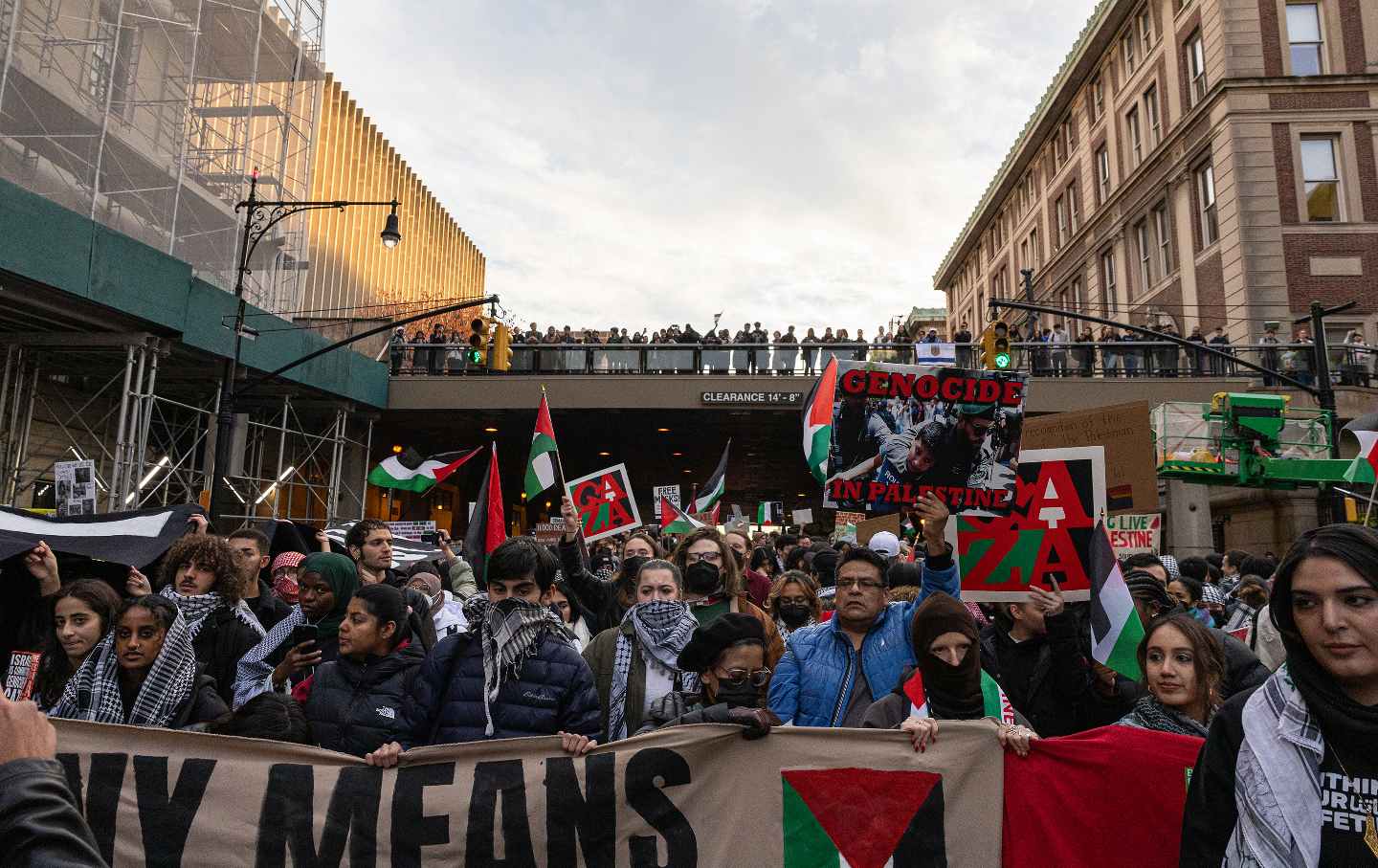
Students and activists protesting Columbia University’s decision to suspend the student groups Students for Justice in Palestine and Jewish Voice for Peace.
(Shawn Inglima / Getty)On November 10, 2023, Columbia University suspended student groups Jewish Voice for Peace and Students for Justice in Palestine through the end of the fall semester. As of now, the suspension remains in effect. “The two groups repeatedly violated University policies related to holding campus events, culminating in an unauthorized event Thursday [November 9] afternoon,” said Gerald Rosberg, senior executive vice president of Columbia. Rosberg concluded the suspension notice by saying “like all student groups, SJP and JVP are required to abide by University policies and procedures.”
Complicating matters though, one week after making these statements, Rosberg confirmed during a university senate plenary that senior administration changed the university’s events policies without consultation or input from the university senate, as would be typical for other university-wide policy updates. He also acknowledged that pro-Palestine events have avoided violence and “have gone extremely well,” which can be seen as “a reflection of successful implementation of event policies.”
The speed with which the university and its affiliates, like Barnard College, have sought to review and revise policies that impact student organizations’ ability to proceed with educational, social, and political programming is unprecedented, and yet, underwhelming in the face of an organized student body and supportive faculty. Since Hamas’s attack on Israel on October 7 and Israel’s subsequent military action in Gaza, American universities have become significant sites of nationwide attention, pro-Palestine protests, and, naturally, education regarding the ongoing conflict.
In November, the Barnard administration removed a statement titled “Solidarity with Palestine” from the college’s department of women’s, gender, and sexuality studies (WGSS) website, despite faculty opposition. The next month, the college quietly revised policies pertaining to website governance and acceptable political statements. In the revised political activity policy, “posting political statements on websites bearing the barnard.edu name” and posting “signs containing political statements on the grounds of the College” are prohibited activities.
In response to these policy revisions, event cancellations, and student group suspensions, and following a vote that gave the move “an overwhelming bipartisan majority,” the Student Governing Board (SGB) declared noncooperation with changes to the University’s Student Group Event and Procedure policy. As reported by the Columbia Daily Spectator, SGB noted that “though the SGB does not condone the violation of University policy, we see it as incumbent upon us and all students to protect student government and to oppose policies that suppress student speech and limit the possibility of discourse on campus.”
On November 15, more than 100 faculty and graduate workers publicly rallied with a list of five demands including that Columbia publicly recognize that “academic freedom protects all forms of political speech including critiques of Israeli state policies and Zionist political ideology,” and the Barnard WGSS faculty have republished their censored statement on a new, non-college-affiliated website. Likewise, SJP, JVP, and other pro-Palestine student groups (many of which are still recognized by the university), have gone forward with hosting pro-Palestine protests, educational events, and mutual aid fundraisers.
On Monday, December 4, students from the Barnard-Columbia Abolition Collective, Student-Worker Solidarity, and the Columbia-Barnard Young Democratic Socialists of America—all members of the Columbia University Apartheid Divest group—continued their action for Palestine by calling for a tuition strike during the spring 2024 semester. Ultimately, the strike was called off during the first week of classes after an online vote among students, but organizers plan to “continue collecting pledges from current students to withhold donations [to the university] until our demands are met.”
The group’s demands for the strike included “investment and policing transparency,” cutting ties between Columbia Public Safety and NYPD “for protest and crowd control purposes,” and most notably, “a binding divestment referendum,” a reference to September 2020, when Columbia College students voted favorably for a referendum asking if Columbia should “divest its stocks, funds, and endowment from companies that profit from or engage in the State of Israel’s acts towards Palestinians.” Former university president Lee Bollinger rejected that approach, saying that “altering our endowment in order to advance the interest of one side is not among the paths we will take.”
But the protests by SJP and its affiliates were met with a new threat at a peaceful action on Friday January 19. Columbia SJP reported that protesters were sprayed with a horrible-smelling “stink bomb” at the event, before later posting an update that the foul product was identified as Skunk, an Israeli-developed chemical weapon, used as recently as December in East Jerusalem on Muslim worshippers.
Dozens of students told the Spectator that the spray left a strong odor—one that smelled akin to a dead body, according to one graduate student—that led to nausea, burning skin and eyes, and soiled clothing and hair. Numerous students were hospitalized and received care for chemical inhalation.
“At this demonstration, two students sprayed an odorous chemical at CUAD protestors,” reads a press release from the Columbia University Apartheid Divest Coalition on Tuesday. “Following student and community attempts to find the deployers, we identified them as two former IOF Officers who are current Columbia School of General Studies students.”
Columbia administration did not respond to the incident until three days later when Interim Provost Dennis A. Mitchell announced that the alleged perpetrators had been banned—though not academically suspended—from campus while an NYPD investigation proceeded.
In renewed protest on January 24, students gathered on campus again, prompting Columbia administration to restrict campus access to only university affiliates and ID holders from noon onwards, a practice that has been ongoing since October 2023. Attendees chanted things like “Minouche Shafik, you must pay. Medical bills are on the way” and held posters calling for divestment and a ceasefire.
“In light of the 1/19 attack, we reiterate our demand for an end to the IOF-General Studies program and the dual degree program between Columbia and Tel Aviv University,” wrote CUAD. “Despite the clear dangers we face at Columbia, CUAD remains committed to Palestinian liberation.”
Disobey authoritarians, support The Nation
Over the past year you’ve read Nation writers like Elie Mystal, Kaveh Akbar, John Nichols, Joan Walsh, Bryce Covert, Dave Zirin, Jeet Heer, Michael T. Klare, Katha Pollitt, Amy Littlefield, Gregg Gonsalves, and Sasha Abramsky take on the Trump family’s corruption, set the record straight about Robert F. Kennedy Jr.’s catastrophic Make America Healthy Again movement, survey the fallout and human cost of the DOGE wrecking ball, anticipate the Supreme Court’s dangerous antidemocratic rulings, and amplify successful tactics of resistance on the streets and in Congress.
We publish these stories because when members of our communities are being abducted, household debt is climbing, and AI data centers are causing water and electricity shortages, we have a duty as journalists to do all we can to inform the public.
In 2026, our aim is to do more than ever before—but we need your support to make that happen.
Through December 31, a generous donor will match all donations up to $75,000. That means that your contribution will be doubled, dollar for dollar. If we hit the full match, we’ll be starting 2026 with $150,000 to invest in the stories that impact real people’s lives—the kinds of stories that billionaire-owned, corporate-backed outlets aren’t covering.
With your support, our team will publish major stories that the president and his allies won’t want you to read. We’ll cover the emerging military-tech industrial complex and matters of war, peace, and surveillance, as well as the affordability crisis, hunger, housing, healthcare, the environment, attacks on reproductive rights, and much more. At the same time, we’ll imagine alternatives to Trumpian rule and uplift efforts to create a better world, here and now.
While your gift has twice the impact, I’m asking you to support The Nation with a donation today. You’ll empower the journalists, editors, and fact-checkers best equipped to hold this authoritarian administration to account.
I hope you won’t miss this moment—donate to The Nation today.
Onward,
Katrina vanden Heuvel
Editor and publisher, The Nation
More from The Nation
Anger at Corporate Power Is Everywhere Anger at Corporate Power Is Everywhere
It should guide the Democrats.

Honoring the Progressives Fighting for Our Democracy Honoring the Progressives Fighting for Our Democracy
These activists and artists, pastors, and political leaders know what has always been true: The people have the power.
The Fierce and Joyous Face of LA Resistance The Fierce and Joyous Face of LA Resistance
What we can learn from a great American city’s refusal to bend to Trump’s invasion.
San Diego’s Clergy Offer Solace to Immigrants—and a Shield Against ICE San Diego’s Clergy Offer Solace to Immigrants—and a Shield Against ICE
In no other US city has the faith community mobilized at such a large scale to defend immigrants against the federal government.
If Condé Nast Can Illegally Fire Me, No Union Worker Is Safe If Condé Nast Can Illegally Fire Me, No Union Worker Is Safe
The Trump administration is making employers think they can ignore their legal obligations and trample on the rights of workers.
The Counteroffensive Against Operation Midway Blitz The Counteroffensive Against Operation Midway Blitz
How Chicago residents and protesters banded together against the Trump administration's immigration shock troops.

