“We Are the Voices of Gazan Citizens Right Now”
Hundreds of Palestinian Americans and supporters from Cincinnati, Ohio, gathered in Ziegler Park. “My city no longer exists. My village is no longer there.”
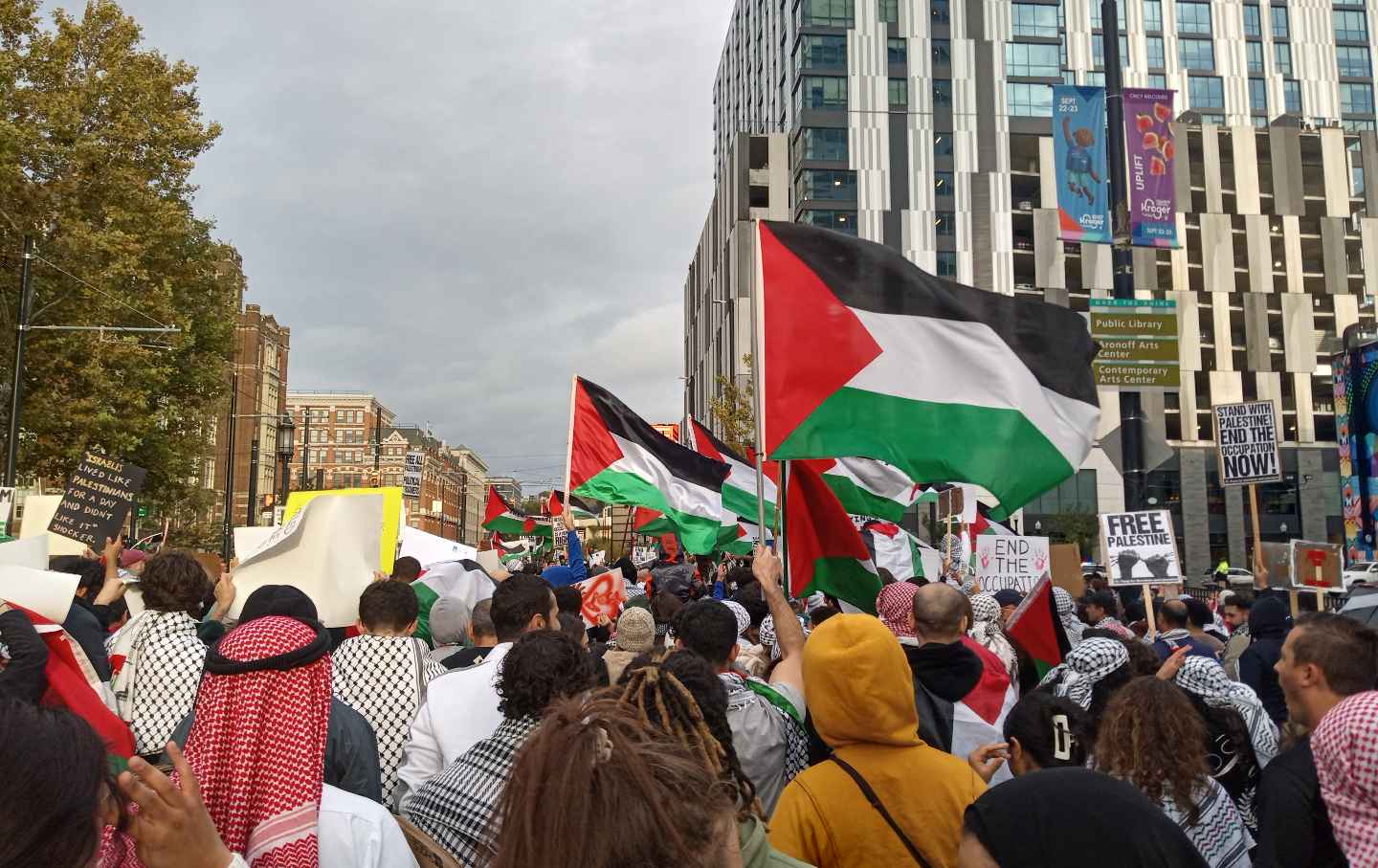
Pro-Palestine protesters marching on East Central Parkway in downtown Cincinnati on October 14.
(Zurie Pope)On October 14, hundreds of Palestinians, Muslims, and supporters of the fight for Palestinian liberation gathered in Cincinnati’s Ziegler Park. The rally was organized by the University of Cincinnati’s Students for Justice in Palestine, but the attendees offered a diverse snapshot of Ohio’s Palestinian and Muslim community ranging widely in age, gender, and ethnicity. People waved Palestinian flags, and placards that read “Free Palestine,” “End All U.S Aid to Israel,” and “From the River to the Sea, Palestine Will Be Free.”
“The situation cannot be described as an open air prison, since it implies that the Palestinians have committed a crime. Actually, Gaza can be described as an extermination camp,” said the rally’s first speaker. “Palestinians are facing genocide, as the whole world is silent to their suffering, and the potential final moments of their lives.”
Nadine Saleh, a 24-year-old protester, said she was in Ziegler Park to “show that I stand against oppression.” Saleh was raised in the United States, but her parents were born in Palestine. “It’s very sad to see all the images online, but that must not deter us from going out and advocating for those people. Because right now they are cut off from electricity, water, and food, and we are the voices of Gazan citizens right now.”
Not everyone in attendance was Palestinian—or even Muslim. “I believe in a world where all people are safe, and have the right to self-determination, and I think that Zionism in Israel actually keeps Palestinians and all people from having that,” said T. Yosef Wise. He spoke about his education work, often in synagogues, and how the Gaza war has damaged his relationship with colleagues. “I’ve been called anti-Semitic even though I teach Torah to young Jews every day.” Wise is a lifelong Cincinnati resident and participated in protests against the Iraq War in the 2000s. “You hear even the same messaging,” he said. “This idea that you either stand with Israel, or you’re with all terrorism.”
Another attendee, Barton Banta, condemned the US government for sending arms and aid to Israel. “Giving them carte blanche to do whatever they want,” Banta said. “We’ve seen what happens with those weapons. Genocide.”
“People need to know there’s another story being told, and mainstream media don’t tell that story,” said Kelly Hunter, one of the many bystanders who watched as pro-Palestine protesters marched down the streets of downtown Cincinnati. The event ended in Fountain Square, as the hundreds of participants listened to speakers, talked, and mourned the deaths of people murdered in Gaza. “They are trying to eradicate a race, a whole ethnicity,” said Christina Saliba, a second-generation Palestinian-American. “I go with my father, and my father is telling me stories about these cities he used to visit that he can’t even move freely in anymore, you know? And that’s hard to hear.”
As the president of the University of Cincinnati’s Students for Justice in Palestine, Laila Shaikh spoke about the difficulty of rebuilding UC’s SJP chapter while dealing with the possible backlash. At a pro-Palestine rally in Columbus, Ohio just days before, a man in a truck swerved at protesters, hitting one demonstrator riding a bicycle. According to the head of the SJP, the Cincinnati police reached out to them beforehand to warn about potential violence, but no counterprotests were organized.
So far, SJP has operated “mostly by word of mouth,” collaborating with groups like the Arab Student Association. “People feared for their safety,” she said. “Professors didn’t want to advise it because they feared they would lose their job.”
Regardless, Shaikh believed her college needed people to speak out about the conditions Palestinians are living under. “My own family, my own friends—we are losing people on a daily basis.” Shaikh spoke of her relatives in Palestine, the city they came from, and how both had been eradicated by settlers. “My city no longer exists. My village is no longer there. I’ve almost lost everyone. I had seven generations of history, and it was completely wiped off the map.”
Disobey authoritarians, support The Nation
Over the past year you’ve read Nation writers like Elie Mystal, Kaveh Akbar, John Nichols, Joan Walsh, Bryce Covert, Dave Zirin, Jeet Heer, Michael T. Klare, Katha Pollitt, Amy Littlefield, Gregg Gonsalves, and Sasha Abramsky take on the Trump family’s corruption, set the record straight about Robert F. Kennedy Jr.’s catastrophic Make America Healthy Again movement, survey the fallout and human cost of the DOGE wrecking ball, anticipate the Supreme Court’s dangerous antidemocratic rulings, and amplify successful tactics of resistance on the streets and in Congress.
We publish these stories because when members of our communities are being abducted, household debt is climbing, and AI data centers are causing water and electricity shortages, we have a duty as journalists to do all we can to inform the public.
In 2026, our aim is to do more than ever before—but we need your support to make that happen.
Through December 31, a generous donor will match all donations up to $75,000. That means that your contribution will be doubled, dollar for dollar. If we hit the full match, we’ll be starting 2026 with $150,000 to invest in the stories that impact real people’s lives—the kinds of stories that billionaire-owned, corporate-backed outlets aren’t covering.
With your support, our team will publish major stories that the president and his allies won’t want you to read. We’ll cover the emerging military-tech industrial complex and matters of war, peace, and surveillance, as well as the affordability crisis, hunger, housing, healthcare, the environment, attacks on reproductive rights, and much more. At the same time, we’ll imagine alternatives to Trumpian rule and uplift efforts to create a better world, here and now.
While your gift has twice the impact, I’m asking you to support The Nation with a donation today. You’ll empower the journalists, editors, and fact-checkers best equipped to hold this authoritarian administration to account.
I hope you won’t miss this moment—donate to The Nation today.
Onward,
Katrina vanden Heuvel
Editor and publisher, The Nation