
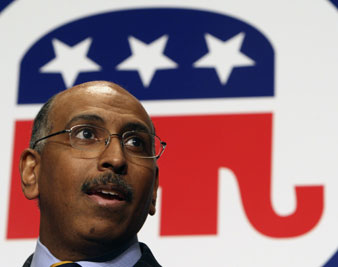
 AP ImagesMichael Steele, shortly after being elected chairman of the RNC.
“Are there any conservatives in the house?” thundered Michael Steele, the new chairman of the Republican Party. He was getting funky, to use the GOP’s new vernacular, as he scanned the hotel ballroom for young conservatives: “Young people in the house, stand up!”
Turning to serious matters, Steele urged his allies to acknowledge their party’s mistakes, while salting the message with millennial slang. “Tell America: ‘We know the past, we know we did wrong–my bad.‘ ” Escalating the banter, master of ceremonies Michelle Bachmann, a 52-year-old Minnesota Congresswoman most famous for suggesting an investigation of Barack Obama’s “anti-American views,” took the mic from Steele and proclaimed, “You be da man!” Twice.
Who needs SNL when you have CPAC?
This cultural flailing might seem like little more than fodder for the late-night shows, but it also reinforces the demographic conundrum facing Republicans. And no, I’m not just talking about race.
Steele is the first African-American chairman of the GOP, a striking development that remains forever overshadowed by its catalyst, the election of President Obama. Leading a party pales next to leading the country, of course, but even if Steele had a bigger job, there are no silver medals for breaking barriers. You don’t remember Larry Doby, do you?
So Steele soldiers on, sans street cred, in pursuit of those voters Obama won so convincingly. (More on who they are in a minute.) The strategy, Steele told the Washington Times, is a “hip-hop makeover” for Republicans. And he meant it.
In the past few weeks, Steele has reached out to the President via rap lyrics; advocated conservative principles in a television debate with Chuck D., star of the politically charged hip-hop group Public Enemy and, in a sign that Steele may be on to something, provoked a challenge for a freestyle rap battle from Stephen Colbert. Yes, Proposition Eight can finally meet Eight Mile. Now who exactly is this all for?
Popular
"swipe left below to view more authors"Swipe →
The media coverage has focused, predictably, on black voters. A Sunday article in the Boston Globe asked whether Steele can “lure minorities” to the GOP, while pundits have scoffed at the idea the Republicans would out-organize Barack Obama in black communities. Yet Steele is not just targeting black voters–the Democrats’ most reliable voting bloc long before hope was trendy. He is focused on young voters, who flocked to Obama in the largest demographic shift of the 2008 election. The new chairman has said so directly, too: “Where we have fallen down in delivering a message is in having something to say, particularly to young people.” And he is right–about the problem, anyway.
In 2004, John Kerry won voters under 30 by nine points, and lost every other age group.
Last year, Obama won those young voters by a staggering 34 points. (And he lost voters over 45).
If Obama can hold those voters’ support, and keep them backing Democrats in Congress, the Republicans really would have no national future.
Young voters back Obama’s policies, sure, but many also appreciate his youthful style and new-school “brand.” For this generation, by default, hip-hop is the shared cultural experience. (See the top albums of the last decade, for example.)
Obama’s comfort with that culture, and endorsements from its leaders, has earned him generational credibility. When Obama channeled Jay-Z on the campaign trail to brush the “dirt” of petty attacks off his shoulders, young people knew exactly what he meant. Older television pundits did not get the reference. Some even conceded their confusion while blasting the gesture as “contemptuous,” (as the Washington Post reported at the time). Obama invoked hip-hop deftly and accurately. He played on the theme that being tough does not mean you respond to every attack. Just as Jay-Z confidently brushes away his enemies, and hip-hop culture scolds the “haters” who pillory successful people, Obama signaled that his political approach–transcending trench warfare and pessimistic snark–was cool, current and strong.
Now contrast that to Steele’s gimmicky foray into dusty LPs. Here is his debut in the NewYork Times after assuming the chairmanship: ” ‘It’s going to be an honor to spar with [Obama],’ he said, before throwing down the gauntlet to Mr. Obama with a quotation from… a rap song by Kool Moe Dee: ‘How ya like me now?‘ ”
First of all, what is he talking about? How does the president like a former lieutenant governor now that he’s become chairman of the opposition party? It doesn’t even make sense. Second, the album is twenty-two years old, so this reference does not exactly resonate with young people.
The spectacle got more awkward when Steele offered Bobby Jindal some “slum love” for doing a “friggin’ awesome job” as governor of Louisiana, in an ABC radio interview. As the Wonkette blog pointed out, this mess of a shoutout was actually coaxed out of Steele, based on his proclivity for questionable slang. All this heavy-handed hip-hop may make him “da man” for fellow travelers like Rep. Bachman. To young people, Steele just looks like he’s fronting .
In the end, however, this is all still a welcome trend. For decades, our national politics were fueled by a supposed cultural–backlash from older whites–from Willie Horton and the White Hands to the Pledge of Allegiance and the Confederate Flag–which Republicans exploited and relayed through a range of cultural tropes. Democrats used to nervously compete on this turf. Just last year, in fact, an old-school consultant flanked by the battle flag was chiding Obama to drop the urban “elitism” and get rural.
Now the turntables have turned, as the GOP chairman might say. It is Republicans who are frantically remixing their message for cultural appeal, targeting a new generation of voters who speak a different language. And the Democrats, led by Obama, have found their rhythm.

