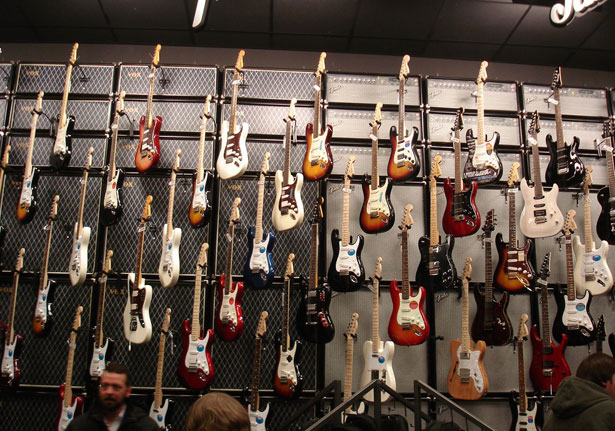
Guitars on display at Guitar Center. (Photo courtesy of Flickr user Stephen Cummings. Licensed under Creative Commons.)
At the end of May, employees at Guitar Center’s flagship store in Manhattan overwhelmingly voted to form a union of its fifty-seven retail workers. The national Retail, Wholesale and Department Store Union (RWDSU) organized the win, marking what the union hoped would be the first of many such votes around New York City and the rest of the country.
Brendon Clark, 28, was one of the workers who voted to unionize. Clark has been working at Guitar Center for four years.
“It’s been a long time coming,” said Clark. “Our grievances have been at play for at least six or seven years, the main thing being how we’re paid and our compensation. No one ever considered a union, and a lot of that is because of how the company has not necessarily blocked unions, but just kind of blocked any way for employees to maybe press on the issue.”
Clark was hired about a year after Bain Capital bought Guitar Center in 2007, and he says a regular sales person at the store used to have a lot of autonomy, but things started to go awry when Internet sales for guitars and other equipment boosted and workers suddenly had to compete with giant online retailers like Amazon.com. Guitar Center tailored its marketing and discounting to represent the way the market was turning, and workers like Clark say their hourly wage and commission structure have been slashed since the investment firm took over.
“What they started to do was offer sale prices all the time, price-matching Amazon, and basically doing whatever they can to make sure the customer leaves satisfied at the lowest price possible, but with the company doing that, in order for that demand to be met, they have to cut away at pricing, which cuts away at profit, which ultimately cuts away at our pay check because we’re 100 percent commission employees,” he says.
“We’re paid on a pay structure that existed before the Internet existed. The company has modified their strategy in marketing and their web presence, and just about every way they do business, except for how they pay their employees,” said Clark.
Within the past three years, Guitar Center has rapidly expanded. Four years ago, the chain had 200 stores and it was very rare for the company to open another one. Within the past six months alone, it has opened ten stores.
Popular
"swipe left below to view more authors"Swipe →
“We’ve seen more stores open, we’ve seen more emphasis on dot com sales, and they were neglecting existing stores and existing markets that were profitable, and the number-one profiting store is Manhattan, and it was falling by the wayside,” Clark says.
Guitar Center management was less enthusiastic about the vote.
“We always want to have a working environment that our folks love, and it’s unfortunate that we now have a third party involved,” says Dennis Haffeman, executive vice president of human resources for Guitar Center, a $2.1 billion retail chain owned by Bain Capital. “We’re constantly listening to our employees’ needs so that Guitar Center can be the best work environment in the music industry and, quite frankly, the best in retail.”
But workers don’t seem to love the working environment at all, which is why they called for the vote. RWDSU started working with workers in late 2012 after workers approached the union complaining of worsening compensation.
Clark describes a payment system called “fading,” which he calls “a way for the company to get away with paying us less without it making it seem like they do.”
Workers at Guitar Center make the legal minimum wage plus commission, but they aren’t paid that commission until they sell a certain amount of product against their base pay.
“Where that becomes an issue is during slower months, like this month for example, or if a sales person has a bad month, which everyone eventually does. Sometimes you don’t sell enough product and you ultimately don’t make enough money for the company to cover minimum wage, even though you’ve worked full-time and you’ve showed up to work on time and did your job to its fullest, you’re making minimum wage that month,” he says.
That’s problematic for a number of reasons. All the money workers make in heavily trafficked months, they hang on to in preparation for months ahead. There’s never a consistent pay check. They’re never fully sure if what they receive in pay is going to cover their bills, because minimum wage in New York City is extremely low.
“We’re in this gray area where we have solid jobs, which are hard to get in New York, and we have benefits, but at the same time, we’re not making enough money to survive, and a lot of us end up selling our instruments to make rent and living off of credit cards.”
And the problem isn’t just in New York.
“There were many weeks where I only ate one meal a day, sometimes none, due to low wages,” said another Guitar Center employee in a Southern state who asked to remain anonymous out of concern for their job. “Some brands pay more than others. Successful sales people sell what makes money, not what is truly needed.”
“It’s a mistake to just focus on Amazon. It’s also Sweetwater, Musician’s Friend, owned by Guitar Center, Direct Factory Sales, and now even Best Buy is selling gear. There is no Internet tax either, so sometimes you have to reduce the price of the product by the tax rate to match your own website. This can often be the entire commission,” the employee added, saying Guitar Center staff are increasingly treated like free consultants.
“Sometimes people buy products on Ebay and then pose as potential buyers, just to get educated.”
The customers come in, ask about a mixer they bought online, get advice from staff, and then leave.
“It’s a dying art and the business is cut-throat.”
“The commission-only model has been a struggle for many of the workers. Some workers make as little as $800 a month while living in New York City, one the most expensive cities to live in,” says RWDSU’s Janna Pea. “Also, with the commission-only model, it creates loopholes for the company. If you have an eight-hour shift, but you spend three of those hours teaching a class, you’re losing money because you’re not on the floor selling products. It’s a tough situation for someone to have to depend on a commission-only wage.”
Despite the successful vote at the Manhattan store, it’s difficult to get Guitar Center workers to go on-record about the unionization effort. Clark explained there have been rumors of retribution by management at a Guitar Center in San Francisco where workers voted to unionize.
“It didn’t go through successfully for a number of reasons, but a number of sales staff that were vocal during that vote, about five or six months afterwards, they no longer worked there. The company tells us they weren’t fired for supporting the union, but they were fired for other tedious things,” he says.
In Manhattan, workers are protected now because they have unionized and they’re in the midst of formulating a contract, so Guitar Center wouldn’t be able to edge out employees without there being some kind of legal repercussions.
But before the vote, Clark said people were scared.
“[Workers] are afraid to be vocal about their concerns in wanting to unionize because they’re afraid that if they were to do that, management would start looking at them for every possible thing that they could do wrong and fire them for those reasons.”
Clark thought it was worth the risk.
“A lot of people have lost sight of the good unions do, mainly building what is now the middle class today,” he says.
Clark did everything he was supposed to do. He graduated college even though it buried him debt. He immediately looked for a job, but couldn’t find a high-paying one in the terrible market that is oversaturated with college graduates.
“Hard-working, educated people have nothing coming their way because capitalism has driven things into either the high end or the low end. When it all comes down to maximizing profit and the bottom line, there’s no protection for the employee at that point. It’s all focused on the company and how much profit they’re drawing. The less they have to pay someone, the more profit they’re going to make, and the more they can grow their business,” he says.
Clark describes an environment at Guitar Center where there is a hard divide between upper management and Bain Capital, where, he says, “my word means nothing at the end of the day.”
“I feel like the only way to be heard is to have an actual support where we can all collectively sit down and talk things out and I have federal protection. Otherwise, there’s nothing for me. There’s nothing that will make my voice heard.”
Mass protests are erupting in Brazil. Read Dave Zirin’s analysis here.

