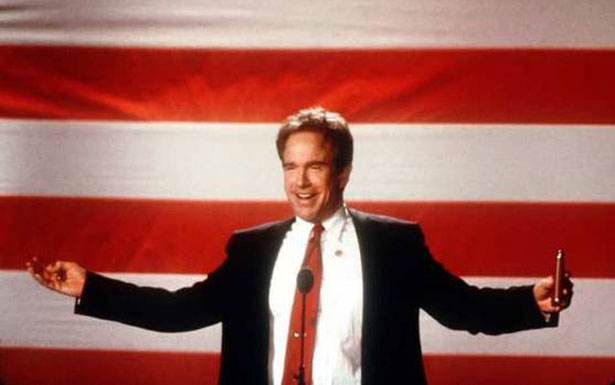
According to the lead article on page 1 of yesterday’s New York Times, Obama “in private…has talked longingly of ‘going Bulworth,’ ” in the face of “hindrances on him” (read, the hysterical nonsense that passes for politics in this country). As the co-writer of Bulworth, I have to say… “Nice!” The reporter of the Times piece, whose name I’ve already forgotten, calls Bulworth a “little remembered Warren Beatty film from 1998.” Well, it’s nice to think someone remembers it.
In Salon, Joan Walsh asks the question, “Should Obama Go Bulworth?” She doesn’t really answer her own question, but in interrogating what it might mean, she does heap a good deal of praise (and not a small measure of scorn) on the film. She quotes some of the lines I wrote for the raps Bulworth does at the big fundraiser at the Beverly Wilshire, calling them the political “high point” of the film. Also nice!
After offering a detailed account of the film—especially with regard to its handling of race, which she seems to mostly like, but also sees as occasionally cartoonish, naïve and relying on the racist trope of the Magic Negro (all points that I wouldn’t entirely concede, but would also have to say are not entirely lacking in merit)—she concludes that she “hated” the ending of Bulworth, because it was “a microcosm of unhealthy left wing fantasies, bad and good: that bold, progressive truth-telling will lead to landslide wins over corporate Democrats—and also get you killed.”
Now I would never deny being susceptible to unhealthy left-wing fantasies. We all need something to live for, after all. But I really don’t take her points on this at all. First of all, Bulworth’s landslide was meant as a punch line. It was a comic conceit that no one is meant to take literally or seriously.
His shooting is a different matter. Truth be told, I was originally very unhappy with the picture and sound editing of the final scene, because, I felt, it suggested too heavily that Bulworth was (as Walsh assumes) meant to be dead. But my intention for the final moments was for Bulworth’s life to be hanging in the balance, with the audience not knowing if he would live or die, at which point Amiri Baraka’s “magical negro” character clearly points us in a different direction.
“You can’t be no ghost, Bulworth. You got to be a spirit!” he demands. (These wonderfully poetic lines were written by the great poet himself, as was all the glorious dialogue spoken by his character—so if he’s magical, it’s Baraka’s own magic.) The meaning was clear to the 16-year-old girl in the test screening in the north Bronx. “He’s saying,” she told the interviewer, “you’ve got to make a difference with your life.” The point isn’t if you live or die, but whether your life is worth living. Warren Beatty often told me he wanted the message of the film to be from Martin Luther King: “If you have nothing worth dying for, you have nothing worth living for.”
Popular
"swipe left below to view more authors"Swipe →
Warren didn’t mind leaving the ending somewhat ambiguous, with the audience believing either that Bulworth was dead or hovering between life or death. But I was horrified at the notion that the audience would take away the idea that if you stand up and tell the truth, they will kill you.
As the years have rolled on, I’ve wondered why the notion bothered me so much. Walsh calls it a nihilistic fantasy, but isn’t the real fantasy that there is always, or even often, a happy ending for people who put their lives on the line for justice in this world? In reality, the happy endings are usually reserved for those who stay inside the well-defined parameters of allowable discourse—those like President Obama, and rest of the professional progressive class, who spend their careers admonishing the rest of us not to let the perfect become the enemy of the good.
In the opening scenes of the film, Bulworth makes a deal he doesn’t intend to keep with the insurance industry. He accepts a $10 million life insurance policy as a bribe to stop a bill they don’t want. But he’s planning to have himself killed, passing the money to his daughter, before he can make good on his part of the deal.
Obama made his own deal with the insurance companies. Only he lived to keep it. Before he was nominated he is reported to have said that, like Bulworth, he favored single-payer health insurance. We know how that movie turned out.
Whether legally forcing people to buy health insurance based on profit, not health, is actually good for anyone but the insurance industry remains to be seen, but what has been clear from the start is that Obama has always understood what it means to be president of the United States. He has always known that the job description simply does not allow for taking on any of the major industries such as “health” care, banks or oil. Or failing to keep the world order of Western military and economic hegemony in place. It requires, in fact, the opposite. Job one.
Bulworth, and, the film suggests, all intelligent people involved in politics in every form, know this. What Bulworth, the character, does that is so outrageous and so funny is not that he deplores this state of affairs or offers a visionary alternative but simply that he says it out loud. This, to me, is the only thing Obama could sensibly mean by longing to “go Bulworth.”
But he never will say any of it out loud. No one has to worry about that. He’s a politician working a system that’s not broken, but fixed. He is no Bulworth.

