Stanley Nelson’s new documentary The Black Panthers: Vanguard to the Revolution is a bracing examination of the history and politics of the Black Panther Party for Self Defense. Given that we are living in a time when the issues that animated this revolutionary socialist organization—racist police brutality and economic injustice—still resonate and given that new movements are finding their voice, this film could not be more timely. The documentary also made me consider the ways in which boxer Muhammad Ali played a role in the inspiration of the very existence of the Black Panther Party. In many respects, the events of the sports world were not in the mind of rank-and-file Panthers because they weren’t playing games. As onetime Panther—and long-time political prisoner—Mumia Abu-Jamal said to me in an interview, “As someone who grew up, very young in the Party, I didn’t form a lot of the idolatries that many age-mates did. At 14 to 15, I wasn’t fantasizing about being a member of the NBA or the NFL. I was a member of the Black Panthers, and that was enough for me.” Yet almost in the next moment Mumia said, “But if ever there was a sports hero to us, it was Muhammad Ali.”
Because he had been speaking out against racism, war, and the mainstream civil-rights movement for several years before the Panthers formed, Ali had a singular resonance. His triumphs in the ring were themselves political acts. Future Black Panther Party leader Eldridge Cleaver wrote in his 1968 autobiography Soul on Ice, “If the Bay of Pigs can be seen as a straight right hand to the psychological jaw of white America then [Ali/Patterson] was the perfect left hook to the gut.”
But Ali had an effect on the Panthers that rippled well beyond his wicked grace in the ring. In 1965 the Student Non-Violent Coordinating Committee (SNCC) in Lowndes County, Alabama, launched an independent political party and became the first group to use the symbol of a black panther. Their graphic was of a black silhouette of a panther with a slogan straight from the champ: “WE Are the Greatest.” They took his famous phrase, “I am the greatest,” and made it a collective call to arms. In addition, Panther co-founder Huey Newton said that he became politicized by watching Malcolm X and Muhammad Ali give speeches. They inspired him, but left him wanting more because he “had enough of religion” and later wrote, “references to God or Allah did not satisfy my stubborn thirst for answers.”
As for Muhammad Ali, he was not only aware of the Panthers. He saw what they were doing as a critical contribution to Black Freedom. In a 1970 interview for a publication known as The Black Scholar, Ali said. “I was determined to be one n—-er that the white man didn’t get. Go on and join something. If it isn’t the Muslims, at least join the Black Panthers. Join something bad.”
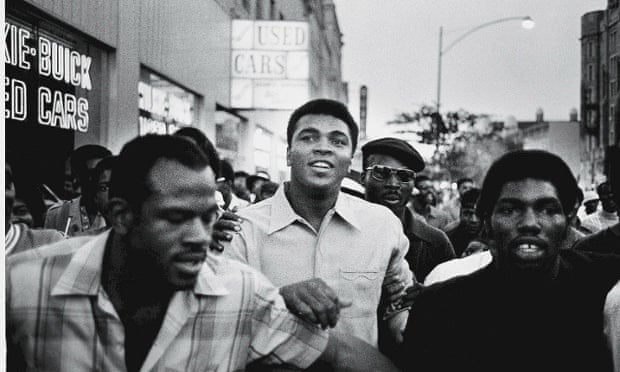
There are photos of Ali walking with the Black Panthers online and a clip of Ali speaking at a rally in support of the Panthers in San Francisco where he says, “Those of you who are white…have many white leaders who can speak for you. You have many whites in power who have the billions and trillions of dollars to help you. But black people also need a spokesman.”
Mumia Abu-Jamal also said to me that the only time a picture of an athlete made their newspaper The Black Panther was when Ali lost to Joe Frazier in the 1971 Fight of the Century and they put Ali’s face up there under the heading, “The People’s Champ.”
This linking of Ali and the Panthers was also seen in the minds of the rebel black soldiers fighting “America’s war” in Vietnam. In 1970, journalist Wallace Terry traveled to Southeast Asia to survey 392 African-American and white soldiers. The heroes of black soldiers were primarily Muhammad Ali and Black Panther Stokely Carmichael—all because they were seen as symbols of opposition to the bloody conflict.
Stories like this remind us that Muhammad Ali was not the harmless “civil rights saint” that he is often portrayed as. They also remind us why it is that Ali’s radical teeth have been extracted and why the Panthers, as Stanley Nelson showed so searingly, were subject to vicious state repression. It wasn’t because of berets or charisma. It was because they inspired masses of people to revolt. They inspired people to put down their guns in Vietnam or, even more scarily, turn their guns around. That was Ali. That was the Panthers. And given the plague of problems we face today, that is why Stanley Nelson did such a service by keeping the raw revolutionary memory of this organization alive.