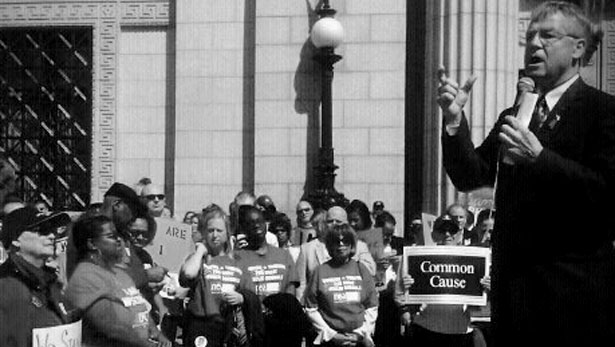
Common Cause President and CEO Bob Edgar. (Photo Courtesy of Common Cause.)
Bob Edgar lived by the guidance of an African proverb: “If you want to walk fast, walk alone. If you want to walk far, walk together.”
For half a century, Bob walked with the movements for economic and social justice, for peace, and above all for democracy. Often he was in the lead. But Bob was never too proud to follow. That was because he believed with all his heart and all his soul in the necessity of making the transit as a whole people, as a whole nation, from disenchantment and disengagement to the America imagined by the social-gospel preachers of a century ago where “the people shall rule.”
Bob Edgar was elected to the US House in the 1974 “Watergate election” as a righteous reformer bent of making real the full promise of American democracy.
He died almost 40 years later, still fighting the same fight he had waged during 12 years in Congress, still every bit as determined and hopeful and focused as he ever was on the real work of getting big money out of politics, creating a media system that sustains honest and freewheeling debate and assuring that every citizen has a right to vote.
It says something about Bob’s joyous work-ethic that, in the two months before his unexpected death from a heart attack at age 69, he seemed to be everywhere. He invited me to deliver the closing keynote address at Common Cause’s remarkable “Watergate at 40” conference in Washington and I had a chance to spend two days with Edgar in mid-March. He was entirely in his element, making the connection between the passion for challenging the Nixon administration abuses of power that brought the university chaplain into politics in the 1970s and the passion for challenging the money-in-politics abuses of the 21st century that were his focus as president of Common Cause.
Less than a month later, I was with Bob at the National Conference for Media Reform in Denver, where we celebrated the breakthrough investigative reporting of the “ALEC Exposed” project, which saw The Nation work with Common Cause and the Center for Media and Democracy to reveal the behind-the-scenes machinations of the corporate-funded American Legislative Exchange Council. Bob was at his best, sharing the kudos with others but accepting the responsibility to fight for greater funding of community and public broadcasting and investigative journalism projects that speak truth to power.
One week later, in Fitchburg, Wisconsin, we were featured speakers at a “All About Citizens United” conference organized by grassroots activists – Oregon Area Progressives and South Central Wisconsin Move To Amend – where hundreds of people heard Bob’s warm, good-humored call for linking up the many reform movements of the moment to raise a mighty campaign to drive the money changers from the temple. “I’ll believe corporations are people the day after they have a colonoscopy,” he declared. “I think money is important, money is speech, but money can stifle speech. And we in fact are the only leaders we have to save democracy.”
Bob spoke at length that day of getting his start as a preacher in the coal regions of Pennsylvania and his “accidental” election to Congress, of his long-term activism for civil rights (as a member and champion of the Leadership Conference on Civil and Human Rights), for peace (as the brilliant anti-war leader of National Council of the Churches of Christ in the USA in the years before the U.S. invasion of Iraq) and for an America as kind and as generous as its people.
At Bob’s call, the people in that room rose to their feet and followed his chant of: “We are… we are… the leaders we’ve been waiting for.”
Bob Edgar… Bob Edgar… was the leader we were waiting for.
He kept reminding us of the direction we needed to head in to get to the America that should be. Now, in his memory, in his honor, we march on to complete the journey.

