The Supreme Court Could Decide This Term’s Big Gun Case on the Basis of… Grammar
Justices like Neil Gorsuch are doing all they can to make sure “bump stocks”—which turn regular guns into machine guns—are legal.
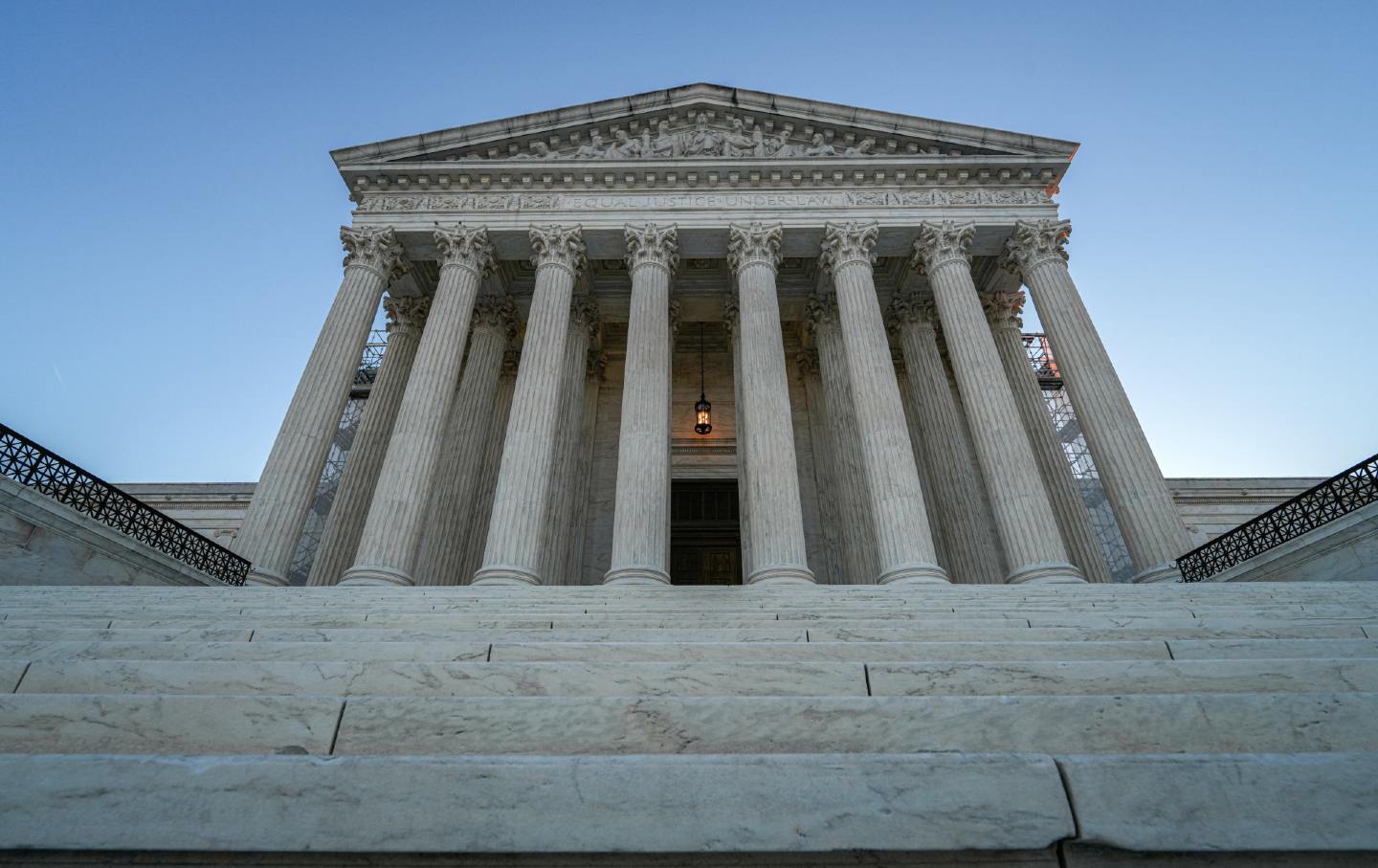
The US Supreme Court Building in Washington, D.C.
(J. David Ake / Getty Images)We live in a country that is soaked in the blood of our own children. We live in a country that is riddled with the bullets of mass shooters. Yet every time we try to protect ourselves and our kids from this violence, every time we try to stanch the bleeding caused by weapons of mass murder, Republican jurists rise to defend nearly unrestricted access to these weapons.
The latest example of this was yesterday’s Supreme Court arguments in the case of Garland v. Cargill. After the 2017 Las Vegas musical festival shooting, when gunman Stephen Paddock killed 60 people and injured over 400 in just 10 minutes during the deadliest mass shooting in US history, the Trump administration decided to ban “bump stocks.” Bump stocks are a mechanical device, affixed to the butt of a gun, that turn a semiautomatic weapon into a fully automatic weapon. They work by capturing the recoil from firing a weapon and cycling that kinetic energy back into the shooter’s trigger finger. The shooter fires a bullet, the weapon “bumps” against their shoulder, and that action produces an additional bullet, and so on. From the shooter’s perspective, they pull the trigger once and a continuous hail of bullets comes out of their compensation device, just like a machine gun. By using bump stocks Paddock, a 64-year-old man, was able to fire over 1,000 bullets in 10 minutes in Las Vegas.
Fully automatic machine guns are already banned in the United States. So are weapons that function like machine guns, and modifications that turn weapons into functional machine guns. They’ve been banned since the passage of the National Firearms Act of 1934, a Franklin Delano Roosevelt–era response to the gang violence unleashed by Prohibition. The law was targeted at the gangsters’ favorite weapon, the “tommy gun.” It is worth noting that there was a time in this country when we banned guns used by people to cause mass terror and death.
All the Trump administration did, through the Bureau of Alcohol, Tobacco, and Firearms was add bump stocks to the list of banned modifications. But this angered the National Rifle Association and its army of gun fanatics throughout the country. To this day, I have yet to hear a compelling justification for why anyone would need a bump stock (more on this point later), but legitimate need is never the question when it comes to how Republicans say we must be allowed to kill each other.
Since the conservatives have no argument for why bump stocks should be legal as a policy matter, and since there’s an entire law banning weapons that do exactly what bump stocks allow shooters to do, the conservative justices turned to their last but favorite line of defense: grammar. Here’s how the National Firearms Act defines machine gun: “The term ‘machinegun’ means any weapon which shoots, is designed to shoot, or can be readily restored to shoot, automatically more than one shot, without manual reloading, by a single function of the trigger. The term shall also include…any part designed and intended solely and exclusively…for use in converting a weapon into a machinegun.”
According to the ammosexuals, bump stocks do not fit the definition, because the modification doesn’t “automatically” fire more than one shot, and the multiple shots that are produced do not happen from a “single function of the trigger.”
If you look at bump stocks from the perspective of the shooter, the NRA argument makes no sense. One pull on the trigger, and multiple bullets automatically fly. That’s the operation of a machine gun. But the ammosexuals do not look at this from the perspective of the human person firing the gun; instead, as usual, they look at it from the perspective of the anthropomorphized gun itself. The gun knows it is not firing multiple bullets automatically; the gun knows it’s still responding to multiple pulls on the trigger, even though those pulls are happening faster than any human could consciously produce them. The gun knows what it is; it’s the stupid, fleshy meatbags who have things confused.
You can guess which perspective the conservative Supreme Court justices adopted. Justice Neil Gorsuch, who treats the entire American legal cannon as a workbook from Strunk & White, led the charge. He argued that “function” is an intransitive verb, which means it doesn’t need an object (“the trigger”) to make sense; and since that is the case, the law must be understood from the perspective of the trigger as opposed to the shooter. I wish I were making that up, but I am not obtuse enough to mischaracterize a machine gun ban because of a sentence diagram from my middle school English class.
Most of the oral arguments went back and forth on this point, with Gorsuch and the attorney for the gun lobby, Jonathan Mitchell (the same Jonathan Mitchell who invented the Texas abortion bounty hunting law and recently argued for Trump to stay on the ballot despite his status as an insurrectionist), insisting that liberals were replacing the word “function” for the word “pull.” According to conservatives, if the statute said “pull” of the trigger, bump stocks would be banned, but since it says “function,” all we can do as a society is cower under our desks and hope the mass shooter loses interest.
The alleged distinction between function and pull is how we know that the often-touted conservative solution to the problem of bump stocks will not work. Gorsuch suggested that if we really want to ban bump stocks, Congress should pass a new law explicitly doing so, instead of relying on this one passed in 1934. First of all, that suggestion is offered in bad faith, because Gorsuch and pretty much anybody who has turned on a television in the last 20 years knows that Congress simply refuses to pass any additional gun regulations because Republicans fear angering the NRA. But more important, the gun-manufacturing industry can work around any gun ban as long as there are people like Gorsuch around willing to play silly word games. Bump stocks themselves are a mechanical work-around to the machine gun ban. If you ban “bump stocks,” the gun lobby will look at the definition and design something that functions the same way, but operates slightly differently, and then say that we have to pass an entirely new law to ban their new death toy. And on and on, ad infinitum.
If the law prohibited a single “pull” of the trigger, the ammosexuals would say their new weapon required only a “squeeze” of the trigger. If the law banned squeezing the trigger, the conservatives would say that the gun required only a “stern acknowledgment” of the trigger. The word games never stop with these people, and thus the killing never stops.
Eventually, Justice Elena Kagan had enough. She said that she considered herself a “good textualist,” but that what Mitchell was asking her to do flew in the face of “common sense.” Surprisingly, to me, Justice Samuel Alito asked the most commonsense question of the entire hearing. He asked Mitchell if he could provide any good reason why a legislature would attempt to ban machine guns, but not ban bump stocks at the same time.
Mitchell said he could think of a few: He said bump stocks might help people with “arthritis, “people with disabilities,” and “people who lack finger dexterity.” It was truly one of the most pathetic answers I have ever heard in open court. I can’t tell you what happened immediately after his answer, because I lost five minutes of my life screaming at the audio feed after he said it. This man, who literally thinks gun owners have more rights than uterus owners, actually fixed his mouth to say that the legislative reason for treating weapons affixed with bump stocks differently from already banned machine guns was to help people with creaky fingers who smell like Bengay shoot their way through their enemies as quickly as others. We live in the worst possible time.
Popular
“swipe left below to view more authors”Swipe →Now, I don’t think Alito asked that question because he seriously cared about the answer. Alito is going to vote for the guns, and he was just fishing for an alternative line of reasoning beyond Gorsuch’s tortuous investigation into 1900s grammar. But I’m not sure that conservatives have five votes to overturn the ban on bump stocks. Chief Justice John Roberts was largely silent during the arguments, and while Roberts likes guns, he doesn’t generally like his court to step in and overturn plausibly lawful executive actions.
Most likely, the case will turn on the views of Justice Amy Coney Barrett. She seemed to be on the fence. She told Deputy Solicitor General Brian Fletcher (who argued the case for the government, and argued very well) that she was “sympathetic” to his argument, while she indicated to Mitchell that she found some of his mechanical points about how bump stocks worked unpersuasive. But she also seemed hung up on the single-vs.-multiple function of the trigger nonsense. Barrett has a history of seeming conflicted during oral arguments, but then voting and writing like a standard-issue MAGA Republican when the chips are down, so I’m not inclined to trust her public face anymore. But, on this occasion at least, the liberal justices seemed to take her at her word. Questions from Kagan, Sonia Sotomayor, and Ketanji Brown Jackson seemed designed to address Barrett’s concerns and bring her over to the side of “it’s a goddamn machine gun” like a reasonable person.
I don’t know exactly how this opinion will play out, but I can’t help feeling despair over the fact that it’s this close. Look at where we are. We live in the most violent industrialized nation on Earth. We have a weapon modification that you’d need only if you were storming the beaches of Normandy but was readily available to a random 64-year-old man with no military training. He used it to kill and maim hundreds and hundreds of people in less time than it took you to read this article. The policy justification for that modification reduces to “sometimes my fingers ache,” and the legal justification hinges on whether the use of an intransitive verb in a 90-year-old statute prevents the government from protecting its citizens.
We are lost. I hope the transcript of yesterday’s hearing survives the end of American civilization, because it will help future historians figure out why we failed.
Disobey authoritarians, support The Nation
Over the past year you’ve read Nation writers like Elie Mystal, Kaveh Akbar, John Nichols, Joan Walsh, Bryce Covert, Dave Zirin, Jeet Heer, Michael T. Klare, Katha Pollitt, Amy Littlefield, Gregg Gonsalves, and Sasha Abramsky take on the Trump family’s corruption, set the record straight about Robert F. Kennedy Jr.’s catastrophic Make America Healthy Again movement, survey the fallout and human cost of the DOGE wrecking ball, anticipate the Supreme Court’s dangerous antidemocratic rulings, and amplify successful tactics of resistance on the streets and in Congress.
We publish these stories because when members of our communities are being abducted, household debt is climbing, and AI data centers are causing water and electricity shortages, we have a duty as journalists to do all we can to inform the public.
In 2026, our aim is to do more than ever before—but we need your support to make that happen.
Through December 31, a generous donor will match all donations up to $75,000. That means that your contribution will be doubled, dollar for dollar. If we hit the full match, we’ll be starting 2026 with $150,000 to invest in the stories that impact real people’s lives—the kinds of stories that billionaire-owned, corporate-backed outlets aren’t covering.
With your support, our team will publish major stories that the president and his allies won’t want you to read. We’ll cover the emerging military-tech industrial complex and matters of war, peace, and surveillance, as well as the affordability crisis, hunger, housing, healthcare, the environment, attacks on reproductive rights, and much more. At the same time, we’ll imagine alternatives to Trumpian rule and uplift efforts to create a better world, here and now.
While your gift has twice the impact, I’m asking you to support The Nation with a donation today. You’ll empower the journalists, editors, and fact-checkers best equipped to hold this authoritarian administration to account.
I hope you won’t miss this moment—donate to The Nation today.
Onward,
Katrina vanden Heuvel
Editor and publisher, The Nation
More from The Nation

The King of Deportations The King of Deportations
ICE’s illegal tactics and extreme force put immigrants in danger.
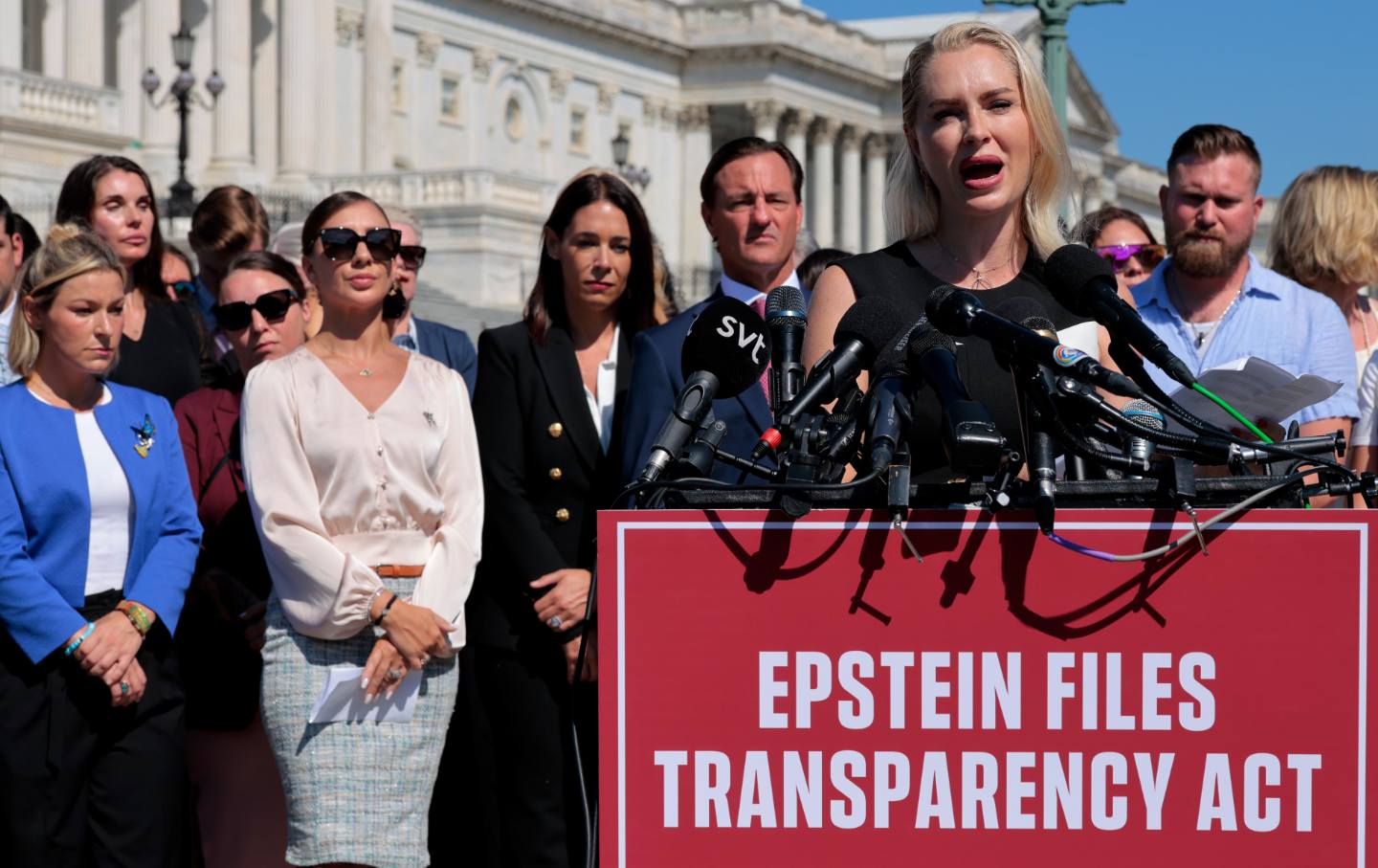
The Epstein Survivors Are Demanding Accountability Now The Epstein Survivors Are Demanding Accountability Now
The passage of the Epstein Files Transparency Act is a big step—but its champions are keeping the pressure on.

Mayor of LA to America: “Beware!” Mayor of LA to America: “Beware!”
Trump has made Los Angeles a testing ground for military intervention on our streets. Mayor Karen Bass says her city has become an example for how to fight back.

Breaking the LAPD’s Choke Hold Breaking the LAPD’s Choke Hold
How the late-20th-century battles over race and policing in Los Angeles foreshadowed the Trump era.

The Fight to Keep New Orleans From Becoming “Everywhere Else” The Fight to Keep New Orleans From Becoming “Everywhere Else”
Twenty years after Katrina, the cultural workers who kept New Orleans alive are demanding not to be pushed aside.

Organized Labor at a Crossroads Organized Labor at a Crossroads
How can unions adapt to a new landscape of work?

