The Right’s Latest Target: Unmarried Women
Archconservatives find single women threatening, and they’re trying to browbeat them into submission.
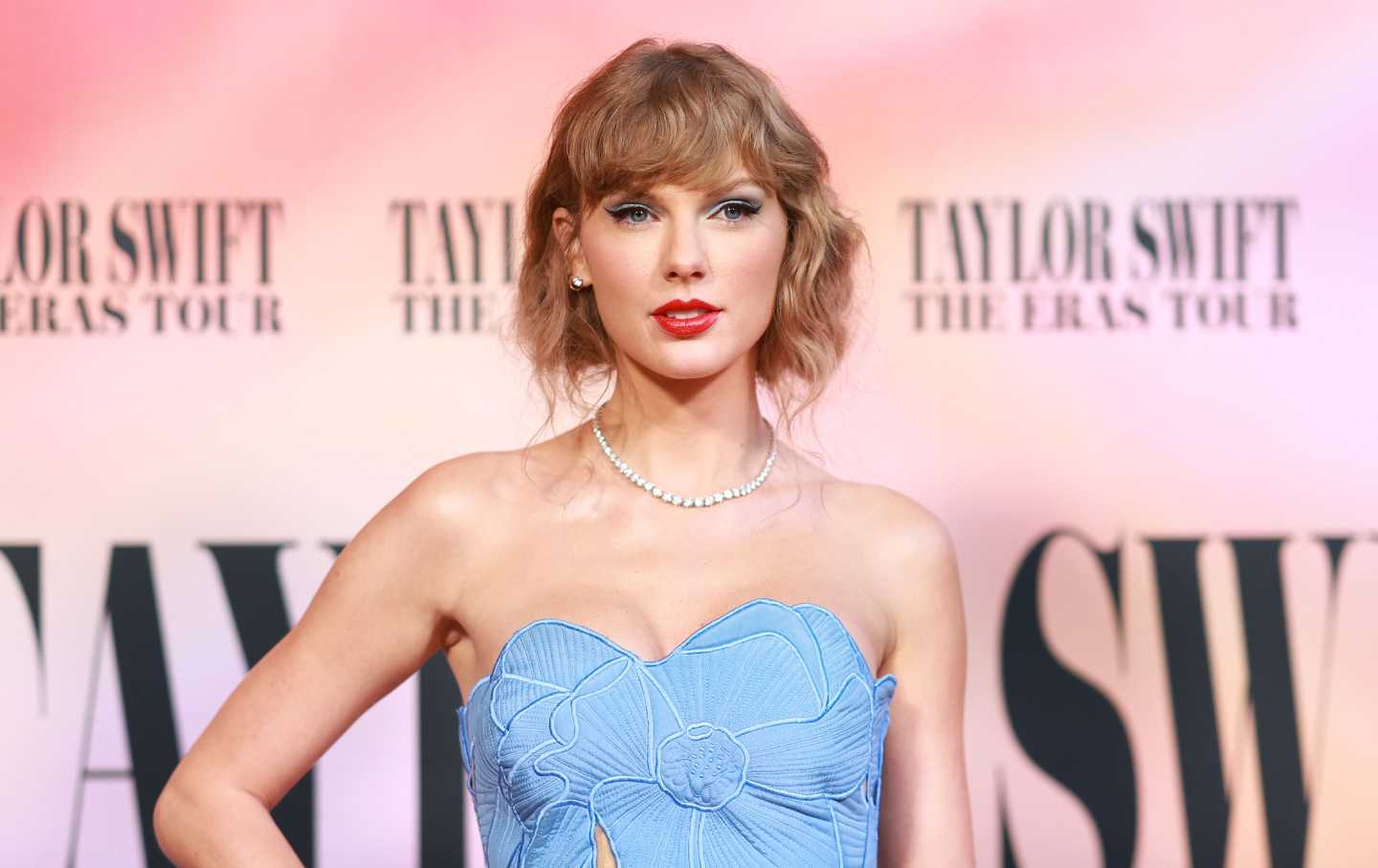
The reactionary right has found an impressive new target in its ongoing culture war. This time it’s Taylor Swift, whose current Eras Tour—encompassing 146 dates on five continents—is a cultural and economic earthquake so large that it has even registered on the sensitive fiscal seismographs of the Federal Reserve. In July, the Philadelphia Fed, in its authoritative Beige Book, credited Swift with reviving that city’s flagging tourism industry. As Time reports, Swift’s tour is projected to gross a record-breaking $2.2 billion and generate nearly $5 billion in consumer spending in the United States.
Swift released her first album in 2006, before she turned 17. At 33, she’s become a media juggernaut comparable to Elvis in the 1950s, the Beatles in the ’60s, or Michael Jackson in the ’80s. And like those earlier celebrities, Swift has become a divisive cultural figure. Her legion of fans—a predominantly female group of enthusiasts known as “Swifties”—are relentless in attacking any criticism of their idol that they view as unfair.
Swifties now have their work cut out for them, as a mouthy section of the American right, which recently has had doubts about Swift, has decided to target the singer-songwriter with invective. In early September, The Federalist posted an article by Mark Hemingway titled “Taylor Swift’s Popularity Is a Sign of Societal Decline.” The article is largely taken up with invidious comparisons between Swift and male musicians like Paul McCartney and Tom Petty, arguing that Swift is narrowly and narcissistically focused on breakup songs about her former boyfriends.
Hemingway’s article enjoyed renewed attention in late September, when Swift was rumored to be dating the Kansas City Chiefs tight end Travis Kelce, himself unpopular on the right for appearing in an ad urging viewers to get their Covid booster. The Federalist’s CEO, Sean Davis, posted Hemingway’s article on Twitter with the blurb “Taylor Swift is dumb and her music sucks.” Roger Kimball, the editor and publisher of The New Criterion, a cultural journal that claims the poet T.S. Eliot as part of its intellectual lineage, felt compelled to elevate the discourse by adding, “Also, she is homely.” Charlie Kirk of Turning Point USA tweeted, “What will break Kelce’s heart first? The COVID shot or Taylor Swift?” Strikingly, the anti-Swift comments are all bullying, designed to insult rather than persuade.
On the face of it, right-wing anger at Swift is puzzling. For most of her career, she’s been studiously nonpolitical and nonpartisan. In recent years, she has emerged as a critic of Donald Trump and a supporter of Joe Biden, but very much in the vein of mainstream liberalism. She’s certainly not a musical firebrand in the tradition of Woody Guthrie, Nina Simone, Joan Baez, or Public Enemy. Hemingway complains that her lyrics are feminine laments (what he calls “bellyaching about a boyfriend” songs). It shows how reactionary the right has become that singing about the perennial topic of bad boyfriends—something that blues and country singers have done for decades—is now considered an affront to civilization.
The most recent political cause that Swift has taken up is voter registration. Like vaccination, voter registration was once considered an innocuous activity that all people of good will could support. Now it has become a source of partisan polarization. As Edith Olmsted noted in The New Republic, Swift’s Instagram advocacy on September 17, National Voter Registration Day, led to a 115 percent increase in 18-year-olds registering to vote compared to the same day a year ago. “Swift’s call for her fans to register to vote was distinctly nonpartisan,” Olmsted wrote, “but it’s the youngest voting cohort that’s demonstrated the sharpest opposition to Republicans at the polls in recent elections—so much so that conservatives have increasingly called for the voting age to be raised and for polling places to be removed from college campuses.”
More unmarried women voting poses a particular threat to the GOP. In 2020, a whopping 63 percent of single women voted for Biden over Trump. This is bad news for the Republican Party, since the number of married people is declining. The share of households headed by married couples declined from 55 percent in 1990 to 46 percent in 2020.
In his broadside against Swift, Hemingway made a telling reference to a far less famous victim of right-wing browbeating, the podcaster Julia Mazur. Hemingway compared Swift’s lyrics to Mazur’s message in a viral TikTok, which he paraphrased as “it’s great being 29 and unmarried and childless.” Others on the right attacked her in much nastier terms. Matt Walsh of The Daily Wire complained that Mazur’s TikTok showed that her “life doesn’t revolve around her family and kids so instead it revolves around TV shows and pop stars. Worst of all she’s too stupid to realize how depressing this is.” Walsh’s Daily Wire colleague Candace Owens characterized the video as showing what “future depression, Xanax-and-wine combo nights alone looks like.” Comments like this led Zach Kessel of National Review to warn his fellow right-wingers not to conflate “conservative” with “jerk.”
Kessel’s observation is worth pursuing. In the age of Trump, conservatism has indeed become jerkism—a politics of pure browbeating and intimidation. In the sordid world of pickup artists—professional misogynists who continue to have an increasing influence on the right—the idea is often promoted that women are best controlled by “negging.” In other words, by constant insults that destroy their self-worth. The right is trying to neg strong, confident women like Swift and Mazur, who are simply trying to enjoy life.
This attempted intimidation, especially after many women are already justifiably enraged by the rollback of abortion rights, is remarkably counterproductive. To this profoundly piggish agenda, all one can say is, “Good luck with that, jerkoffs.”
Disobey authoritarians, support The Nation
Over the past year you’ve read Nation writers like Elie Mystal, Kaveh Akbar, John Nichols, Joan Walsh, Bryce Covert, Dave Zirin, Jeet Heer, Michael T. Klare, Katha Pollitt, Amy Littlefield, Gregg Gonsalves, and Sasha Abramsky take on the Trump family’s corruption, set the record straight about Robert F. Kennedy Jr.’s catastrophic Make America Healthy Again movement, survey the fallout and human cost of the DOGE wrecking ball, anticipate the Supreme Court’s dangerous antidemocratic rulings, and amplify successful tactics of resistance on the streets and in Congress.
We publish these stories because when members of our communities are being abducted, household debt is climbing, and AI data centers are causing water and electricity shortages, we have a duty as journalists to do all we can to inform the public.
In 2026, our aim is to do more than ever before—but we need your support to make that happen.
Through December 31, a generous donor will match all donations up to $75,000. That means that your contribution will be doubled, dollar for dollar. If we hit the full match, we’ll be starting 2026 with $150,000 to invest in the stories that impact real people’s lives—the kinds of stories that billionaire-owned, corporate-backed outlets aren’t covering.
With your support, our team will publish major stories that the president and his allies won’t want you to read. We’ll cover the emerging military-tech industrial complex and matters of war, peace, and surveillance, as well as the affordability crisis, hunger, housing, healthcare, the environment, attacks on reproductive rights, and much more. At the same time, we’ll imagine alternatives to Trumpian rule and uplift efforts to create a better world, here and now.
While your gift has twice the impact, I’m asking you to support The Nation with a donation today. You’ll empower the journalists, editors, and fact-checkers best equipped to hold this authoritarian administration to account.
I hope you won’t miss this moment—donate to The Nation today.
Onward,
Katrina vanden Heuvel
Editor and publisher, The Nation