“The thing is that, when you are a popular athlete, and you accept the money and the fame, and you become a front person for those who have the power, and they say be like this guy and kids that are coming up say, well, be like him, I won’t protest against anything, I’ll accept everything, I’ll just try to be a great athlete and make a lot of money. So a culture dies when you do that. You’re doing a great injustice to young kids that are coming up, and I never wanted to be a representation of less than a man and have young kids coming up emulating me.” — Jim Brown
The senseless killing of 17-year-old Trayvon Martin by a self-appointed “neighborhood watch captain” has provoked anguish, rage and now, at long last, resistance. We’ve seen rallies, demonstrations and walkouts at dozens upon dozens of high schools in Florida alone. Even more remarkably, this resistance has found expression in the world of sports. An impressive group of NBA players from Carmelo Anthony to Steve Nash to the leaders of the NBA Players Association have spoken out and called for justice.
The most notable and widely publicized example of athletic solidarity was seen on the NBA’s marquee team, the Miami Heat. The entire Heat squad posed for a photo, all wearing the now iconic hooded sweatshirts. Trayvon was wearing a “hoodie” when he was killed, and this fact has, maddeningly, been a central rationale given by his killer’s defenders for why he was perceived as a threat.
Of all teams in the league, the Heat had the greatest responsibility to step up and be heard. They were Trayvon’s favorite and he was killed that late afternoon after leaving his house for a snack during half-time of the NBA All-Star game, which featured the Heat’s Big Three of LeBron James, Dwyane Wade and Chris Bosh.
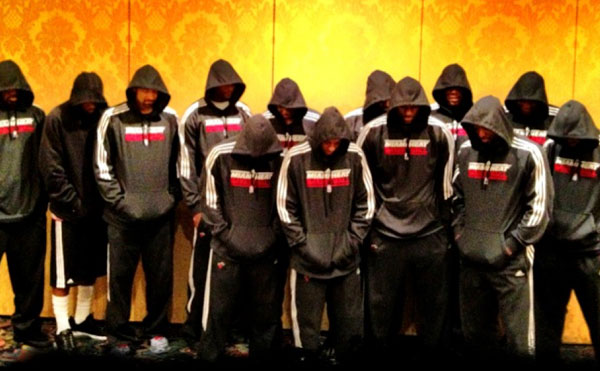
Given the depth of this movement, particularly in southern Florida, it’s not too surprising that the Heat made this powerful gesture. But maybe it is surprising for many fans to learn that the effort was driven by “The King” himself, LeBron James. The photo was reportedly James’s idea and it was first posted to his personal Twitter account with the hashtag #WeWantJustice.
James later said, “It was very emotional, an emotional day for all of us. Taking that picture, we’re happy that we’re able to shed light on the situation that we feel is unjust.”
His teammate Wade commented to the Associated Press, “This situation hit home for me because last Christmas, all my oldest son wanted as a gift was hoodies. So when I heard about this a week ago, I thought of my sons. I’m speaking up because I feel it’s necessary that we get past the stereotype of young, black men and especially with our youth.”
Later, at their game on Friday night, James and several of his teammates, took the floor with messages such as “RIP Trayvon Martin” and “We want justice” scrawled on their sneakers.
LeBron’s actions might surprise fans given that he’s never publicly displayed a social conscience, but perhaps they shouldn’t. Years ago, before “The Decision,” before he “took his talents to South Beach,” before anyone burned his jersey, and before he became the sports world’s favorite villain, a young LeBron James—pegged already the most physically gifted basketball player to ever walk the earth—said he had two goals in life. One was to be the richest athlete in history and the other was to be “a global icon like Muhammad Ali.”
These might be two great goals, but they don’t exactly go great together. The contradiction is rooted in the fact that Ali remains a global icon because of the fame and fortune he sacrificed for what he believed to be the greater good. “The Greatest” took deeply unpopular stands against war, racism and even the mainstream civil rights movement. He was sentenced to five years in Leavenworth for opposing the draft, and said, “If I have to go to jail, I’ll go to jail happy.” He also shouted three words pro athletes are hardwired to never say: “Damn the money.” Lebron James would have miles to travel, millions of dollars to forsake and dozens of Confederate talk radio hosts to offend to ever be mentioned in the same breath as Ali. But this is a start.
The fact that LeBron James has used his exalted platform to speakout for Trayvon and his family even at the risk of his own bottom line, should be in these dark days, a great source of hope. Trayvon’s killing has motivated millions to wake up and give a damn about what rots beneath the mini-malls, gated communities and “security culture” that shades great swaths of our country. We all have a role to play in not only making sure there is justice for Trayvon but also in ensuring no other family or community has to suffer such a loss. If and when there is another killing rooted in fear and ignorance, we now have every right to ask LeBron, “What are you going to say now?” That’s the scary thing about choosing to give a damn. People will expect you to mean it.

