The United States Has Always Been a Divided Nation
Coming to terms with this reality will allow us to strengthen and maximize the full power and potential of our nation—the one dedicated to the proposition of equality.
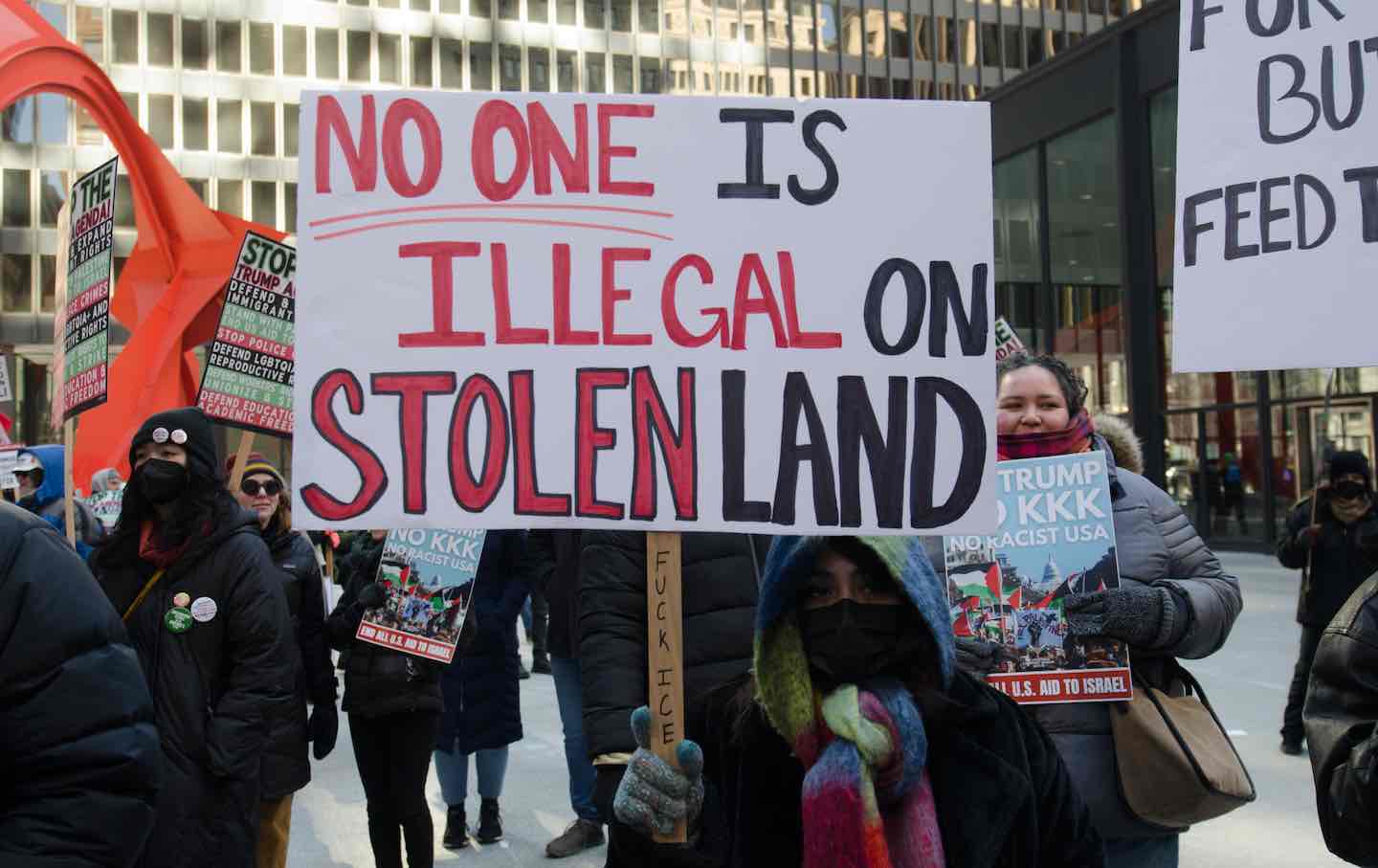
Protesters march through downtown Chicago, opposing Donald Trump’s presidential inauguration on January 20, 2025.
(Jacek Boczarski / Anadolu via Getty Images)
As we brace for a potentially brutal four years, it is essential that we have a clear understanding of the actual fight that we are engaged in. The fact is that there have always been two different, hostile, and usually combative nations within this one country; the current real and existential threat to our democracy is an outgrowth of a centuries-long struggle over who belongs in America and who doesn’t. By coming to terms with this reality and redirecting our energy, efforts, and resources accordingly, we can better withstand Trump’s assaults, make meaningful progress towards fostering greater justice and equality in many parts of the country, and lay the foundation for retaking power at the federal level in 2026 and 2028.
What, Exactly, Is a “Nation”
It can be confusing to understand what constitutes an actual nation, since we live in a world where the planet’s population has regularly been organized and reorganized, often violently, to fit within shifting borders. The complexity is accentuated by the fact that there are also 574 Native American “nations” within the current borders of the United States.
Notably, the definition of a nation is not simply, or even primarily, a question of borders. The United States’ borders have shifted multiple times, including in the 1840s when the country went to war with Mexico in support of the white colonizers in the region who wanted to continue to enslave Black people. After that bloody war, the United States annexed 55 percent of Mexico’s land mass and created the current Southwest of this country (giving rise to the defiant phrase favored by many Mexican Americans—“we didn’t cross the border, the border crossed us”).
Alaska is perhaps the clearest illustration that geographic proximity is not the defining characteristic of a nation. The state is located 500 miles from the northern border of the continental United States. And although the only country geographically contiguous to Alaska is Canada, the region still sends two senators and one representative to Washington, DC, to serve in the United States Congress. Furthermore, Donald Trump’s latest nonsense about annexing Greenland further affirms the reality that borders don’t define a nation.
So what exactly is a nation? First, while often used interchangeably, it is not necessarily the same thing as a country.
Voice of America describes a “country” as an organized political unit, with territory, sovereignty, and a governing body. For its part, a “nation,” as defined by scholars and described by the think tank Global Policy Forum is “a large group of people with strong bonds of identity.” That common identity “is typically based on shared culture, religion, history, language or ethnicity.” You sometimes see disparate people bound by a common identity organically using the phrase in contexts such as popular culture (Cornell University professor Riche Richardson, for example, teaches a class called, “Beyoncé Nation: The Remix Course”).
Common identity based on shared culture, religion, and ethnicity has been an ever-present reality in a country whose first naturalization law, passed in 1790, restricted citizenship to “free white person[s].”
The Civil War
The clearest manifestation of the cleavage of one country into two nations occurred in 1861 when the leaders of the slaveholding states refused to accept the results of the presidential election in which the candidate backed by Black people—Abraham Lincoln—won. The legislatures in 11 states formally voted in rapid succession to leave the United States of America and create their own nation, the Confederate States of America. Each nation elected leaders, convened governing bodies, collected taxes, and drafted young men to serve in their respective militaries.
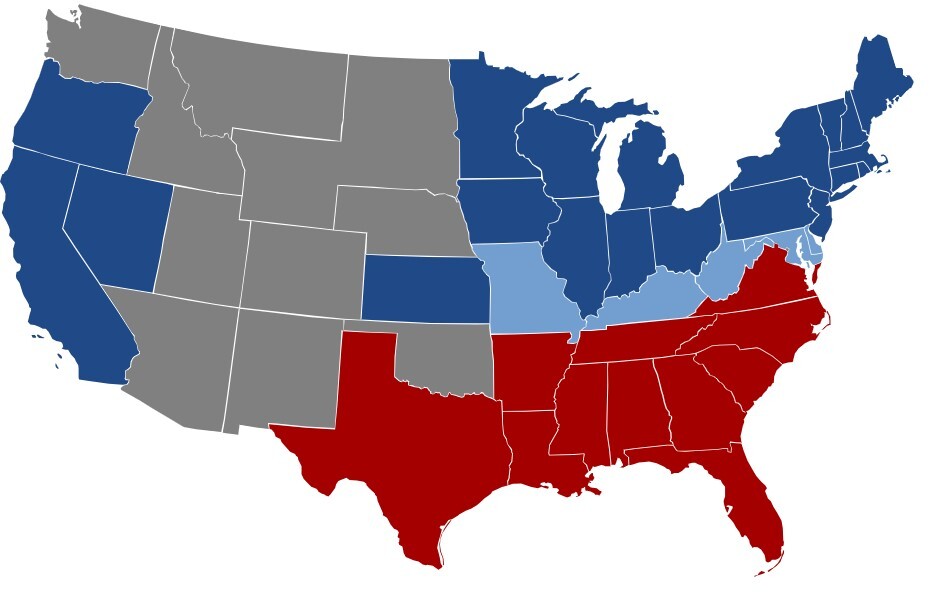
The Civil War also provided the clearest articulation of the values, visions, and priorities that distinguished the respective nations. Lincoln eloquently described the United States in his famous Gettysburg Address. The opening lines of that 272 word speech remain relevant and instructive to this day:
Four score and seven years ago, our fathers brought forth on this continent a new nation, conceived in liberty, and dedicated to the proposition that all men are created equal. Now we are engaged in a great civil war, testing whether that nation, or any nation so conceived and so dedicated, can long endure.
For their part, the Confederates did not dispute what was at stake. In its Declaration of Secession, South Carolina—the first state to secede—clearly and unmistakably stated that the cause of the conflict was the “increasing hostility on the part of the non-slaveholding States to the institution of slavery.” Three months later, Confederate Vice President Alexander Stephens drove the point home in his famous Cornerstone Speech, plainly stating that the Confederate government’s “foundations are laid, its cornerstone rests, upon the great truth that the negro is not equal to the white man; that slavery subordination to the superior race is his natural and normal condition.”
Today, 38 percent of the country’s entire population lives in states that went to war in the 1860s and killed people by the tens of thousands in defense of the belief that “the negro is not equal to the white man.” So while the most common—and comfortable—response to the racism and atrocities of the Civil War is “that was a long time ago,” the essential inconvenient truth is that the underlying struggle that caused the conflict 163 years ago has persisted to the present day.
The Civil War Never Ended
The determination to carry on the Confederate cause stretched from the 1865 assassination of Lincoln by a white supremacist just five days after the Confederates ostensibly surrendered at Appomattox, all the way up through Trump’s pardon of the January 6, 2021, insurrectionists—people who, carrying the Confederate flag, stormed the United States Capitol wearing sweatshirts emblazoned with the words “MAGA Civil War.”
Popular
“swipe left below to view more authors”Swipe →In Trump’s lifetime, the political and financial power of the Confederate-adjacent portion of the population has steadily grown. In 1948, two years after Trump was born, a coalition of white Southerners proudly declared, “We stand for the segregation of the races,” formed the Dixiecrat Party and mounted a third-party presidential bid that succeeded in winning the most votes in four states. Twenty years later, in 1968, Alabama’s segregationist Governor George Wallace took the white supremacist baton and launched his own presidential bid, quintupling the Dixiecrat popular vote and winning five states outright. Alabama writer John Anderson highlighted the reality that Wallace’s “startling appeal to millions of alienated white voters was not lost on Richard Nixon and other Republican strategists.”
For all the energy expended seeking nonracial explanations of American voting behavior, it remains the fact that in every single election since Democratic President Lyndon Johnson signed the 1965 Voting Rights Act, the majority of white voters have sided with the Republicans. Every. Single. Election. For 60 years. That’s how residents of a nation—a grouping of people who share a common identity—behave.
The fundamental failure of Democrats and progressives over the past four years was the inability to understand the essential distinction of what’s happening in this country. We remain “engaged in a great civil war, testing whether that nation, or any nation so conceived and so dedicated, can long endure,” but too many on the Democratic and progressive side are afraid to truly engage that battle. Rather than confront and denounce Trump’s racism by staunchly standing for the kinds of calls for justice and equality that were widespread in the weeks after George Floyd’s murder in 2020, too much of Democratic messaging downplays the fight for equality in the hope of wooing people drawn to the nativist and divisive leadership of Trump.
Surviving this period and pursuing the path back to power requires tailoring strategies, plans, and actions that will strengthen and maximize the full power and potential of our nation. Looking through that lens, we will see that we are more powerful than we feel at the moment. To take just one example, in Houston, Texas, and its surrounding county Harris, the majority of voters (52 percent) sided with the Democrats in 2024. Harris County’s population is larger than that of 15 states. And when you take into account the fact that nearly 90 million people did not vote, the power-building potential is considerable.
Doubling down on strengthening the people and places in our nation—the one dedicated to the proposition of equality—is the best way to navigate the uncertainty and chaos that Trump’s administration is causing while continuing the journey toward justice. Better understanding the exact composition of our nation and the opportunities that still exist for building power and making progress will be the subject of part two of this two-part series.
More from The Nation

A Trump Administration Official Says It Won’t Investigate the Killing of Renee Good A Trump Administration Official Says It Won’t Investigate the Killing of Renee Good
Deputy Attorney General Todd Blanche makes clear that the Department of Justice won’t look into the death of Renee Good—but that won’t stop Minnesota from investigating.

Zohran Mamdani Takes on the Gig Economy’s Wage Thieves Zohran Mamdani Takes on the Gig Economy’s Wage Thieves
New York City is suing a delivery app for stealing workers’ pay—signaling that under Mamdani, gig companies can no longer break the law with impunity.
Martin Luther King Jr.’s Dream: Love Against Racism Martin Luther King Jr.’s Dream: Love Against Racism
As Dr. King reminded us, “Hate cannot drive out hate; only love can do that.” His words continue to call us toward justice, compassion, and the power of love to confront racism.

How Taiwan Became the Chipmaker for the World How Taiwan Became the Chipmaker for the World
A new book tells the story of the island-nation’s transformation into a central hub for technological development and manufacturing.

A Civil Rights Veteran Revisits the Summer of 1965 A Civil Rights Veteran Revisits the Summer of 1965
The white college student supported Black voters in segregated Alabama, and began documenting the front lines of the voting rights fight, which locals continue to disregard.

The People vs. ICE The People vs. ICE
Across the country, neighbors are working together to protect one another from Trump’s immigration crackdowns.


