
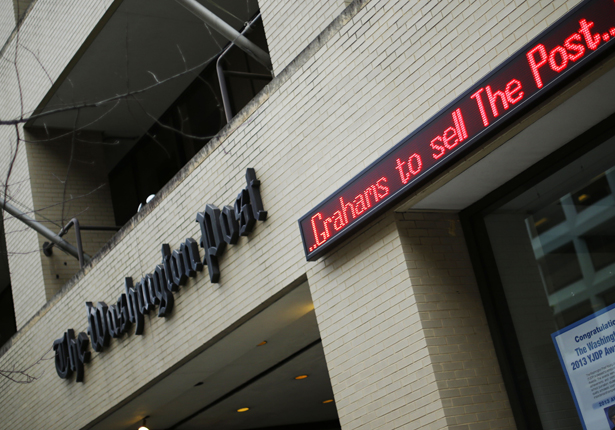
A view of the Washington Post building on Tuesday, Aug. 6, 2013. Amazon.com founder Jeff Bezos bought The Washington Post for $250 million. (AP Photo/Pablo Martinez Monsivais)
The sale of The Washington Post has inspired a predictable avalanche of emotion about the end of the good old days of famous families owning great newspapers. The Sulzbergers alone remain, but their newspaper, The New York Times, is sui generis: a global brand that has the kind of readership that advertisers covet and information for which at least a million people will pay hundreds of dollars. With the possible exception of The Wall Street Journal, which has been weakened but not quite ruined by its current owner, Rupert Murdoch, no other American newspaper can imagine itself occupying such territory. The Post may have had such a chance at the beginning of the Internet era, but Donald Graham and his advisers bet wrong—on metropolitan saturation coupled with national and international retrenchment—and this decision, together with missed opportunities related to the founding of both Politico and Facebook, doomed the Post to shrinking influence and disappearing profits.
The final years of the Graham dynasty bespeak a desperation to keep the franchise alive. There was the “Salongate” scandal, in which they attempted to sell corporate access to their reporters and editors for as much as $250,000 a pop, and then dissembled about the truth when it was revealed. There was Donald Graham’s willingness to lobby senators personally for the paper’s for-profit education arm, which took advantage of the naïve hopes of veterans and low-income Americans seeking to better themselves through education, only to end up in unmanageable debt. And the paper’s editorial page became a kind of final resting place for discredited neocon frothing and Bush administration apologias, characterized in both cases by the frequently inaccurate (and always hysterical) Jennifer Rubin. I doubt anyone at the paper really believes that Rubin was hired or retained on the basis of her merits as a journalist, rather than as a sop to the Sarah Palin wing of the far right. A franchise with greater self-confidence would have told these whiners to take a hike—or at least gone to the trouble of hiring someone, like Ross Douthat or David Brooks, who combines conservative politics with occasional self-reflection and criticism.
Sadly, these missteps signify an even larger problem: that of a paper that has lost its pride of place as the tribal drum of American politics. The Post has always had a cozy relationship with the rest of the permanent Washington establishment—witness the late David Broder lecturing President Clinton not to mess with his “place”—but in the current era, that’s almost all it has. Real people increasingly find it irrelevant to their interests and unnecessary to whatever model of citizenship they may have adopted. Today’s Washington Post is an ocean liner without an ocean.
Regarding the sale itself, it’s a sign of how low journalistic morale has fallen that the mere fact that a super-successful Internet entrepreneur like Jeff Bezos is willing to buy the paper is cause for optimism. And perhaps Bezos’s business acumen will indeed return the paper to profitability and blaze a path for the rest of the industry. Barring such a miracle, maybe his example will at least inspire fellow Internet billionaires to exchange their excess billions for the influence and prestige that used to be accorded to this increasingly endangered species of newspaper-owning rich folk.
Popular
"swipe left below to view more authors"Swipe →
But count me as a skeptic. Look at the manner of Bezos’s success at Amazon. Sure, he’s created a visionary enterprise and provided a significant service to people who live in remote areas without access to bricks-and-mortar bookstores. No doubt Amazon is great for consumers almost everywhere. But at what cost?
In our big towns and cities, Amazon has waged war on independent booksellers, using its no-tax advantage to decimate their ranks to the point where we read in the August 12 New York Times that many are forced literally to beg customers for donations to survive. Having taken out the Borders chain and now gunning for Barnes & Noble, Amazon may soon make physical book browsing, and hence serendipitous literary discovery, all but impossible.
Amazon has been deadly for literary culture in other respects. It bullies publishers on pricing, especially for e-books, and therefore significantly reduces their ability to provide advances to young and not yet established authors. What’s more, it insists on offering used books in the same space as new ones, tempting the consumer to save money and cut out the author and publisher entirely. (The same is true for CDs and DVDs.) If Amazon succeeds in its quest to resell “used” e-books, it will likely destroy that revenue stream for authors and publishers entirely. (And yes, I think Kindle Singles are a wonderful development for long-form reporting, but, once again, the compensation structure is unlikely to provide authors with the kind of income that allows for regular food and drink, much less college tuition.)
And what of the way the company treats its workers? As an investigative series in the Lehigh Valley Morning Call revealed, Amazon so overworked its low-paid warehouse staff that during a Pennsylvania heat wave, it parked an ambulance outside for quick access to the hospital emergency room. A doctor there called federal regulators and reported it as an “unsafe environment.”
My point in raising these issues is not to wag my finger at Bezos and Amazon. This is the nature of contemporary American capitalism in all its destructive and dehumanizing glory. But if you were to use Amazon as your example for how to bring new and profitable life to a major metropolitan newspaper, two things would necessarily place extremely low on your list of priorities: the health of the culture that produces the paper, and the personal well-being of the journalists who nurture and sustain it.
The old journalism order is dying and the new one is not yet born, as my old comrade, Antonio Gramsci, might say were he alive today. We remain tethered, at best, to “a pessimism because of intelligence, but an optimism because of will.”
Former Post reporter William Greider wrote about his tenure at the paper shortly after its sale to Jeff Bezos.

