
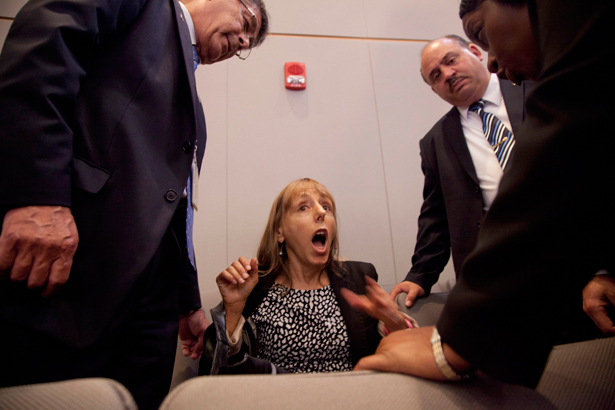
CODEPINK founder Medea Benjamin is surrounded by security as she shouts at President Barack Obama during his speech on national security, Thursday, May 23, 2013, at the National Defense University at Fort McNair in Washington. (AP Photo/Carolyn Kaster)
This article was first published at Common Dreams.
Having worked for years on the issues of drones and Guantánamo, I was delighted to get a pass (the source will remain anonymous) to attend President Obama’s speech at the National Defense University. I had read many press reports anticipating what the president might say. There was much talk about major policy shifts that would include transparency with the public, new guidelines for the use of drones, taking lethal drones out of the purview of the CIA, and in the case of Guantánamo, invoking the “waiver system” to begin the transfer of prisoners already cleared for release.
Sitting at the back of the auditorium, I hung on every word the president said. I kept waiting to hear an announcement about changes that would represent a significant shift in policy. Unfortunately, I heard nice words, not the resetting of failed policies.
Instead of announcing the transfer of drone strikes from the CIA to the exclusive domain of the military, Obama never even mentioned the CIA—much less acknowledge the killing spree that the CIA has been carrying out in Pakistan during his administration. While there were predictions that he would declare an end to signature strikes, strikes based merely on suspicious behavior that have been responsible for so many civilian casualties, no such announcement was made.
The bulk of the president’s speech was devoted to justifying drone strikes. I was shocked when the president claimed that his administration did everything it could to capture suspects instead of killing them. That is just not true. Obama’s reliance on drones is precisely because he did not want to be bothered with capturing suspects and bringing them to trial. Take the case of 16-year-old Pakistani Tariz Aziz, who could have been picked up while attending a conference at a major hotel in the capital, Islamabad, but was instead killed by a drone strike, with his 12-year-old cousin, two days later. Or the drone strike that 23-year-old Yemini Farea al-Muslimi talked about when he testified in Congress. He said the man targeted in his village of Wessab was a man who everyone knew, who met regularly with government officials and who could have easily been brought in for questioning.
When the president was coming to the end of this speech, he started talking about Guantánamo. As he has done in the past, he stated his desire to close the prison, but blamed Congress. That’s when I felt compelled to speak out. With the men in Guantánamo on hunger strike, being brutally forced fed and bereft of all hope, I couldn’t let the president continue to act as if he were some helpless official at the mercy of Congress.
“Excuse me, Mr. President,” I said, “but you’re the Commander-in-Chief. You could close Guantánamo tomorrow and release the eighty-six prisoners who have been cleared for release.” We went on to have quite an exchange.
While I have received a deluge of support, there are others, including journalists, who have called me “rude.” But terrorizing villages with Hellfire missiles that vaporize innocent people is rude. Violating the sovereignty of nations like Pakistan is rude. Keeping eighty-six prisoners in Guantánamo long after they have been cleared for release is rude. Shoving feeding tubes down prisoners’ throats instead of giving them justice is certainly rude.
At one point during his speech, President Obama said that the deaths of innocent people from the drone attacks will haunt him as long as he lives. But he is still unwilling to acknowledge those deaths, apologize to the families, or compensate them. In Afghanistan, the US military has a policy of compensating the families of victims who they killed or wounded by mistake. It is not always done, and many families refuse to take the money, but at least it represents some accounting for taking the lives of innocent people. Why can’t the president set up a similar policy when drone strikes are used in countries with which we are not at war?
There are many things the president could and should have said, but he didn’t. So it is up to us to speak out.
Did Obama reject perpetual war in his speech, or just rename it? Read John Sifton for more.

