Where Hope Has a Gift Shop
The nostalgic architecture of the Obama Presidential Center
The Nostalgic Architecture of the Obama Presidential Center
Where hope even has a gift shop.
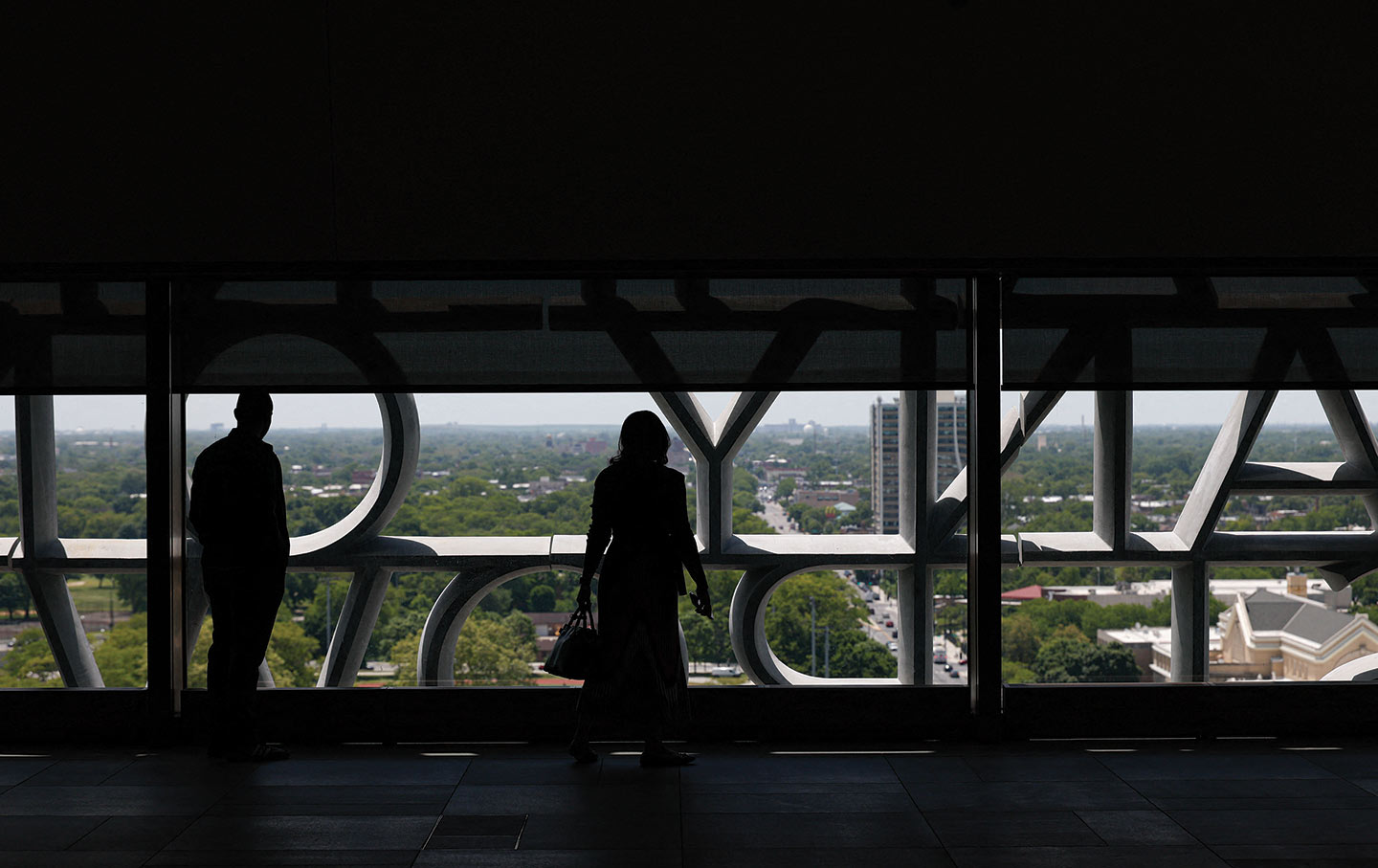
The Obama Presidential Center.
(Kamil Krzaczynski / Getty)
“Hope now has a permanent home,” Obama Foundation CEO and former senior adviser to the president Valerie Jarrett tells an audience of about three dozen reporters in a small auditorium designed for intimate, terraced seating. We are in part of what’s called the Forum, a section of the Obama Presidential Center that is open to the public. Just beyond these walls is a restaurant where one can buy an Obama Burger, and just beyond that is the Fannie Lou Hamer Walkway, sponsored by Blue Cross and Blue Shield of Illinois, which provides passage to the Nancy Pelosi Garden Pavilion, placed right beside the car park, perhaps an homage to how long the former speaker held her seat in Congress. Farther afield is the rest of the center, which includes a museum, offices for the Obama Foundation, several basketball courts, a branch of the Chicago Public Library, and a playground.
Tina Tchen is here to announce the foundation’s new leadership initiatives, which are about as revealing as the perfunctory placards and memorializations of “hope” and “change” all around us. These include a mid-career program for “the next generation of leaders”—not only “NGO leaders,” we are told, but“folks who are military leaders, who are in government, who are in business, big and small, who are in academia.” Among the participants, Jarrett continues, “we have a young man who is currently the deputy mayor for sustainability in the city of London. We have Emmanuel Macron’s economic adviser. We have a woman in our last class who was the director of the Kosovo Army military-training facility. Here in Chicago, we’ve got a Morgan Stanley banker who’s doing change in their neighborhood.” Oh, I’m sure!
Tchen is soon followed by John Roberson, formerly the city of Chicago’s chief operating officer and now the incoming executive vice president of the Obama Center. Roberson tells the audience that “this is an $850 million investment in the South Side of Chicago. I’m going to say it again: $850 million. Not a single penny of government money. That’s important because that shows the intentionality of the President and Mrs. Obama.” It’s also important because it captures a notable element of Obama’s presidency: promising social change only to implement economic austerity, for example, or bailing out the big investment banks while many Americans’ mortgages went belly-up—and with them, the foundations of their lives. It’s rather like the wall downstairs, largely out of sight, where the Obama Foundation’s offices are located, which lists the names of all the workers whose labor built the project: a hollow paean to the working class, even as the center itself and the real-estate speculation around it forces such workers out of their homes. More than hope and change, irony is the order of the day at the Obama Center.
Earlier, two beleaguered-looking figures took the stage, one tall and lanky, the other diminutive but better dressed in comparison. They were Tod Williams and Billie Tsien, the husband-and-wife founders of the architecture firm TWBTA, who won the commission to design the Obama Presidential Center in 2016. (To give you some perspective, the competition winners were announced right after I graduated from college, and as I write this, I am 32 years old.)
As far as large projects go, TWBTA was an interesting choice by the former president, who was intimately involved in the design process from beginning to end. At the time of their selection, Williams and Tsien were in competition with some of the most famous architects in the world, including Renzo Piano, whose Whitney Museum of American Art had just opened in Greenwich Village, and Diller Scofidio + Renfro, who had just begun construction on the Shed at Hudson Yards.
TWBTA is best known for the extensive use of stone and other masonry, dramatic transitions in lighting, and spaces that feel intimate and handcrafted. (Seemingly in contrast, the interiors firm has designed boast a lot of patterns and colors, as seen in its lobbies and atria at David Geffen Hall.) While TWBTA wasn’t a household name, its small-to-medium-scale museum work, such as the Barnes Foundation in Philadelphia and the former Folk Art Museum in New York, was well regarded in architectural circles. As far as architects go, it was a very Obama choice: The firm signaled erudition and sophistication while still being well-known enough to generate buzz.
However, like ma-ny other architecture firms today, TWBTA has a hard time scaling up. This is almost embarrassingly obvious when it comes to the various structures that make up the Obama Center. Instead of a single building, the center is really a sprawling campus. There’s the aforementioned Forum, the public-library branch, the Home Court (designed by a different architect), and the playground, as well as the towering, almost tomb-like museum—nearly windowless and clad from top to bottom in New Hampshire granite—which has been variously called by detractors “the Obamalisk” and “the Death Star.”
When a member of the press asked Williams about the criticism of the building’s design and its Star Wars–like qualities, he said that the museum was built for longevity and that public opinion often changes over time. An Obama Center official then interjected to say that Mark Hamill himself had come to tour the tower with Obama.
Offering their own architectural tour of the center, Williams and Tsien stood awkwardly in front of a presentation and tried to explain their process and choices. A lot of architectural communication is bullshit, but the bullshit is often revealing. As for what inspired the shape of the building, the architects say that it was “designed to look like four hands coming together.” The exact number of hands that were involved in the design, and whose hands they were, was not made clear—but the extent of Obama’s involvement certainly was, as the architectsmentioned that the president wanted the building “to be interesting from all vantage points.” This explains some of the more baffling design decisions, such as the seemingly arbitrary articulations on the surface of the façade on the southeast corner. At the opposite corner from these ridges is the text from Obama’s speech on the 50th anniversary of the March on Selma. It’s easy to joke that the words are pretty much illegible except, perhaps, by drone, which is doubly ironic—not only because it brings to mind Obama’s penchant for using drones to stealth-bomb Afghan weddings but also the use of drones by real- estate people to showcase their properties’ scale and worth.
Much as with Obama’s presidency itself, as one tours the Obama Center, one realizes that the liberal language of community and social justice has often served as a cover for economic disruption and an intense battle to privatize that which for a century has belonged to the public. The center sits on a vast area of Jackson Park, originally designed by Frederick Law Olmstead, which—despite a legal battle by the nonprofit group Protect Our Parks that was ongoing for almost 10 years before the latest lawsuit was dismissed in 2024—the Obama Foundation has essentially made its own by securing a long-term lease from the city in order to build on it. During the center’s construction, the foundation made its possession of this public park clear by removing swaths of trees, whose absence makes the plaza and the playground almost unbearably hot in the summer.
Like many large-scale ventures in real estate, the Obama Center has also not helped the community in which it was built. As it approached completion, rents in the neighboring communities of Woodlawn and South Shore began to skyrocket, with many residents being priced out of units they’d lived in for years or even decades. To help residents prepare for the onslaught of tourists, the friendly folks at Airbnb have partnered with the Obama Foundation to “host a free virtual workshop focused on helping local residents welcome new visitors, earn supplemental income, and champion their neighborhoods…building off of Airbnb’s historic donations to community organizations focused on boosting economic empowerment.” According to Airbnb’s statistics, South Side residents earned more than $15.1 million from hosting visitors through Airbnb in 2025—“income,” the company tells us, “that approximately 60 percent of hosts say helped them stay in their homes and manage the city’s rising cost of living.” Economic empowerment, indeed.
The Obama Center is not a presidential library, though many of the event’s speakers engaged in the parapraxis of calling it that. A spokesperson told me that because Obama’s was the first digital presidency, there was little need for a paper trail. Technically, the library portion is held at the National Archives in Washington, DC. For all the recent outrage about Donald Trump’s commissioning a presidential library that’s actually a hotel, the precedent has been set by his predecessor, who has built for himself a kind of complex, much of which apologizes for itself.
The center’s eight-story museum is so obviously a tourist destination that the idea that the rest of the grounds are for local people is fairly laughable. Allegedly, the lawns and gardens are there to serve as a front lawn for the community, although unlike an actual park, the monumental site, the impeccable landscaping, and the phone-scrolling rent-a-cops pretty much inhibit this outright. Beyond that, timed passes for the museum have been reserved through next year, so we will have to see how the conflict between the explicit restriction of flows of people and the purported function of public space play out.
Intended for the local community or not, the campus sprawls across Stony Island Avenue, where the Main Court—the former president’s NBA-regulation basketball court—resides with the aluminum-paneled hulkiness of a college cafeteria. (It was designed by the firm Moody Nolan, whose Chicago office is led by the local architect Renauld Deandre Mitchell.) The playground, which is the most public-facing and engaging part of the center, suffers from being exposed to direct sun but is otherwise very sweet, with tall, fast-moving slides and jungle gyms shaped like dragonflies. The landscape architecture, especially the green roof of the Forum and the parking garage, is more sensitive than the stone palazzo, complete with an unsettling, hollow-eyed bronze statue of Mr. and Mrs. Obama holding hands, that anchors the three buildings by TWBTA. It reminds me of the REACH, Steven Holl’s addendum to the Kennedy Center, which is more visually dynamic and better integrated into the site. It’s also worth saying that the two smaller buildings—the ones Obama appeared to be significantly less involved with—are not unhandsome. The scale of the Forum and the new branch of the Chicago Public Library are both grand and intimate, and the stonework—made of the same granite as the museum—is, in this context, tactile. TWBTA’s interiors for the library (which includes a reading room of Obama’s favorite books) are likewise bright and engaging.
The two smaller buildings, however, are not the main draw of the Obama Center. That would be, of course, the towering museum, which is completely out of proportion to the rest of its environment. Visually, it is more in communication with the University of Chicago than with the rest of the South Side. In addition to its inappropriate scale, there is the inappropriate scale of the granite slabs that clad the building. They are both too big to add texture and they are too small to create the desired, monumental effect that the building is a singular cast-in-one volume. Combine the outsize scale with the building’s shape, which is somewhat akin to a brutalist Himalayan salt lamp, and one really gets a sense of how mistaken the whole entity is: a massive and unsightly pillar whose awkwardness is only further amplified by the nearly indecipherable text and other stuck-on accoutrements.
When one enters the museum, it almost feels like a joke: The entryway is hostile—one is met with bright lights, security guards, and metal detectors, on the other side of which is the word HOPE in the script of a ransom note affixed to a concrete wall. After picking up an Obama audio guide, one is confronted by a series of confusing atria that feature large-scale works of public art and sculptural stairs and corridors that lead nowhere. It takes a while to find the actual passageway into the museum itself: a claustrophobic escalator cornered against the north-facing wall of the building. Fredric Jameson once remarked about John Portman’s Westin Bonaventure Hotel that even in architecture, late capitalism works tirelessly to conceal, abstract, and obfuscate flows of capital and people, and the Obama Center is perhaps as exemplary of this phenomenon as Portman’s precipitous, topsy-turvy lobbies were. The escalators turn into elevators, and the elevators have strange and private stops—to get back down from the top floor, one needs to take a separate, much larger elevator than the one they took going up.
Popular
“swipe left below to view more authors”Swipe →When one finally arrives on the first floor of the museum’s exhibition space, they are greeted by a copy of the Declaration of Independence alongside Native American petitions in a glass case. There are also a handful of small displays that include artifacts from many US civil-rights struggles: the abolition movement, women’s suffrage, the fight against Jim Crow, union activism, and the social programs established during the Great Society era. And that’s about where all of the actual history in the museum stops. These displays and a backlit collage of objects from the ’60s exist merely as a backdrop for the main event: Barack Obama is born.
It is hard to describe just how much this museum is a temple to Obama. While many presidential centers have exhibitions lauding their subjects’ successes, they also tend not to equivocate on their less-successful policies. For example, the mausoleum-like Lyndon B. Johnson Library makes sure everyone knows that he fucked up in Vietnam. There is no such fair play at the Obama Center, however, which is all about celebration. Obama’s voice booms on every floor. Videos abound of him talking about how the 1990s were a time of opportunity. The walls are covered in the careful documentation of his achievements; “hope and change” is baked into the structure.
The first floor of the exhibition is the most interesting, because it covers the time when Obama was most interesting: when he was a community organizer on the South Side, when he was a state senator for Illinois, and of course the 2008 election, which was a genuinely monumental achievement. When I was 14, I attended Obama’s 2009 inauguration on a school trip and remember it very well—the freezing cold, the voice projecting over the jumbotron, the celebrations in the streets. The speech he gave was one of the few times in my life when I considered myself unabashedly proud to be an American. But what follows on the next two floors of the museum exhibition is increasingly ludicrous. The second floor tells us all about how Obama solved the Great Recession—ignoring the fact that he bailed out the banks and General Motors and left everyone else behind. Then there’s a section on his foreign policy, with titles like “Strengthening Alliances” and “Destroying Terrorist Networks.” “To destroy the terrorist groups al Qaeda and [ISIL] President Obama used every element of US power. This included the military, intelligence, diplomacy, homeland security, and a commitment to the rule of law and human rights.” This, despite the fact that the rule of law was seriously undermined by Obama’s expansion of digital surveillance and that human rights no longer applied to the many civilians who were collateral damage in the United States’ targeted strikes.
While there’s a wall and video display devoted to LGBTQ people in the military, the topic of gay rights, which were greatly expanded under Obama, is less prominent. On one of the walls, we get yet another list of Obama’s achievements: the Paris Climate Accords, the Affordable Care Act, restoring diplomatic ties with Cuba. But we get very little on how his continued expansion of the power of the executive branch ensured that Trump could—and would—undo nearly all of these.
In a learning corner for children that feels like an afterthought, one can be taught important concepts of democracy, almost all of which ring hollow, while an iPad lets visitors view “memes” (i.e., political cartoons) from history. Banned books lie behind lift-a-flaps. Several displays ask the viewer: “How would you respond?” A typical question goes something like: “Some Americans question whether freedom is granted equally—or whether certain rights should be guaranteed. If you heard: ‘My rights don’t mean as much as a rich person’s do—I can’t afford to buy a giant billboard or a bunch of ads as part of my free speech,’ how would you respond?” The correct answer is, of course, placation—your rights do matter. (Even though the question is telling the uncomfortable truth.) Another insipid display features three wells of light shining on three buttons and the question “In a 2023 poll, just 28% of Americans said they were satisfied with how our democracy is functioning. What should we do about it?” Visitors can vote for (a) “Continue to make change while upholding democracy”; (b) “Throw democracy out and start over with a new system”; or (c) “I don’t care.” It’s pretty clear at this point that we no longer live in a legitimate democracy of any kind, and yet we are forced to pretend otherwise. As is the case with the rest of the museum, the present—the here and now, the political world we currently inhabit—simply doesn’t exist. The nostalgia for the moment before the disaster and the refusal to reckon with what has actually happened since then is so palpable that at times it borders on delusion. At the Obama Center, one walks into 2008 and never leaves. “Hope and change” doesn’t disappoint, and as such it becomes little more than a brand or, perhaps worse, just something one can say without meaning it. Hope has a permanent home, as Jarrett put it. It is a tomb.
But perhaps what is most ridiculous about the Obama Center museum is the celebrity of it all. The top floor of the exhibition features a number of absolutely asinine displays: little dioramas of parties at the White House; a bust of the man himself; a comic strip about the Obamas’ dogs; a display of Michelle’s dresses; another devoted to the various species named after the former president. Many presidential libraries have a full-scale replica of the Oval Office as it was inhabited by their namesake. In the selfie age, this has more of a photo-booth feel than a historical element to it. By the time one takes the elevator to the observation deck, they’re beginning to feel drowsy with Obama fatigue. Finally, we have escaped—if only we could muster the energy to enjoy the view.
Somehow, the observation deck also has its flaws. An enclosed room at the top of the building, it has a ceiling installation consisting of a pyramid from which little blue rays of text from Obama’s Selma speech emanate. It feels overwhelmingly flat in a room that, with its stonework, textured wood walls, and gargantuan letters, is otherwise dynamic and tactile. The text that interrupts the view is perhaps one of the few interesting design choices in the entire building—one wants to reach out and grab the beveled letters. But unfortunately, once you’ve had your fill of this feature, you then make your way back into the nostalgic world of Obama adulation, taking the elevator down to the ground floor of the Forum, where you’ll be greeted by an expansive Obama-themed gift shop.
After I left the center, I began thinking about what it means as a piece of architecture. For me, it functions as a kind of cenotaph for neoliberalism: a monument—or tomb—for a subject whose body is lost or buried elsewhere. The most famous cenotaph in architecture was the one proposed for Isaac Newton, designed in 1784 by the French neoclassical architect Étienne-Louis Boullée but never built: It consisted of a single, giant, vacuous sphere. And while artifacts and objects technically exist in the Obamalisk, it is spiritually vacuous, its substance is the empty world that Obama’s presidency never actually built. It is a tomb without a body—anyone’s body.
One cannot deny that the Obama Center will have a special place in the architectural canon, not because it’s good but because it is arguably the last building of the 2010s—itself an extension of the 1990s and 2000s—built half a decade too late. The model of production for civic buildings—museums, libraries, concert halls, etc.—by famous architects, reliant on both large-scale private (and sometimes public) funding and large swaths of cheap, developable urban land, is over. The architects responsible—giants of their field—are dying, and both the operations of their firms and the scale of their projects are far less economically viable at a time when land is extremely expensive and governments are turning away from civic architecture. The buildings of this now-bygone era, such as the Whitney, the Shed, and the Paris and Hamburg philharmonic halls, are ostensibly “public-facing” while generating rents of a different kind—those that the Brazilian architectural theorist Pedro Fiori Arantes calls the “rent of form”: They make money through the increased value of the surrounding real estate, as sites for advertising and photo shoots, and as venues for the tourism industry, which has come to displace many others.
For better and for worse, this approach to architecture no longer exists, even as the Obama Presidential Center offers us one last homage to its ambition and optimism. In this way, perhaps the most tragic element of the center is just how far it ended up being from its own declared purpose, which is to foster hope and the inspiration to effect change in the hearts of its visitors. Instead, hope and change exist only in the past tense, though I guess you can buy them on a water bottle in the gift shop.
More from The Nation
Boots Riley’s Communist Heist Film Boots Riley’s Communist Heist Film
Yes, it even has Marxist teleporters.

John Edgar Wideman’s American Vernacular John Edgar Wideman’s American Vernacular
The master novelist offers a view of a United States defined by its cultures of improvisation.
Do Epics Need Heroes? Do Epics Need Heroes?
In recent years, the online right has contested adaptations of epic in order to make an argument about masculinity. The Odyssey is their latest target.

A Rave Novel Rediscovered A Rave Novel Rediscovered
Ann Scott’s “Superstars” captures the last gasp of pre-Internet counterculture.

