
The School Behind the Billionaires and the Billionaire Tax
UC Berkeley will inevitably be behind the defeat or victory of Proposition 40.
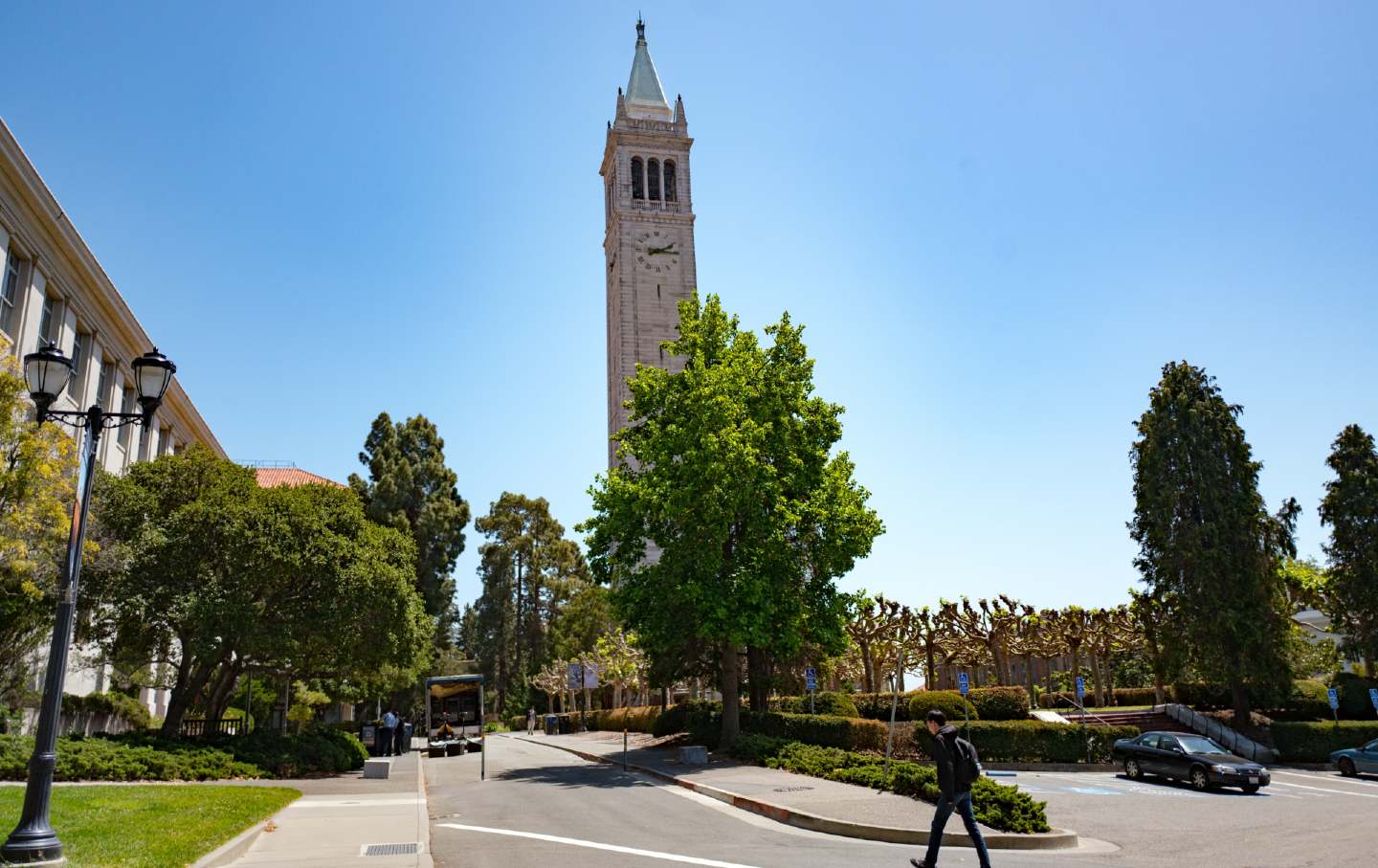
A view of Sather Tower, also known as the Campanile, at the University of California, Berkeley.
(Smith Collection / Gado / Getty Images)
Something of an identity crisis is taking shape in the Bay Area at the University of California system’s flagship university.
The foggy region is being torn in two as programmers and progressives duke it out in a battle over California’s Proposition 40, or “Billionaire Tax,” on the ballot in November. Since its announcement last November, it has spurred a pricey political spar to the tune of tens of millions. On one side of the brawl are academics and students spearheading the effort to pass the progressive measure. On the other are some of the wealthiest names in Big Tech pouring millions into efforts to stop it.
Oddly enough, all parties hail from my university, UC Berkeley. The measure’s chief intellectual architects include Emmanuel Saez, a preeminent scholar on wealth inequality, taxation, and retirement who has taught at Berkeley since 2002. He’s joined by Professor Brian Galle of the UC Berkeley School of Law, who, along with David Gamage and UC Davis professor Darien Shanske, authored the measure. Together, they form the brain trust behind what Saez describes as “the first time, anywhere in the world, there’s going to be a direct vote on whether people want to increase taxes on the ultrarich.”
But some of Saez’s fiercest opposition comes from another Golden Bear. Among Proposition 40’s most prominent critics is Eric Schmidt, the former Google chief executive who spent six years at Berkeley earning his master’s and doctoral degrees. He has teamed up with fellow tech billionaires Larry Page and Sergey Brin to pour a combined $85 million into opposition campaigns.
UC Berkeley will inevitably be behind the defeat or victory of Proposition 40. The irony of Saez—who’s made a career addressing income inequality— and Schmidt—whose fortune is contingent on income inequality—having the same blue-and-gold logo on their LinkedIn profiles is striking. But to Professor Saez, it’s not confounding nor a coincidence that UC Berkeley’s fingerprint is all over the upcoming election in California. According to the economics professor, the efforts of both parties are natural byproducts of a Berkeley education.
“We praise ourselves for being the best public university not just in the country, but also probably in the world,” Professor Saez said. We spoke in his office on the sixth floor of Evans Hall—the same building in which Eric Schmidt spent the late 1970s studying, when it housed Berkeley’s Department of Computer Science. “It’s not surprising that some of our alumni succeed in this wonderful ecosystem and become CEOs of huge companies and startup entrepreneurs,” Saez said. “But at the same time,” he continued, “Berkeley has a lot of academic expertise in economics and has been famous for championing more progressive views. And so we also have faculty like myself talking about excessive wealth concentration.”
Professor Saez collaborated with his Berkeley colleague Gabriel Zucman on The Triumph of Injustice, a 2019 book detailing the demise of progressive taxation in the United States. The professors found that billionaires have long been paying lower effective tax rates than middle-class workers.
After stumbling upon a New York Times article about Saez’s work, SEIU United Healthcare Workers West (SEIU-UHW) approached him with an idea: a wealth tax that could fund state programs such as Medicaid for California. The union had been suffering under Trump’s funding cuts to the healthcare system. “They wanted to find a way to raise revenue in a progressive way,” said Saez. Thus was born Proposition 40, a measure whose fate for approval or rejection is now in the hands of California’s voters.
Popular
“swipe left below to view more authors”Swipe →Berkeley exists at the heart of Silicon Valley. The region has created more billionaires than perhaps anywhere else on the planet, and Saez noted that the tech machine is fed by the academic quality of universities like Berkeley and Stanford. “California, and in particular Silicon Valley,” he said, “is generating an incredible number of billionaires. Their wealth has grown enormously fueled by the AI boom. Frankly, if you want to become a billionaire, Silicon Valley is the best place to be. ’”
At the same time, Professor Saez noted, “UC Berkeley is the biggest engine of upward mobility among all US universities in the sense that it is the university that takes the biggest number of students from less advantageous backgrounds.” It has also long been a hub of progressive activism. This joining of two worlds is precisely why the students at UC Berkeley have been uniquely positioned to advocate for or against Proposition 40. And students, it turns out, may be one of Proposition 40’s only hopes for becoming law. Berkeley’s Institute of Government Studies found in its most recent poll that voters ages 18 to 29 are by far the tax’s most supportive demographic. In large measure, the fate of the bill lies with college students.
In May, the Berkeley Political Union student organization and Young America’s Foundation jointly hosted a debate between Professor Saez and Arthur Laffer, an Economic Policy Advisory Board member under Ronald Reagan who opposes Proposition 40 on the grounds that the measure would undermine investment and job creation. Students—a demographic Professor Saez assessed as “perhaps our strongest base”—brought the economic giants in conversation with each other, and they filled UC Berkeley’s Stone Center on Wealth and Income Inequality for hours to listen to the economists’ jousts on unrealized capital gains and progressive taxation. Here, the $100 million dollar fight for Proposition 40 boiled down to something every Berkeley student is familiar with: a fiery yet civil debate on campus between two know-it-alls on a Tuesday.
UC Berkeley’s contradictions mirror those of California itself. The state has long served as an American laboratory for both social and economic change. Now, with Proposition 40 on the ballot, the results are sure to resonate across the nation. Professor Saez, for one, figured, “If we do it here, the rest of the country and the world eventually will follow.”
Become a Sustaining Donor This September
Between the reemergence of right-wing red-baiting and Donald Trump’s use of the chilling National Security Presidential Memorandum–7 to criminalize left political organizing, we’re seeing McCarthyism reborn before our eyes.
This assault on democracy cannot be ignored or wished away. Resisting it requires bravery in the face of threats and repression, a steadfast commitment to the truth, and the unwavering belief that we can—and will—overcome this darkness.
We must have an independent media that sets the record straight, unearths corruption and abuses of power, and advances a politics of justice and dignity for all if we’re to win this fight.
That’s why I’m writing to you today. This September, The Nation needs to add 100 monthly donors to sustain our progressive journalism. Your contribution makes the next investigative report, the next truth-speaking column, and the next pathbreaking essay all possible.
I hope you’ll support our work with a recurring donation today. If you donate $10 or more a month, we’ll send you a brand new “Hands Off the Free Press!” sticker to recognise your commitment to our cause. Please, donate today.
Onward,
Katrina vanden Heuvel
Editor and Publisher, The Nation
More from The Nation

Dolly Parton Was a Proud Union Sister Dolly Parton Was a Proud Union Sister
Organized labor is celebrating the life and legacy of an artist who championed working women and carried a union card for almost 60 years.

Of Debt and Deficits and the Dollar System Of Debt and Deficits and the Dollar System
By force of preset agendas, conservatives and liberals react to debt headlines like Pavlov’s dogs.

What Happens When 8 Million People Lose Their Student Loan Repayment Plan? What Happens When 8 Million People Lose Their Student Loan Repayment Plan?
As the Biden-era SAVE plan ends, borrowers are facing unaffordable bills, lost payment records, and errors that have falsely put some into default.

David Ellison’s Delusional Stab at Self-Justification David Ellison’s Delusional Stab at Self-Justification
While the Skydance–Warner Bros. merger is in legal limbo, the CEO seeking to pull it off makes a disingenuous case for it in the court of public opinion.
The War on the UAW The War on the UAW
The United Auto Workers called for a ceasefire in Gaza. The union’s federal monitor didn’t like it—and now he’s investigating Shawn Fain, just weeks before union elections.

How Public Equity Can Promote a Revived American Democracy How Public Equity Can Promote a Revived American Democracy
Critics are assailing deals to give the government stakes in major companies—but they’re overlooking their civic dividends.

