How Journalists Can Stand Up to Trump’s Bluster
Newsroom layoffs make it harder, but reporters must keep telling the truth about climate change.
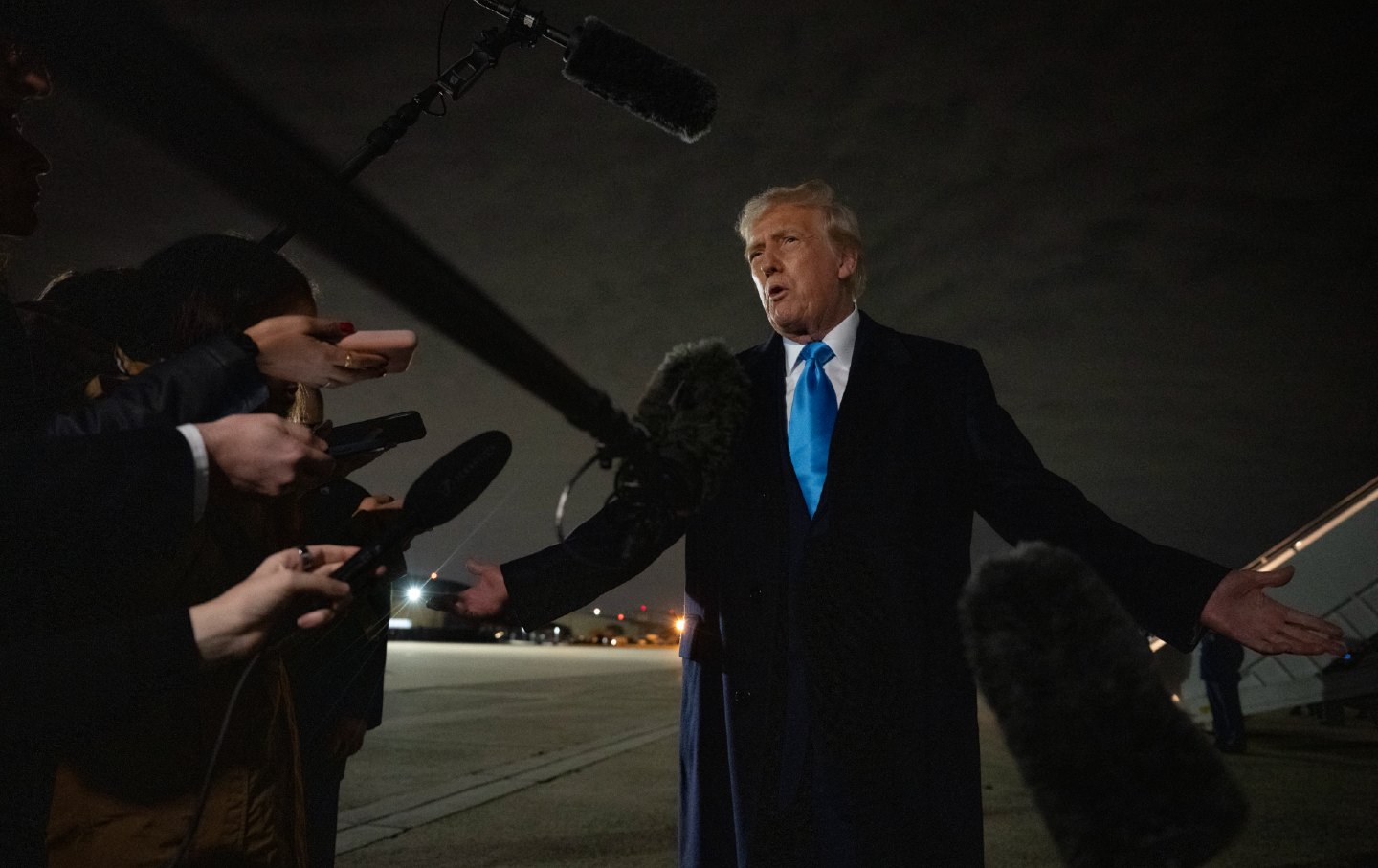
President Donald Trump speaks to the press upon arrival at Joint Base Andrews in Maryland on February 2, 2025, as he returns to the White House from Florida.
(Jim Watson / AFP via Getty Images)
It’s a tumultuous time for climate journalists, and not only because the current president and an unelected billionaire are running roughshod over US law, attacking NOAA and the Environmental Protection Agency, and installing climate deniers across the federal bureaucracy. Even as the Los Angeles fires and a rapidly melting Arctic all but scream that climate breakdown is worsening, some of the most accomplished journalists on the climate beat have had their jobs threatened or eliminated. “We need the press to be at its best now,” media analyst Margaret Sullivan wrote on Substack. But it’s hard to do our best when newsroom staffs are shrinking and owners are kowtowing to the White House.
A massive round of layoffs at CNN ousted Rachel Ramirez, a reporter whose coverage has demonstrated the expansiveness of the climate beat and who won a Covering Climate Now Journalist of the Year Award in 2024. Cost-cutting at CBS News claimed the jobs of Ben Tracy, formerly the senior climate and environment correspondent, and his colleague, producer Chris Spinder—finalists in the 2023 CCNow Awards. Allen Media announced that it was firing meteorologists at nearly two dozen local TV stations it owns; instead, local weather reports would be supplied from distant Atlanta. Outcry from viewers at WTVA in Mississippi and elsewhere led Allen to rescind that order—for now.
A decline in local news correlates with a decrease in public health and an increase in government corruption, studies have shown, because there are fewer avenues to provide health warnings and fewer watchdogs on spending. Having fewer journalists on the climate beat would invite similar outcomes. Nor should Trump’s bluster intimidate news outlets into thinking that telling the climate story is somehow politically biased. Our job is to report facts, and human-caused climate change is a scientifically established fact.
CCNow is preparing a roster of activities to help our fellow journalists cope with this fast-moving crisis. A Talking Shop webinar will discuss how to cover the Trump administration’s actions, which veteran climate journalist Bill McKibben has summarized. And CCNow partner outlets can discuss our new initiative, The 89 Percent Project, at two partner town halls on February 11, at 11 am and 10 pm US EST.
Meanwhile, Ezra Klein’s latest New York Times column offers insight into how journalists can avoid being overwhelmed by the Trump-Musk blitzkrieg. Citing former Trump adviser Steve Bannon, Klein noted that Trump’s media strategy has long been to throw so many outlandish statements into the public sphere that it’s hard to keep up. “People largely learn of what the government is doing through the media,” Klein wrote. “If you overwhelm the media—if you give it too many places it needs to look, all at once, if you keep it moving from one thing to the next… it is hard to even think coherently.”
Trump’s plan, Klein argues, “is to play king on TV. If we believe he is already king, we will be likelier to let him govern as a king…. That can only happen if we believe him.”
Journalists play an outsize role in whether the public “believes” Trump has king-like authority. When reporting on actions Trump and his administration are taking, we can describe those actions as things they are trying to do, not as fait accompli. We can spell out the implications of those actions: Shuttering the National Weather Service, as Project 2025 urges, would leave Americans without life-saving warnings about weather disasters. When such actions are plainly illegal, as with Trump and Musk’s desire to block the spending of funds authorized by Congress, we can say they are illegal. And we can point out, as last week’s Climate Beat noted, that the vast majority of the public—74 percent in the US, 89 percent globally—wants their governments to “do more” about climate change, not less.
Disobey authoritarians, support The Nation
Over the past year you’ve read Nation writers like Elie Mystal, Kaveh Akbar, John Nichols, Joan Walsh, Bryce Covert, Dave Zirin, Jeet Heer, Michael T. Klare, Katha Pollitt, Amy Littlefield, Gregg Gonsalves, and Sasha Abramsky take on the Trump family’s corruption, set the record straight about Robert F. Kennedy Jr.’s catastrophic Make America Healthy Again movement, survey the fallout and human cost of the DOGE wrecking ball, anticipate the Supreme Court’s dangerous antidemocratic rulings, and amplify successful tactics of resistance on the streets and in Congress.
We publish these stories because when members of our communities are being abducted, household debt is climbing, and AI data centers are causing water and electricity shortages, we have a duty as journalists to do all we can to inform the public.
In 2026, our aim is to do more than ever before—but we need your support to make that happen.
Through December 31, a generous donor will match all donations up to $75,000. That means that your contribution will be doubled, dollar for dollar. If we hit the full match, we’ll be starting 2026 with $150,000 to invest in the stories that impact real people’s lives—the kinds of stories that billionaire-owned, corporate-backed outlets aren’t covering.
With your support, our team will publish major stories that the president and his allies won’t want you to read. We’ll cover the emerging military-tech industrial complex and matters of war, peace, and surveillance, as well as the affordability crisis, hunger, housing, healthcare, the environment, attacks on reproductive rights, and much more. At the same time, we’ll imagine alternatives to Trumpian rule and uplift efforts to create a better world, here and now.
While your gift has twice the impact, I’m asking you to support The Nation with a donation today. You’ll empower the journalists, editors, and fact-checkers best equipped to hold this authoritarian administration to account.
I hope you won’t miss this moment—donate to The Nation today.
Onward,
Katrina vanden Heuvel
Editor and publisher, The Nation