We Can’t Surrender to Climate Destruction
Politicians and pundits are telling us to accept the escalating breakdown of our planet. We have to fight back.
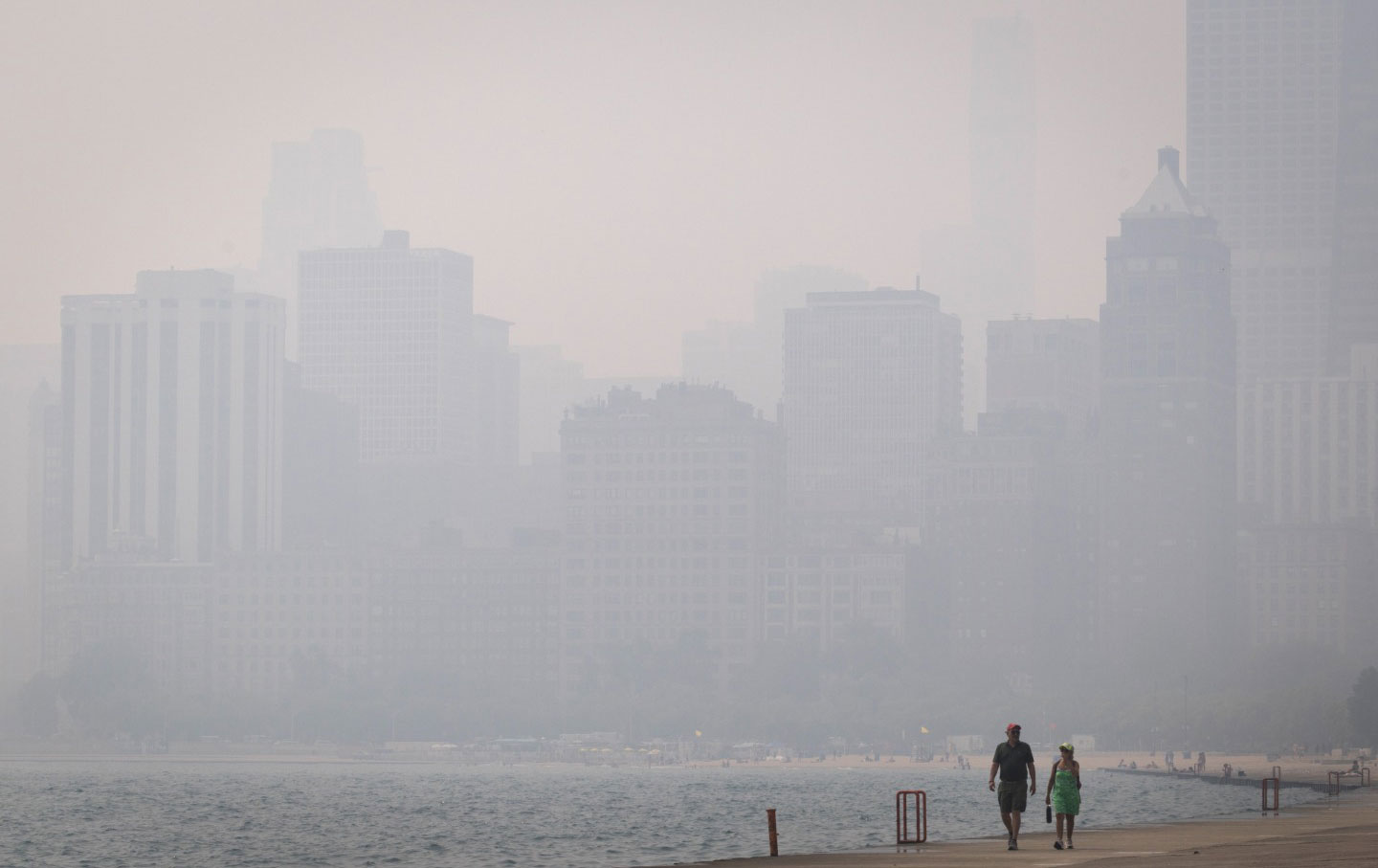
In July, Chicago’s air was so thick with smoke you could smell it and taste it and feel it in your throat. Health officials were telling us to stay inside as much as possible. People wandered around big-box stores looking for air purifiers. Parents shared tips on how best to protect their kids. The haze made the edges of buildings look less sharp and made your thoughts less sharp, too, as headaches and lightheadedness set in. There were also reports of increased hospital visits by people with conditions like asthma.
The situation in Chicago was caused by smoke from Canadian wildfires, which, science has made clear, are bigger and more catastrophic than ever because of human-made climate change. The fires spread destruction through Canada, with First Nations people bearing the worst, and along with wildfires in northern Minnesota, sent hazardous smoke into the United States from Minneapolis to New York. If summer is the season of splash pads and beaches and watermelon slices, it is also, increasingly, a time of mustard-tinted air, hiding in your home if you have one, and refreshing your air-quality-tracking app.
As the frequency of these apocalyptic scenes increases, regular people are scrambling—to get through their workday, to protect their loved ones, to figure out how to breathe cleaner air. Yet there is an astonishing lack of urgency among those actually in a position to do something about the climate crisis.
The message from our political and media class is unmistakable: Climate destruction, while perhaps not desirable, is the new normal, an inevitability. This message is obviously unacceptable, but the explanation for its growing prevalence cannot be reduced to platitudes about mass complacency or human adaptability. It is imposed by an elite that is institutionally unwilling to grapple with the stakes of what is happening.
A large majority of people on this planet are concerned about climate change. A 2024 study in Nature Climate Change found that, globally, 89 percent of people want their governments to do more to fight the climate crisis. And according to a 2026 study in Health Affairs Scholar, 65 percent of adults in the United States are concerned that climate change will harm their personal health.
These findings are borne out by anecdotal evidence. On July 17, Fabian Martin, a Chicago delivery worker, told me he had spent the previous day outside during the worst of the smoke. “The smoke is so dirty,” he said. “Imagine my lungs.” A friend texted me on the same day: “This is so apocalyptic. Makes me afraid for the future.”
Yet just as public concern is climbing, media coverage of climate change is plummeting. John Kotcher, the director of the Center for Climate Change Communication at George Mason University, said in February that “we have reached the lowest point in how often people hear about” climate change since 2015. The media critic Adam Johnson (full disclosure: He’s also my husband) found that there was no mention of the role of climate change in nearly two dozen nightly-news segments about the smoke and other extreme weather events on ABC, CBS, and NBC from July 13 to 19.
On the political level, the Republican Party remains outright denialist, while Democrats as a whole are talking about climate change less. A slew of Democratic Party–aligned think tanks, meanwhile, is encouraging politicians to adopt an even lighter touch. The billionaire-backed Searchlight Institute, for instance, recommended precisely that in a 2025 memo, “The First Rule About Solving Climate Change: Don’t Say Climate Change.”
It doesn’t have to be this way. The catastrophe of climate change is not inevitable. It is a human creation, and the people most responsible for driving it have names. They sit in corporate boardrooms and congressional offices. They remain sluggish and cavalier as their constituents choke on toxic air. Yet the scientific consensus is that the crisis can be mitigated if we stop extracting fossil fuels from the ground.
Achieving such a monumental change will certainly be difficult. It will require an economy-wide mobilization, a reconfiguring of how our society is organized, and, no doubt, a confrontation with capitalism. But nothing can compare to the hardship of what is to come if such action is not taken: Entire countries will be uninhabitable, and millions of people will die, with poor countries that did the least to cause the crisis hit hardest first (though, as we are seeing, people in “rich” countries will suffer greatly too).
More and more people are coming to understand this existential threat on a visceral level. It has entered our lives, and our lungs. The dread of heat and smoke and storms is becoming a normal part of summer. But normalcy should not be mistaken for acceptance. Our grim new routine, rather, is a screaming alarm that if we don’t stop the scourge of fossil-fuel extraction now, we will look back one day and remember this summer, when dangerous smoke enveloped millions, as the good times.