75 Percent of Americans Side With Striking UAW Members
Polling shows exceptionally wide support for the union’s bold demands.
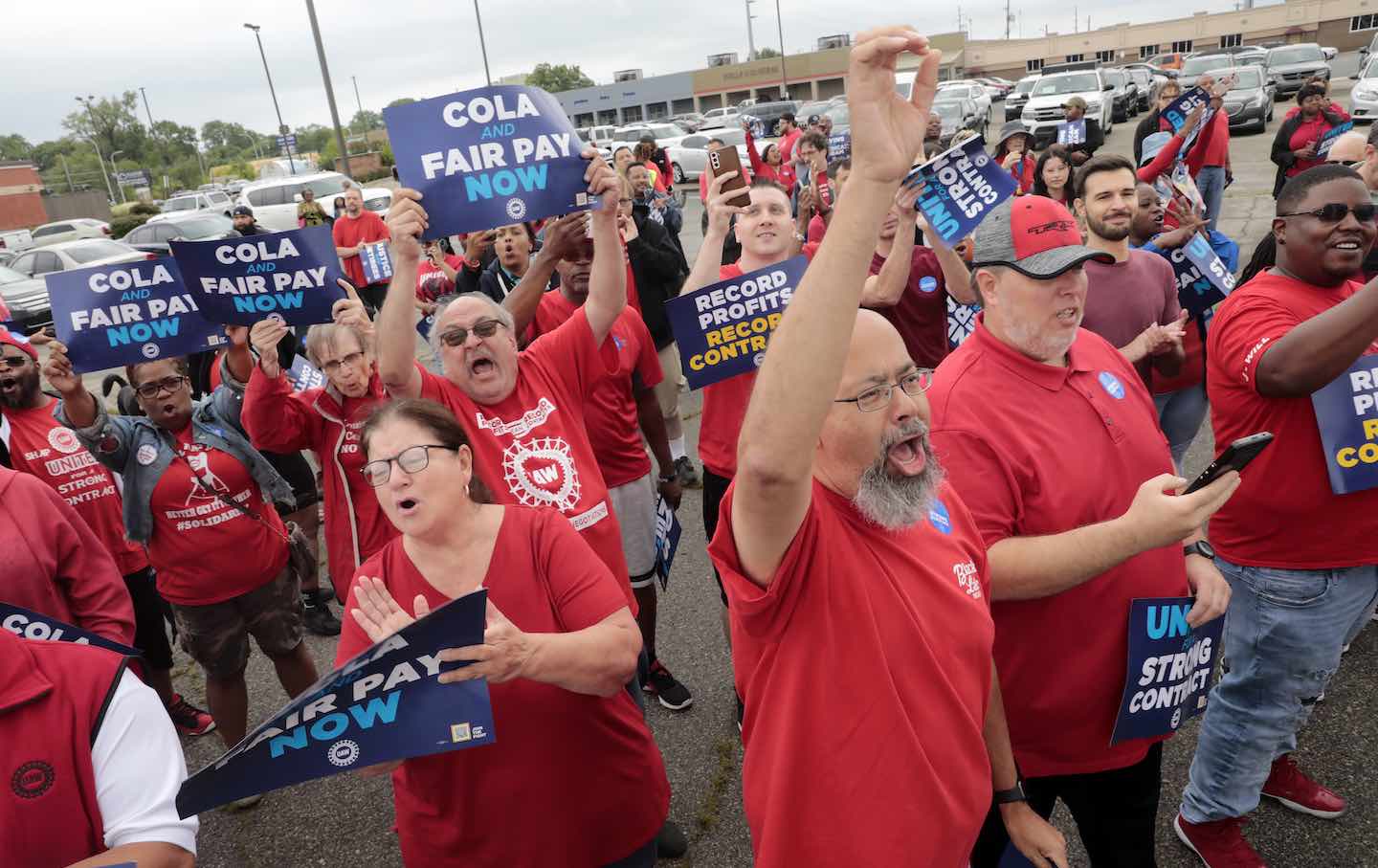
Demonstrators during a United Auto Workers practice picket outside the Stellantis Mack Assembly Plant in Detroit, Mich., on August 23, 2023.
(Photo: Jeff Kowalsky / Bloomberg)The United Auto Workers went into negotiations with the Big Three automakers and delivered what is arguably the boldest set of demands from a major industrial union in modern times. The union asked for a 46 percent pay hike, improved health care and retirement benefits, the renewal of cost-of-living pay raises, an end to different tiers of wages for older and newer workers, the restoration of defined pension benefits, and a 32-hour week with 40 hours of pay.
In any serious labor negotiation, the union asks for a lot, with the understanding that the final agreement will be at least somewhat more modest. And the union has moderated some of its demands in the course of collective bargaining with General Motors, Ford, and Stellantis—the international consortium of carmakers that now owns Chrysler.
But the automakers—which made a combined $21 billion in profits in the first six months of 2023 alone—claimed, as the Thursday expiration deadline for existing UAW contracts approached, that they could not afford to meet even the most reasonable, most basic demands of the workers. So, at midnight, UAW members joined picket lines outside selected GM, Ford, and Stellantis plants.
“Tonight, for the first time in our history, we will strike all three of the Big Three at once,” announced UAW President Shawn Fain shortly before the walkout began.
That’s one reason this is an epic moment in the history of American trade unions. And here’s another one: This strike enjoys an extraordinary level of support from the American people.
It’s no surprise that the workers were “strike ready.” As Fain explained, “Our union’s membership is clearly fed up with living paycheck to paycheck while the corporate elite and billionaire class continue to make out like bandits.” But the great mass of Americans appear to be every bit as “strike ready” as UAW members.
When Gallup pollsters asked voters just before Labor Day which side of the dispute between the UAW and the Big Three they sympathized with, 75 percent said they were with the union. Just 19 percent lined up with the corporations. A Morning Consult survey conducted last week found 2-1 support for the UAW, and noted that even the union’s boldest proposals—such as the demand for a 32-hour workweek—attracted significantly more support than opposition.
That’s a big deal. It confirms data showing that the general popularity of unions is rising, and that the American people have come to believe that unions benefit both their members and those who aren’t in unions, that labor organizations improve the standing of unionized companies, and that strong unions are good for the US economy. Indeed, on that last measure, Gallup found: “A record-high 61 percent say unions help rather than hurt the U.S. economy, eclipsing the prior high from 1999 by six points.”
Importantly, these numbers also tell us that when unions make big demands, and when they aggressively advance those demands in order to counter corporate spin (as the UAW has done with a savvy social media campaign and unity-building op-eds written by Fain with allies such as US Representative Ro Khanna), the American people will recognize organized labor’s “asks” as fair and necessary.
That’s a point Senator Bernie Sanders made when he argued in a statement ahead of the UAW strike: “Despite what you might hear in the corporate media, what the UAW is fighting for is not radical. It is the reasonable demand that autoworkers, who have made enormous sacrifices over the past 40 years, finally receive a fair share of the enormous profits their labor has generated.”
Media outlets and politicians—not just anti-labor Republican zealots such as former Wisconsin governor Scott Walker but also new Democratic centrists who have sought to align their party more closely with Wall Street and corporate interests—have for years tried to tell us that unions are relics of the past. A 1991 Harvard Business Review article spelled out the pro-business line with an argument that knowing managers “believed that the rules of the economic game have changed.” The article continued:
Competition is global, technological innovation continuous, the work force increasingly professional. In such an economic environment, unions are ill-suited to meeting the needs of either workers or companies. At best, they are an irrelevance—a leftover from a previous industrial era. At worst, they are an obstacle to making companies and countries competitive. Little wonder, then, that unions are on the wane.
That sentiment took hold over the ensuing decades and infected media coverage of labor disputes, even as unions grew in popularity. So it comes as no surprise that during the current negotiations, Fain found it necessary to deconstruct media coverage, placing an emphasis on the fact that car prices have soared not because of workers’ pay demands but because of record profiteering by the auto companies. “You don’t hear the media wringing their hands over how Big 3 profits are driving up the cost of cars. You don’t see big splashy nightly-news segments on how consumers will be impacted by companies choosing to spend billions on executive salaries, stock buybacks and special dividends,” said Fain. “No, you only hear these concerns when the working class stands up and demands a fair share of the value we produce.”
Popular
“swipe left below to view more authors”Swipe →Sanders says that analysis is spot-on. “The corporate media will always side with CEOs and shareholders,” argues the senator. “Every time working Americans stand up and demand what is just and fair, the corporate media is there to tell viewers that workers are asking for too much.”
What’s clearly changed is that the American people aren’t buying the corporate spin anymore. The people have spoken, and they are sticking with the union.
Disobey authoritarians, support The Nation
Over the past year you’ve read Nation writers like Elie Mystal, Kaveh Akbar, John Nichols, Joan Walsh, Bryce Covert, Dave Zirin, Jeet Heer, Michael T. Klare, Katha Pollitt, Amy Littlefield, Gregg Gonsalves, and Sasha Abramsky take on the Trump family’s corruption, set the record straight about Robert F. Kennedy Jr.’s catastrophic Make America Healthy Again movement, survey the fallout and human cost of the DOGE wrecking ball, anticipate the Supreme Court’s dangerous antidemocratic rulings, and amplify successful tactics of resistance on the streets and in Congress.
We publish these stories because when members of our communities are being abducted, household debt is climbing, and AI data centers are causing water and electricity shortages, we have a duty as journalists to do all we can to inform the public.
In 2026, our aim is to do more than ever before—but we need your support to make that happen.
Through December 31, a generous donor will match all donations up to $75,000. That means that your contribution will be doubled, dollar for dollar. If we hit the full match, we’ll be starting 2026 with $150,000 to invest in the stories that impact real people’s lives—the kinds of stories that billionaire-owned, corporate-backed outlets aren’t covering.
With your support, our team will publish major stories that the president and his allies won’t want you to read. We’ll cover the emerging military-tech industrial complex and matters of war, peace, and surveillance, as well as the affordability crisis, hunger, housing, healthcare, the environment, attacks on reproductive rights, and much more. At the same time, we’ll imagine alternatives to Trumpian rule and uplift efforts to create a better world, here and now.
While your gift has twice the impact, I’m asking you to support The Nation with a donation today. You’ll empower the journalists, editors, and fact-checkers best equipped to hold this authoritarian administration to account.
I hope you won’t miss this moment—donate to The Nation today.
Onward,
Katrina vanden Heuvel
Editor and publisher, The Nation
More from The Nation
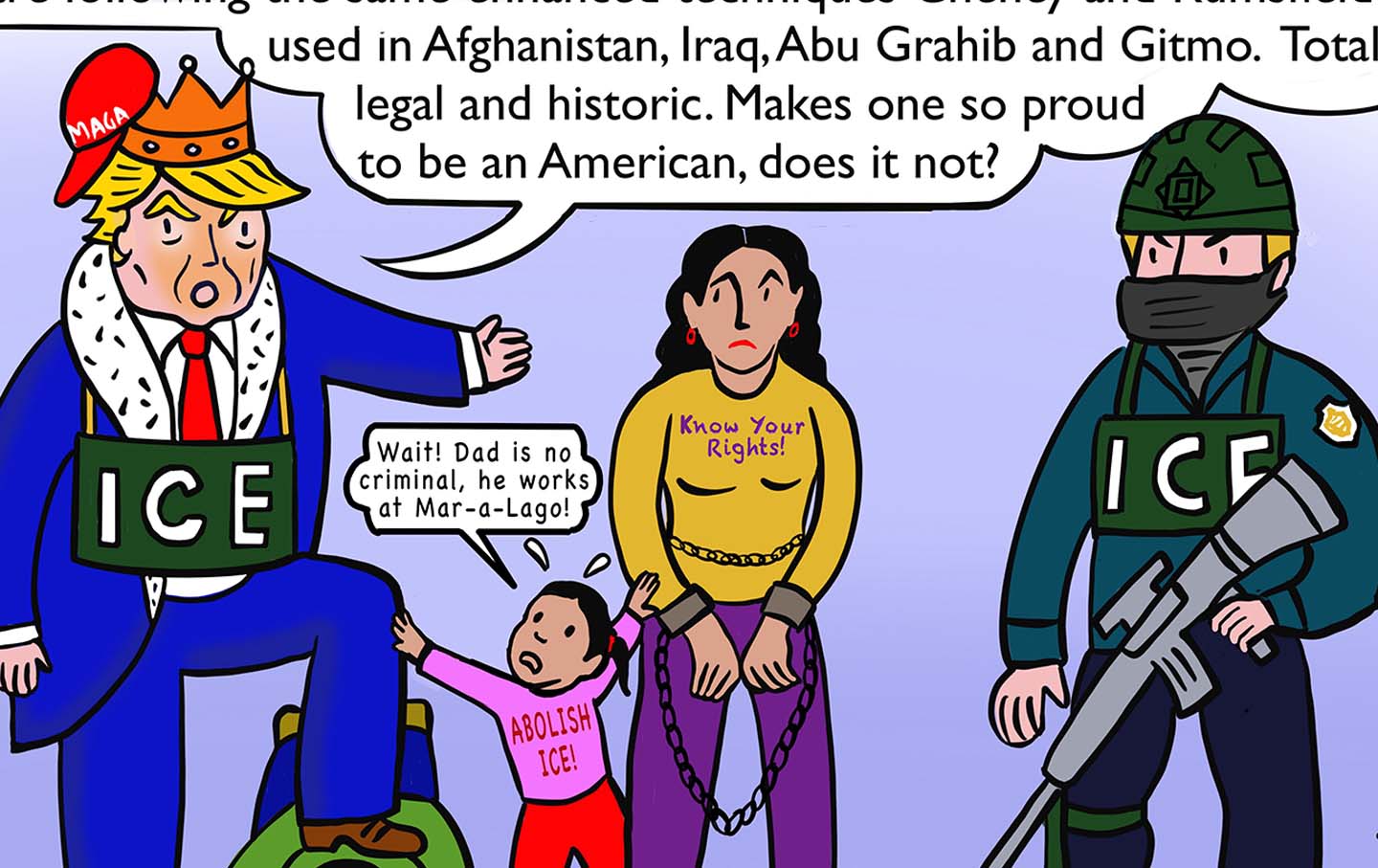
The King of Deportations The King of Deportations
ICE’s illegal tactics and extreme force put immigrants in danger.
How Rob Reiner Tipped the Balance Against Donald Trump How Rob Reiner Tipped the Balance Against Donald Trump
Trump’s crude disdain for the slain filmmaker was undoubtedly rooted in the fact that Reiner so ably used his talents to help dethrone him in 2020.
The Economy Is Flatlining—and So Is Trump The Economy Is Flatlining—and So Is Trump
The president’s usual tricks are no match for a weakening jobs market and persistent inflation.
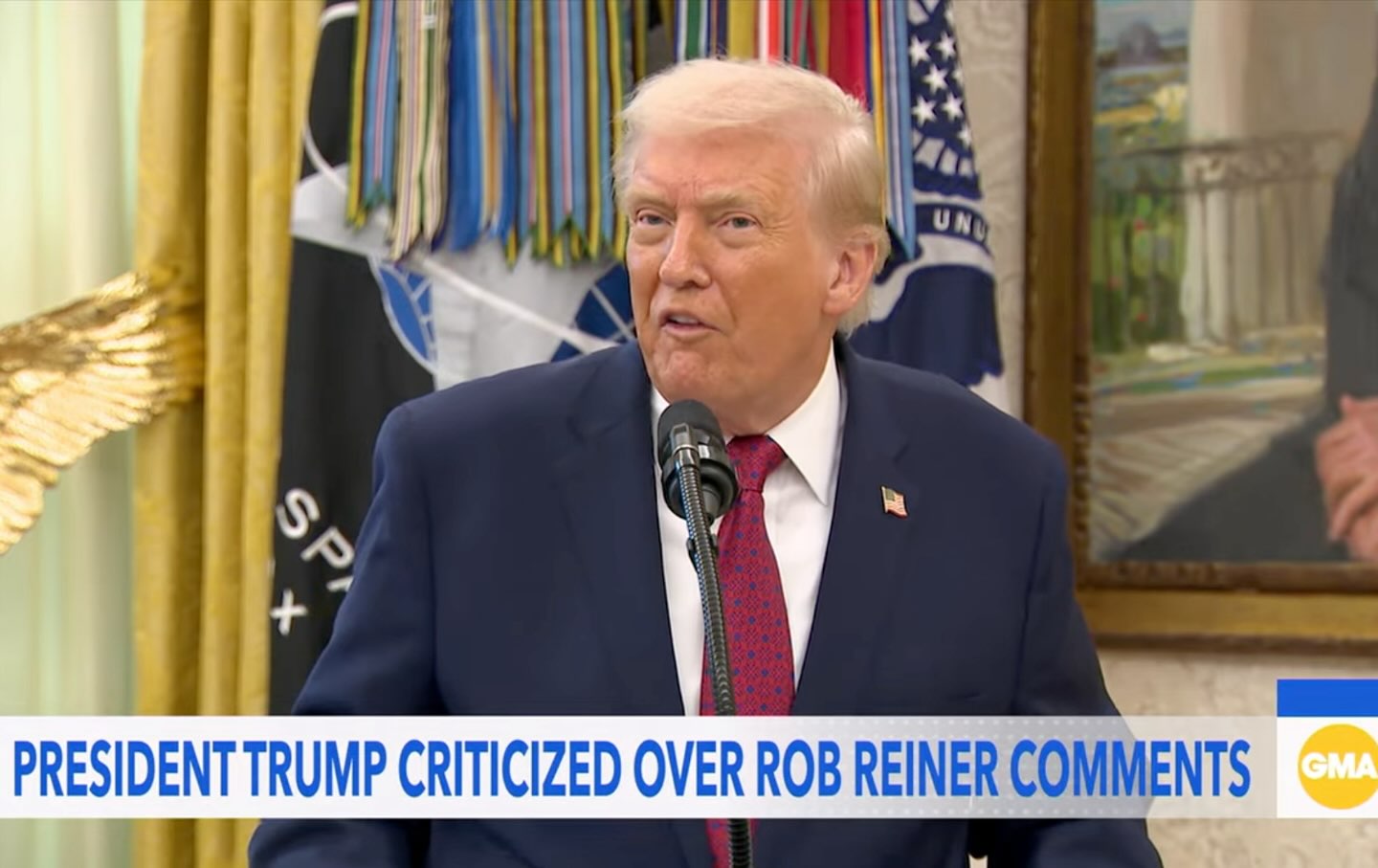
Trump’s Vile Rob Reiner Comments Show How Much He Has Debased His Office Trump’s Vile Rob Reiner Comments Show How Much He Has Debased His Office
Every day, Trump is saying and doing things that would get most elementary school children suspended.