People Are Urging Bernie Sanders to Back a Gaza Cease-Fire. Here’s Why He Hasn’t.
Sanders has insisted on supporting a “humanitarian pause” instead of a cease-fire. To understand why, you have to look at his personal history.
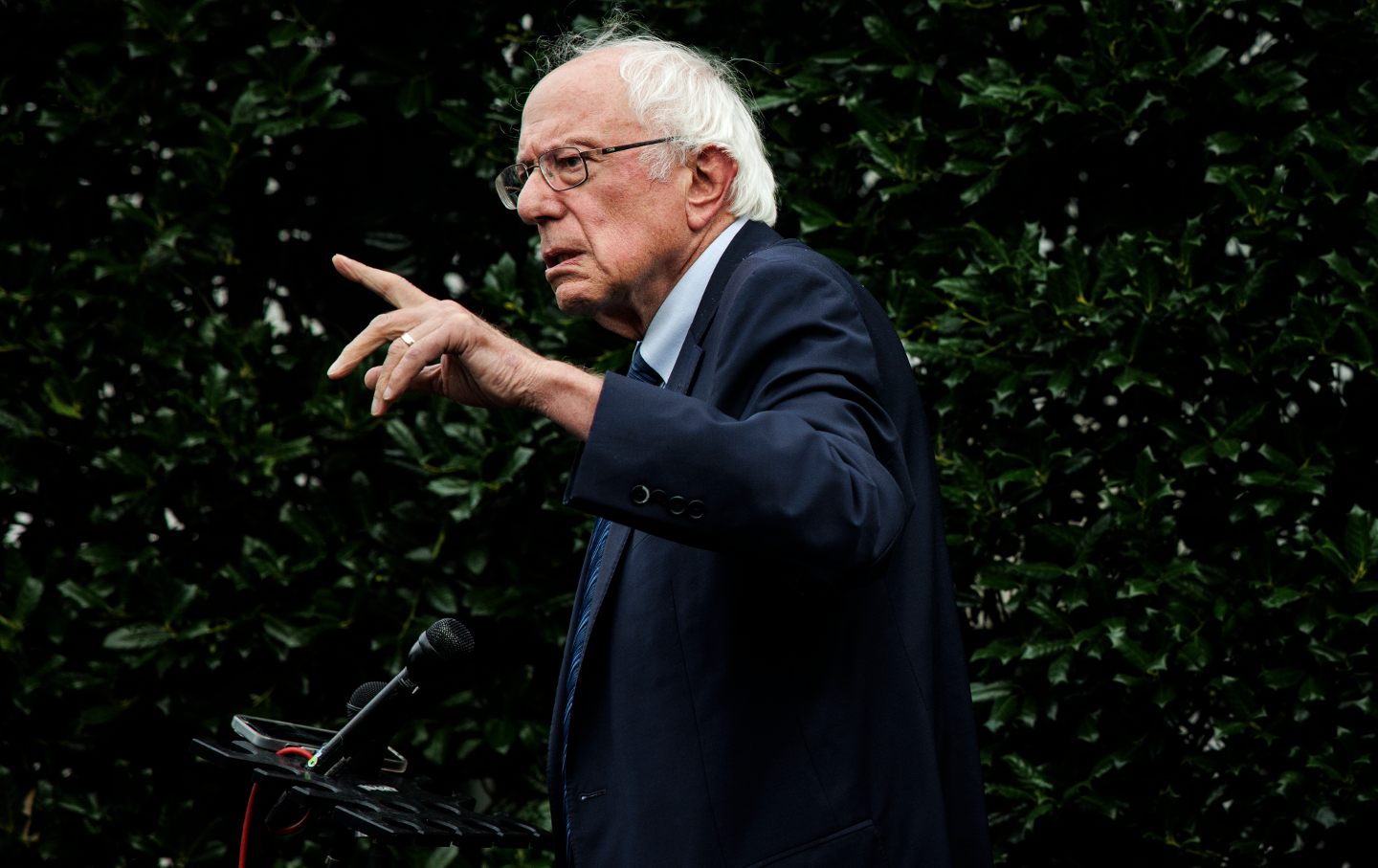
Senator Bernie Sanders (I-Vt.) speaks to reporters in front of the West Wing after meeting with President Joe Biden at the White House on August 30, 2023, in Washington, D.C.
(Samuel Corum / Sipa USA via AP)As Israeli missiles continue to pound Gaza—killing, at most recent estimate, more than six times as many people as were killed by Hamas in its bloody October 7 incursion, including thousands of children—a cease-fire has become the consensus demand of progressive activist groups like IfNotNow and Jewish Voice for Peace. It has also become the demand of many of the most high-profile progressive members of Congress.
Just two days after Hamas’s attack, Representative Alexandria Ocasio-Cortez was calling for an end to the violence. “An immediate ceasefire and de-escalation is urgently needed to save lives,” Ocasio-Cortez said in a statement. A week later, AOC signed the Ceasefire Now Resolution along with 11 of her progressive House colleagues, including fellow “Squad” members Jamaal Bowman, Rashida Tlaib, Cori Bush, and Ilhan Omar.
But the call for a cease-fire has yet to receive the backing of the single most influential progressive on Capitol Hill: Senator Bernie Sanders. The Vermont socialist, whose trailblazing presidential runs helped inspire a generation of left-wing activists, including everyone in the Squad, has stubbornly avoided using the term “cease-fire,” even as he calls for a “humanitarian pause” in Israel’s assault to get aid to Palestinian civilians in Gaza.
Sanders has stuck to this position even as calls for a cease-fire have started to move from the edges of the Democratic Party to its center. On Thursday, Illinois Senator Dick Durbin, the second-highest-ranking Democrat in the Senate, became the first senator to endorse a cease-fire when a TV interviewer pressed the issue; though Durbin is relatively progressive, commentators like MSNBC’s Mehdi Hasan took note that he got out ahead of Sanders, the left’s standard-bearer in the Senate.
Many in Sanders’s orbit have also backed a cease-fire. Matt Duss, the executive vice president of the Center for International Policy, who served as Sanders’s foreign policy adviser from 2017 to 2022, endorsed the goal of a cease-fire in The Guardian this week, urging progressive activists to “continue to apply pressure to those not yet courageous enough to support a cessation of this horror.” At the same time, Duss cautioned against “a false binary between whether Israel should be taking any military action or not,” arguing that the distinction between “humanitarian pause” and “cease-fire” is largely semantic, that the former can be extended to the latter and the latter is not a peace treaty, and that the important thing is to protect civilian lives and oppose Israel’s indiscriminate bombing of civilian areas without necessarily opposing targeted military action against Hamas leaders. Though Duss no longer works for Sanders, he remains in contact with the senator and with his successor as foreign policy adviser, Max Hoffman; from his position, it makes sense to call for a big-tent approach to rein in Israel’s assault.
But for many on the left who passionately supported Sanders in 2016 and 2020, the refusal to call for an actual cease-fire is baffling. “How many dead Palestinians is enough for Bernie Sanders to call for a ceasefire? We learned today that it is higher than 8,000, how high it actually is is still not known,” tweeted Palestinian-American writer Yousef Munayyer on Wednesday. Daniel Denvir, host of Jacobin’s popular podcast The Dig, contrasted “the Squad’s leadership demanding a ceasefire while Bernie breaks our hearts, refusing to speak out against genocide.” Felix Biederman, cohost of the left-wing podcast Chapo Trap House, which ferociously championed Sanders’s presidential runs, had the harshest words of all for Sanders: Israel, he wrote, “is doing their best to end all life in Gaza and the most you can offer is suggesting a brief timeout while assuring them that they’re allowed to do whatever they want. hope you live just long enough to see Biden lose and the last years of your life wasted.”
Sanders is the most powerful leftist Jewish politician in America. He has been a consistent critic of Israel. He is well aware of the horrors being inflicted on Gaza. He would seem to be an obvious spokesman for a cease-fire. And yet he has clearly taken a firm decision not to call for one.
To understand where Sanders is coming from, it helps to know a little about his personal history. Though he is well to the left of his Senate colleagues and has consistently voiced support for the basic human rights of Palestinians and criticized the Israel lobby, Sanders is in many ways a product of the liberal Zionist tradition. During his 2020 campaign, Sanders advisers urged the instinctively private candidate to talk more about his Jewish background, including the fact that his father, an immigrant from Poland, lost most of his family in the Holocaust. The slaughter of Europe’s Jews is deeply personal for Sanders, and it likely factors into his response to the October 7 attacks, which were the single deadliest day for Jews anywhere in the world since 1945. The members of the Squad, who come from a wide diversity of backgrounds and are on average many decades younger than Sanders, lack this direct connection to the personal trauma that many American Jews of Sanders’s generation feel.
They also lack his direct connection to Israel itself, including his time living on a socialist kibbutz near Haifa in 1963. As Sanders wrote in Jewish Currents in 2019, “It was there that I saw and experienced for myself many of the progressive values upon which Israel was founded. I think it is very important for everyone, but particularly for progressives, to acknowledge the enormous achievement of establishing a democratic homeland for the Jewish people after centuries of displacement and persecution.” Sanders went on to acknowledge that Palestinians experienced the founding of Israel very differently, “as the cause of their painful displacement,” and to call for a two-state solution. His understanding of the conflict is basically indistinguishable from that of J Street, the “pro-Israel, pro-peace” organization that many progressive Democrats prefer to the increasingly right-wing AIPAC—and J Street has refused to back a cease-fire, though it has called for humanitarian pauses.
Sanders, it should be acknowledged, has called for an end to the indiscriminate bombing of Gaza and the killing of thousands of Palestinian civilians, warned against a ground invasion, and insisted on more humanitarian aid—and the practical effects of his demands would more or less amount to a cease-fire. A defender of Sanders might reasonably ask why the word “cease-fire” is essential, while a critic might respond that if that’s what he supports then he shouldn’t have so much difficulty saying it. But the truth is that there is a meaningful ideological distinction to be drawn between calling for a cease-fire and calling for a humanitarian pause: The latter acknowledges that some military operations by Israel might theoretically be legitimate, even if much of what they’re doing in practice is not.
Those on the left who demand a cease-fire are saying, in effect, that we don’t identify with Israel’s desire to wipe out Hamas militarily, because we see everything that’s happening in the context of a decades-old colonial project in which Israel is fundamentally the aggressor. By contrast, those who call for a humanitarian pause may acknowledge the need to protect Palestinian civilians, or that Israel’s ongoing assault on Gaza is brutal and unjustified, or even that Israel owns its share of responsibility for the underlying conflict—but still, they insist, Israel was attacked by Hamas on October 7 and has some right to respond in kind. Sanders has been clear that this is where he stands. “Israel suffered a major attack and has, as do all other countries under similar circumstances, the absolute right to defend itself,” he said last week.
To put my own cards on the table, I wish Sanders would call for a cease-fire, and as a longtime supporter and admirer, I’m disappointed that he hasn’t. I understand the reasons why, but I don’t think they excuse the call he’s made. At the same time, I’d like to think Sanders appreciates that so many young activists aren’t relying on him for cues on how to talk about this unfolding atrocity. Instead, they are organizing and demonstrating on their own terms, based on their own collective sense of what is morally demanded of them right now. As Sanders has said many times, the movement is much bigger than him.
Disobey authoritarians, support The Nation
Over the past year you’ve read Nation writers like Elie Mystal, Kaveh Akbar, John Nichols, Joan Walsh, Bryce Covert, Dave Zirin, Jeet Heer, Michael T. Klare, Katha Pollitt, Amy Littlefield, Gregg Gonsalves, and Sasha Abramsky take on the Trump family’s corruption, set the record straight about Robert F. Kennedy Jr.’s catastrophic Make America Healthy Again movement, survey the fallout and human cost of the DOGE wrecking ball, anticipate the Supreme Court’s dangerous antidemocratic rulings, and amplify successful tactics of resistance on the streets and in Congress.
We publish these stories because when members of our communities are being abducted, household debt is climbing, and AI data centers are causing water and electricity shortages, we have a duty as journalists to do all we can to inform the public.
In 2026, our aim is to do more than ever before—but we need your support to make that happen.
Through December 31, a generous donor will match all donations up to $75,000. That means that your contribution will be doubled, dollar for dollar. If we hit the full match, we’ll be starting 2026 with $150,000 to invest in the stories that impact real people’s lives—the kinds of stories that billionaire-owned, corporate-backed outlets aren’t covering.
With your support, our team will publish major stories that the president and his allies won’t want you to read. We’ll cover the emerging military-tech industrial complex and matters of war, peace, and surveillance, as well as the affordability crisis, hunger, housing, healthcare, the environment, attacks on reproductive rights, and much more. At the same time, we’ll imagine alternatives to Trumpian rule and uplift efforts to create a better world, here and now.
While your gift has twice the impact, I’m asking you to support The Nation with a donation today. You’ll empower the journalists, editors, and fact-checkers best equipped to hold this authoritarian administration to account.
I hope you won’t miss this moment—donate to The Nation today.
Onward,
Katrina vanden Heuvel
Editor and publisher, The Nation
More from The Nation
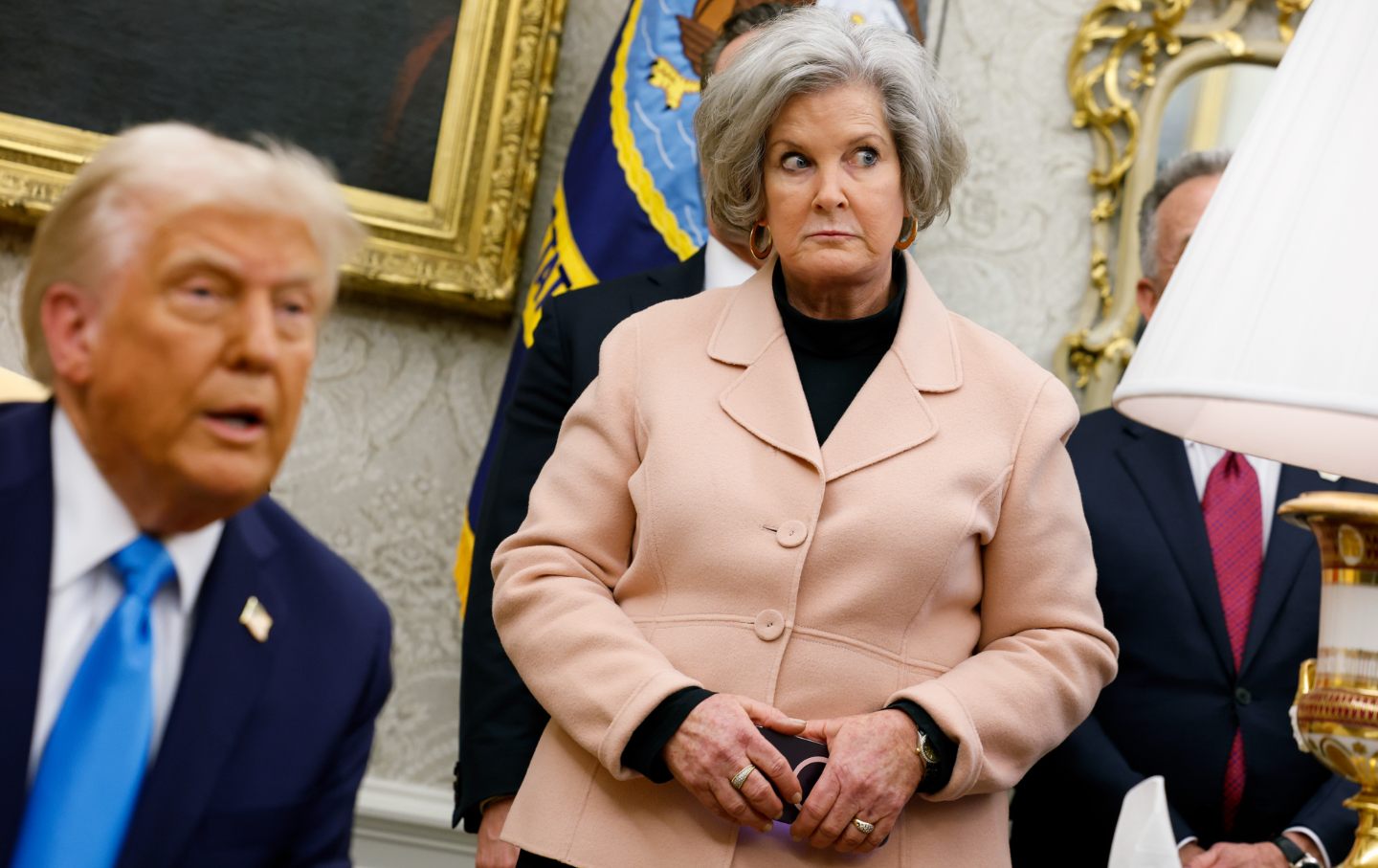
The Shocking Confessions of Susie Wiles The Shocking Confessions of Susie Wiles
Trump’s chief of staff admits he’s lying about Venezuela—and a lot of other things.

The King of Deportations The King of Deportations
ICE’s illegal tactics and extreme force put immigrants in danger.
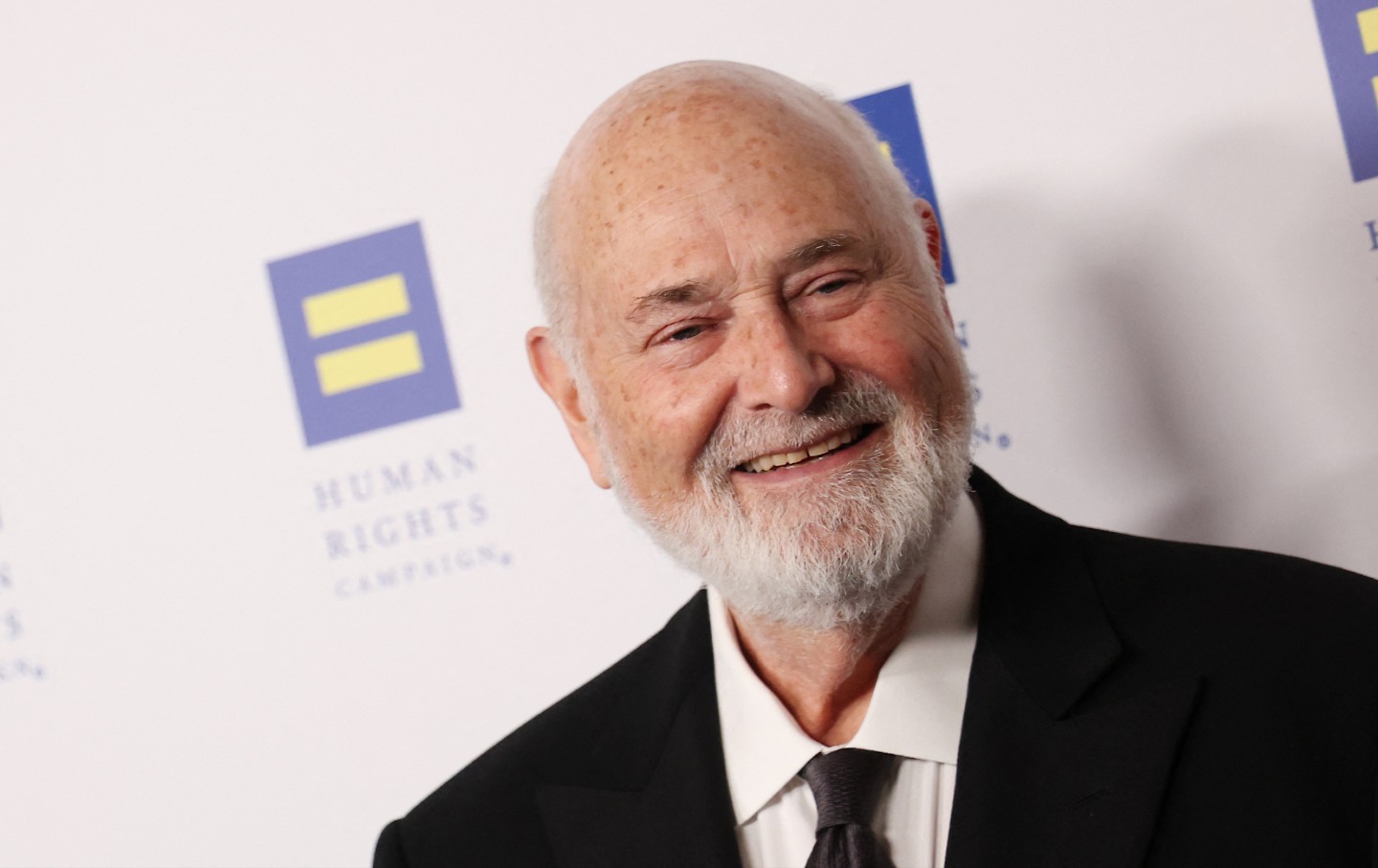
How Rob Reiner Tipped the Balance Against Donald Trump How Rob Reiner Tipped the Balance Against Donald Trump
Trump’s crude disdain for the slain filmmaker was undoubtedly rooted in the fact that Reiner so ably used his talents to help dethrone him in 2020.
The Economy Is Flatlining—and So Is Trump The Economy Is Flatlining—and So Is Trump
The president’s usual tricks are no match for a weakening jobs market and persistent inflation.
Trump’s Vile Rob Reiner Comments Show How Much He Has Debased His Office Trump’s Vile Rob Reiner Comments Show How Much He Has Debased His Office
Every day, Trump is saying and doing things that would get most elementary school children suspended.