Is Bidenomics Ready for the Campaign Trail?
The president is touting the strength of the economy in his reelection campaign. But there’s no guarantee voters will bite.
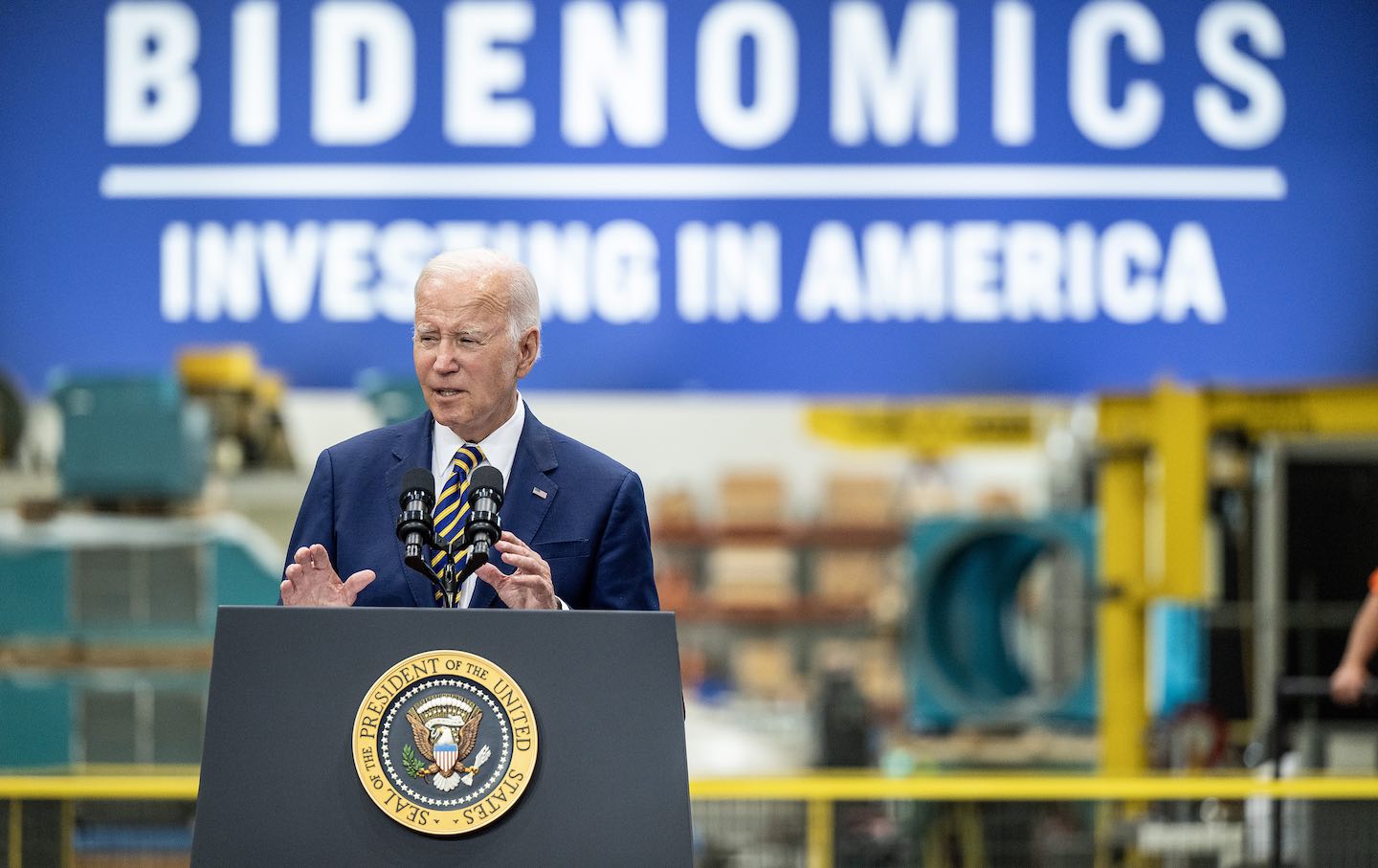
As of this summer, Joe Biden’s economic platform has been repackaged with a campaign-ready name: “Bidenomics.” Since announcing his reelection bid in April, the president has marshaled a body of talking points forcefully touting his impressive numbers on job creation, overall economic growth, and inflation. Meanwhile, Democratic consultants and campaign professionals are waiting for the other shoe to drop. They want Biden’s chronically poor approval ratings—mired at or around 40 percent—to start ticking upward by the time the 2024 campaign season officially kicks off in January.
It’s a long-fetishized article of received political wisdom that a high-performing economy should translate into electoral gold for a president seeking a second term. Indeed, there’s a whole school of rational-choice political science holding that if a president meets certain key metrics of economic growth while in office, his reelection is all but assured. With inflation cooling off in a strong jobs economy, Biden could see a stretch of significant wage growth in time for the 2024 primary season—just what the rational-choice doctors ordered.
But not even the most ardent Biden campaign hand expects “Bidenomics” to morph into “Morning in America” by November 2024. In part, that’s because there are still some drags on the overall economic picture. Until quite recently, inflation has still outpaced the wage growth that’s occurred so far on Biden’s watch, meaning that even a robust jobs economy can feel to many workers like it’s declining.
Still, such caveats attach to the economic records of most sitting presidents. Reagan cruised to reelection with an inflation rate even higher than Biden’s—4 percent then, as compared to right around 3 percent today. Obama was still managing a sluggish, job-starved recovery when he handily beat Mitt Romney in 2012. And the most plausible explanation for the Biden economic lag may have less to do with the president than with the most striking change in American national politics over the past decade: the cult of Donald Trump.
Trump has of course widely and loudly advertised his genius as a manager of the economy—but that’s largely a side effect of the press’s unforgivable elevation of him as a private-sector wizard over the past half-century. In reality, what we might call Trumpenomics has succeeded in political terms by transforming economic performance into another theater of the culture wars. In the same way that the MAGA hordes have morphed Hunter Biden into an all-purpose symbol of the country’s defilement at the hands of a sinister elite criminal conspiracy, Trump has assigned blame for erratic or disappointing economic performance to a rotating cast of villains so tightly intertwined as to be functionally indistinguishable: globalists, media and tech moguls, China, Covid plotters (see also: China), George Soros, etc. In Trump’s inexhaustible telling, this far-flung body of bad actors is united in its manic determination to purloin the true birthright livelihoods of real Americans.
Like all things Trump thinks and utters, it’s a supremely undisciplined word picture. But it has undeniably changed the center of gravity in the popular understanding of the intersection between politics and the economy. In an analysis of the disconnect between the true performance of Biden’s economy and the lackluster response of public opinion, New Republic writer Timothy Noah underlines a critical truth: In the polling that covered the weeks before and after Trump won in 2016, there was an epic 33 percent spike in the share of Republican poll respondents reporting that the economy was performing well, and a 15 percent drop in Democrats reporting that it was doing better. In other words, even before Trump was sworn in as president, political partisans flocked to party-branded accounts of the economy’s performance. The same stark divide turns up today in the polling on Biden’s economic record: 84 percent of Democrats approve of Biden’s handling of jobs and unemployment, while just 15 percent of Republicans do. On inflation, the partisan spread is nearly identical, with 71 percent backing Biden’s record compared with just 5 percent of Republicans.
So while the rational-choice models forecast that economic performance determines voting behavior, the lines of causation now overwhelmingly run in the opposite direction: It’s party affiliation that dictates how Americans think the economy is doing.
In these conditions, the Trumpian narrative of elite-engineered economic declension as but one more species of cultural victimization enjoys tremendous power. A series of overlapping melodramas will always command greater attention than tables and charts plotting out bond yield curves, price trend lines, and wage growth. “Competing with the most proper set of footnotes is not the way to win a political fight,” says Jeff Hauser, head of the executive-branch watchdog group the Revolving Door Project and a critic of the economic determinism practiced in the rational-choice political science academy.
Which is to say that the most pressing challenge ahead for Bidenomics is not to demonstrate a consistent record of evenly distributed growth and prosperity. Rather, it’s to produce an emotionally compelling counternarrative about how the president is fighting off the real bad actors of the economy—the price-gouging oligarchies, the tech monopolies, the banking elites, and the exploitative bosses. “At the Revolving Door Project, we’re always saying that Biden needs to be picking fights with plausible villains,” Hauser says. “If I were advising Biden, I’d have a team of opposition researchers looking into the 100 richest people in the six to eight economic sectors where there’s been price inflation, and find out which of these people has a sordid personal history and is least likely to be managed by a professional PR person. And then I’d goad the hell out of them.” In other words, the way to get full credit for your economic record is to do better politics.
Disobey authoritarians, support The Nation
Over the past year you’ve read Nation writers like Elie Mystal, Kaveh Akbar, John Nichols, Joan Walsh, Bryce Covert, Dave Zirin, Jeet Heer, Michael T. Klare, Katha Pollitt, Amy Littlefield, Gregg Gonsalves, and Sasha Abramsky take on the Trump family’s corruption, set the record straight about Robert F. Kennedy Jr.’s catastrophic Make America Healthy Again movement, survey the fallout and human cost of the DOGE wrecking ball, anticipate the Supreme Court’s dangerous antidemocratic rulings, and amplify successful tactics of resistance on the streets and in Congress.
We publish these stories because when members of our communities are being abducted, household debt is climbing, and AI data centers are causing water and electricity shortages, we have a duty as journalists to do all we can to inform the public.
In 2026, our aim is to do more than ever before—but we need your support to make that happen.
Through December 31, a generous donor will match all donations up to $75,000. That means that your contribution will be doubled, dollar for dollar. If we hit the full match, we’ll be starting 2026 with $150,000 to invest in the stories that impact real people’s lives—the kinds of stories that billionaire-owned, corporate-backed outlets aren’t covering.
With your support, our team will publish major stories that the president and his allies won’t want you to read. We’ll cover the emerging military-tech industrial complex and matters of war, peace, and surveillance, as well as the affordability crisis, hunger, housing, healthcare, the environment, attacks on reproductive rights, and much more. At the same time, we’ll imagine alternatives to Trumpian rule and uplift efforts to create a better world, here and now.
While your gift has twice the impact, I’m asking you to support The Nation with a donation today. You’ll empower the journalists, editors, and fact-checkers best equipped to hold this authoritarian administration to account.
I hope you won’t miss this moment—donate to The Nation today.
Onward,
Katrina vanden Heuvel
Editor and publisher, The Nation