Left-Populists—Unshackle Your Imaginations!
It’s time to challenge the Democrats’ “business model.”
This year’s election left Democrats in a quandary. They clearly needed new, ambitious proposals to help working Americans, but that would undermine a de facto “business model” that has guided their party for decades. Once again, it seemed that nothing would change.
As always, the left had no shortage of good advice for Democrats. Some commentators joined Senator Bernie Sanders in admonishing the party to remember its working-class issues. In one interesting take, Pete Davis proposed overhauling the party’s “civic structure” with tools like maps, membership cards, and mutual aid.
“By pairing local participation with centralized coordination,” Davis wrote, “the national leadership and the local membership could communicate ideas, concerns, mandates, and marching orders back and forth.”
The problem isn’t the advice; it’s the intended audience. It’s dispiriting for activists to spend their lives supplicating to an institution that has strong incentives not to listen. It’s time to stop talking about what Democrats need to do and start talking about what the left should do.
For years, the idea that the Democrats had any plan would have seemed absurd. But the chaos ended in the 1990s, when so-called “New Democrats” reorganized the party using a corporate-style blueprint. They don’t call it a “business model,” of course, but it exists. It helps explain some of the party’s more baffling decisions—and its distaste for the left.
The model’s “product” is corporate-friendly public policy. Revenue from corporations and wealthy individuals (“customers”) finances the party’s mega-million-dollar—now billion-dollar—campaigns, along with a vast superstructure of think tanks, consulting firms, and vendors. They employ thousands of people who, in turn, help shape the party’s direction.
The model worked, for a while. Democrats won the presidency and both houses of Congress in 2008, including a filibuster-proof Senate majority. But it cost them in the end. The 2008 financial crisis made it impossible to fully address the financial emergency and please the “customers,” which frustrated working-class voters.
Dems lost the House in 2010, the Senate in 2014, and the presidency in 2016.
The business model also explains why the party twice rejected Sanders, the most popular politician in the country. Sanders posed an existential threat to the model. His economic proposals undermined its “product,” and his ability to raise large sums of small-donor cash threatened its revenue stream. Better to lose occasionally, even to Trump, than sacrifice the cash flow that finances “centrist” campaigns—and supports thousands of party operatives.
Sanders, the Congressional Progressive Caucus (CPC), and other elected progressives worked diligently under Biden, winning some strong appointments like Lina Khan at the FTC and passing legislation that exceeded expectations. But they paid a price for their loyalty. Like other elected progressives, Sanders and CPC leader Representative Pramila Jayapal (D-WA) arguably traded away some clout by endorsing Biden more than a year before the election, leaving them unable to argue effectively for popular progressive ideas.
That’s changing now. Sanders has openly challenged the party’s “big money interests and well-paid consultants.” He also praised the independent campaign of pro-working-class candidate Dan Osborn in an interview with The Nation, calling Osborn’s Nebraska senatorial bid “a model for the future.”
“Where people can run in the Democratic primary and win,” said Sanders, “that’s fine. Where it is more advantageous to run as an independent…we should do that, as well.”
On his first day as the CPC’s new leader, Representative Greg Casar (D-TX) lashed out at “billionaires,” saying the party should “shed off some of its more corporate elements” and “re-emphasize core economic issues.” Tellingly, Cesar also criticized Biden for running for reelection, saying “it was clear [Biden] needed to step down.”
Much of the left agenda remains popular. Large majorities support steep tax hikes for billionaires, millionaires, and accumulated wealth. Fifty-nine percent of voters believe the government has a responsibility to ensure health coverage for everyone. Nearly three-fourths of those polled in 2022 believed the government should expand Social Security—something Joe Biden promised in 2020 and never mentioned again. And the left has always opposed corruption and money in politics—something voters in both parties despise.
Seventy percent of people polled by Gallup expressed confidence in organized labor—well ahead of Congress and big business. Democratic and Republican voters are equally averse to financial institutions and large corporations.
There also seems to be an inchoate yearning for solidarity. It’s not class consciousness—yet—but could that change? Davis is onto something important with “civic structure.” Left-populists need a community, or a movement.
The left should organize, but how? American history offers some hints. In the 19th century, as now, lives were being devastated by inequality. Economic and technological forces were reshaping work, giving rise to progressive populist movements. Among their traits, writes historian Ronald P. Formisano: They “arise from the grassroots and gain a wide popular base of ‘ordinary people’”; they “show a concern for the redistribution of political or economic power downward”; and their “supporters…believe that they have lost control over their lives.”
That’s timely.
Walter Nugent studied the populist farmer/labor alliance and found that both were “traditionally antimonopoly.” They shared the belief that “producers of goods, whether agricultural or mechanical, had common interests.” Their alliance, Nugent writes, was “open [only] to those who ‘really worked’ and closed to those who ‘lived off the labor of others.’”
In other words: They were the 99 percent.
The FDR era offers more examples of change from below. The New Deal was preceded by years of leftist action, including Socialist Party campaigns that dented Democratic margins, agrarian activism in farm states, and millions of people who joined “Townsend clubs” to demand an old-age pension (which they got) and nationalization of the banks (which they didn’t). Labor actions included general strikes in Seattle and Minneapolis, the Harlan County War, and California agricultural strikes. Unions initiated 1,856 strikes involving 1,470,000 workers in 1934 alone.
These movements shaped the moment. It was their New Deal, as well as Roosevelt’s.
The left also has a chance to revive the 20th century’s anti-war and nuclear disarmament movements. Key voting blocs oppose this administration’s open-handed support for Israel’s actions, including 62 percent of Jewish voters, and a campaign against wasteful military spending would likely be well-received among cash-strapped voters. Democratic insiders didn’t seem to understand that genocide was a moral red line for millions of voters.
Popular
“swipe left below to view more authors”Swipe →Is it time for a third party? Sanders says no, at least not yet. Socialist writer Carl Beijer disagrees, calling for a new Left Party. Third-party and independent candidacies can be useful, although they face many obstacles at the national level. There will undoubtedly be more such campaigns, and successful ones at that. There will also be many occasions when the Democratic Party is the best vehicle for a left agenda. Some activists may even follow the example of the populists who formed a third “People’s Party” but later merged with the Democrats. As Sanders suggests, these choices should be tactical.
But why limit the conversation to political parties? Direct action is still persuasive. A plurality of Americans supported the Occupy movement when it began. Two-thirds of Americans supported Black Lives Matter in 2020.
Mutual aid work is also effective, as with the recent formation of a Tenants Union in New Haven to resist evictions by corporate landlords. Such efforts help individuals and communities while affirming that working people can push back against the forces behind their everyday misery.
An alliance of local groups could be one starting point. Another might be to build on existing groups like Our Revolution and DSA.
It’s time to act—and experiment. It’s time for local activism, new federations and coalitions, perhaps even a national umbrella organization of the left. It’s time to seek ways of unifying the “producers” of the 21st century, creating a new, independent network that would be free to act according to its own lights. Above all else, it’s time for a reaffirmation of possibility.
There are many conversations to be had, many avenues to explore. The first step for left-populists, however, is to unshackle their imaginations. Yes, the left should engage with many institutions, including the Democratic Party—but on its own terms, pursuing its own ideals, and shaping its own unfettered vision for the future.
Disobey authoritarians, support The Nation
Over the past year you’ve read Nation writers like Elie Mystal, Kaveh Akbar, John Nichols, Joan Walsh, Bryce Covert, Dave Zirin, Jeet Heer, Michael T. Klare, Katha Pollitt, Amy Littlefield, Gregg Gonsalves, and Sasha Abramsky take on the Trump family’s corruption, set the record straight about Robert F. Kennedy Jr.’s catastrophic Make America Healthy Again movement, survey the fallout and human cost of the DOGE wrecking ball, anticipate the Supreme Court’s dangerous antidemocratic rulings, and amplify successful tactics of resistance on the streets and in Congress.
We publish these stories because when members of our communities are being abducted, household debt is climbing, and AI data centers are causing water and electricity shortages, we have a duty as journalists to do all we can to inform the public.
In 2026, our aim is to do more than ever before—but we need your support to make that happen.
Through December 31, a generous donor will match all donations up to $75,000. That means that your contribution will be doubled, dollar for dollar. If we hit the full match, we’ll be starting 2026 with $150,000 to invest in the stories that impact real people’s lives—the kinds of stories that billionaire-owned, corporate-backed outlets aren’t covering.
With your support, our team will publish major stories that the president and his allies won’t want you to read. We’ll cover the emerging military-tech industrial complex and matters of war, peace, and surveillance, as well as the affordability crisis, hunger, housing, healthcare, the environment, attacks on reproductive rights, and much more. At the same time, we’ll imagine alternatives to Trumpian rule and uplift efforts to create a better world, here and now.
While your gift has twice the impact, I’m asking you to support The Nation with a donation today. You’ll empower the journalists, editors, and fact-checkers best equipped to hold this authoritarian administration to account.
I hope you won’t miss this moment—donate to The Nation today.
Onward,
Katrina vanden Heuvel
Editor and publisher, The Nation
More from The Nation

The Shocking Confessions of Susie Wiles The Shocking Confessions of Susie Wiles
Trump’s chief of staff admits he’s lying about Venezuela—and a lot of other things.

The King of Deportations The King of Deportations
ICE’s illegal tactics and extreme force put immigrants in danger.
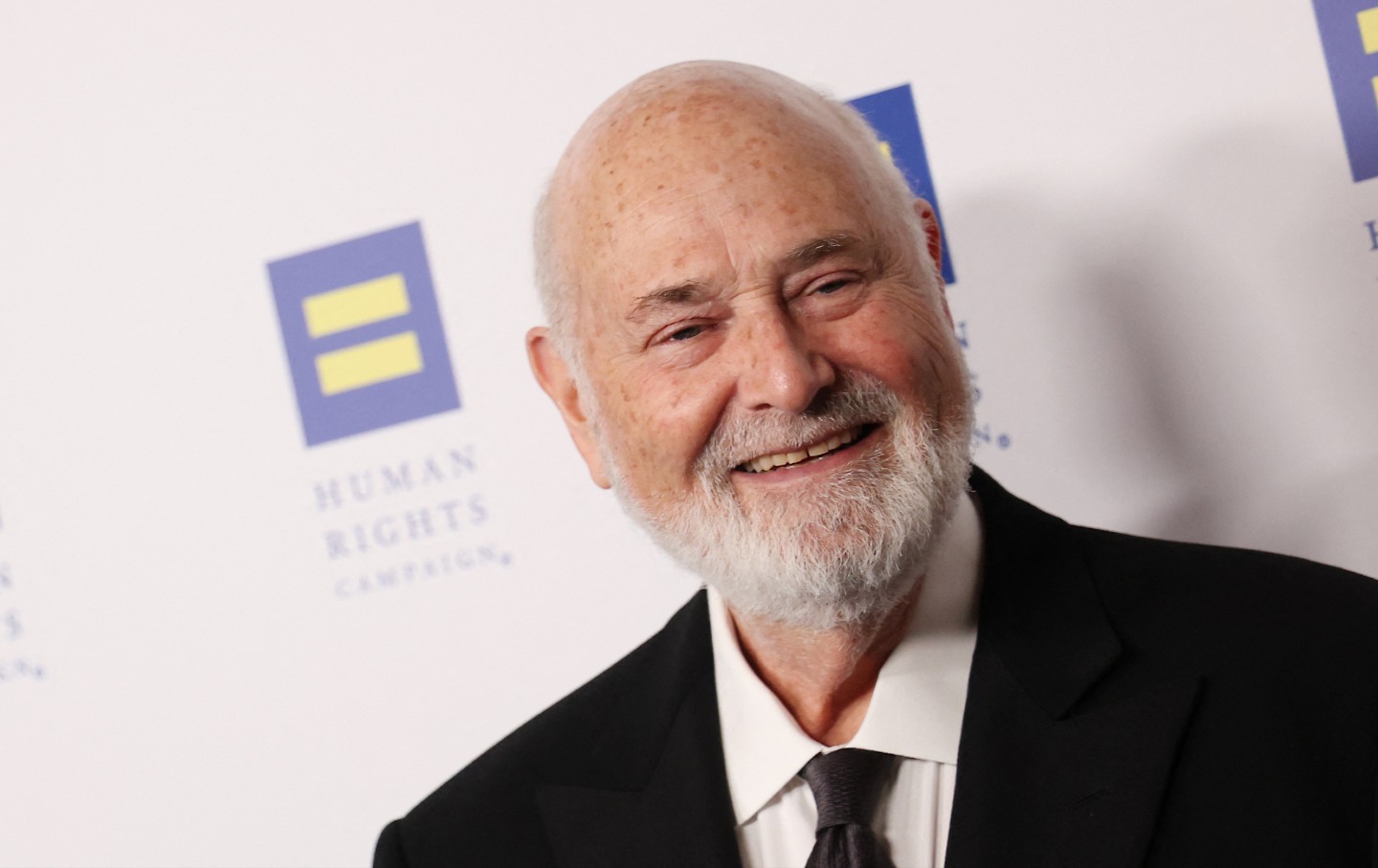
How Rob Reiner Tipped the Balance Against Donald Trump How Rob Reiner Tipped the Balance Against Donald Trump
Trump’s crude disdain for the slain filmmaker was undoubtedly rooted in the fact that Reiner so ably used his talents to help dethrone him in 2020.

The Economy Is Flatlining—and So Is Trump The Economy Is Flatlining—and So Is Trump
The president’s usual tricks are no match for a weakening jobs market and persistent inflation.

Trump’s Vile Rob Reiner Comments Show How Much He Has Debased His Office Trump’s Vile Rob Reiner Comments Show How Much He Has Debased His Office
Every day, Trump is saying and doing things that would get most elementary school children suspended.