Elon Musk Is Trying to Buy Another Election
Not satisfied with controlling the federal government, the shadow president’s political action committee is suddenly spending big on a crucial Wisconsin Supreme Court election.
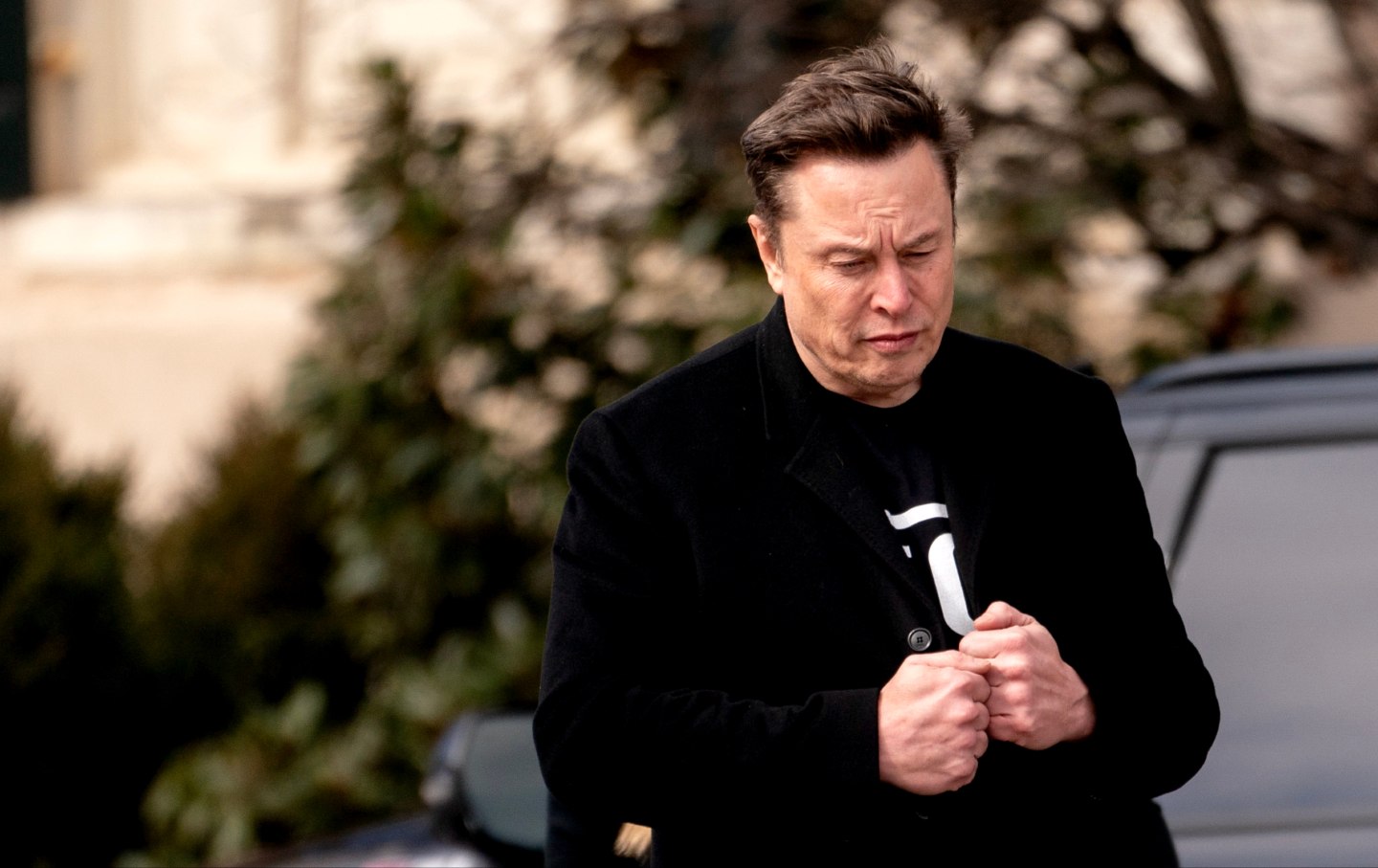
Elon Musk walks to the Eisenhower Executive Office Building near the White House in Washington, DC, on Thursday, February 13, 2025.
(Stefani Reynolds / Bloomberg via Getty Images)Billionaires tend to buy what they want: mansions, yachts, spaceships, communications platforms, connections that allow them to transform nations. That’s a global reality in what will be remembered as an age of resurgent plutocracy. Contemporary oligarchs obtain influence in different ways—in some nations, through direct bribes and shady business arrangements; in others with slightly more genteel democratic sensibilities, through the sort of election expenditures that former US Senator Russ Feingold has long described as “legalized bribery.”
The head of today’s billionaire class, Elon Musk, has used his fortune to insert himself into the electoral processes of many countries—most notably the United States, where the world’s richest man spent upwards of $260 million to secure the election of a malleable lesser billionaire as president. With the threat of additional spending against dissenting Republicans in the Congress, Musk has so intimidated one of the country’s two major parties that he is now widely seen as guiding key affairs of state from a perch as Donald Trump’s “special government employee.”
But the South African-born billionaire does not appear to be satisfied with the outsized role he has assumed with regard to the federal government. He now seeks to influence elections at the state level too—and, in so doing, to upend the civic architecture of a country where the historic and constitutional mandate was for a division of powers that guarded against kingly overreach.
This week, a Musk-backed political action committee, Building America’s Future, bought a reported $1.5 million in advertising time on television stations across the state of Wisconsin, where one of the most critical elections of 2025 will be decided on April 1. The race is for an open seat on the state’s powerful Supreme Court, which currently has a 4–3 progressive majority. The senior member of the court, widely respected progressive Justice Ann Walsh Bradley, is standing down. Running to replace her are Dane County Circuit Court Judge Susan Crawford, who is backed by Bradley and dozens of current and former jurists and court commissioners from across Wisconsin, and former Wisconsin attorney general Brad Schimel, a right-wing ally of former governor Scott Walker who was appointed to a Waukesha County judgeship after being defeated in his 2018 reelection bid for the AG post.
If Crawford wins, progressives will maintain their majority on a court that has been asked to prioritize cases involving abortion rights, labor rights, and free and fair elections. Since Wisconsin is an intensely contested battleground state where five of the last seven presidential contests have been decided by under 30,000 votes, the court’s decisions carry significant national implications.
Fearful that his anti-union agenda could be upended, along with other policies that he and his right-wing legislative allies implemented before voters swept him from office in 2018, Walker has been working overtime to nationalize the Supreme Court race. He’s made no secret of his desire to get conservatives from outside Wisconsin excited about Schimel’s bid, declaring, “The April 1 election is important for those of us in Wisconsin, but it is also vitally important to the rest of the nation.”
The former governor’s message looks to have gained traction with right-wing donors, including, it appears, Musk. The mega-billionaire has made it clear that he favors Schimel, even if he does not seem to know much about how elections are run in Wisconsin. In January, after the court candidates filed their petitions to get on the ballot, Musk tweeted on his X platform, “Very important to vote Republican for the Wisconsin Supreme Court to prevent voting fraud!”
Wisconsin voters elect Supreme Court candidates on a nonpartisan ballot, which means it is not possible to cast a vote this April on the Republican line—or, for that matter, the Democratic line.
Historically, court races in Wisconsin saw candidates attract bipartisan support. That’s less common in today’s hyper-partisan era, when huge amounts of out-of-state money pour into the state’s high-stakes judicial contests. As in the 2023 race that flipped the court from conservative to progressive control, that money tends to follow partisan lines. Along with labor and business groups, the state’s Democratic and Republican parties have been increasingly active in court contests. Crawford has gotten a boost from wealthy Democratic donors, while Schimel has attracted significant support from top Republican funders. Much of the money has come in the form of so-called “late independent expenditures,” such as a $1.35 million ad buy from Fair Courts America, an Illinois-based group funded primarily by billionaire conservative donor Dick Uihlein, which is expected to attack Crawford.
But the entry of the Musk-aligned group has stirred things up in Wisconsin, where media reports and political discussions have focused intense scrutiny on the billionaire’s latest political move.
“Wisconsin is once again the front line against a billionaire takeover of our democracy,” said state Senator Chris Larson, a Milwaukee Democrat who is a longtime backer of reforms that would get big money out of politics. “On April 1st, we must stop Musk’s attempt to buy America out from under us by electing Susan Crawford.”
While Wisconsin conservatives thanked Musk—undoubtedly as part of a ploy to get him to fork over more cash before April 1—Crawford’s camp responded with a hard-hitting statement from spokesperson Derrick Honeyman. “In D.C., Elon Musk has taken control of Americans’ private financial information and cut funding for hungry kids. Now, Musk is trying to buy off Brad Schimel and take over control of the Wisconsin Supreme Court so that Schimel can rubber-stamp an extreme agenda of banning abortion and cozying up to corporations,” said Honeyman. “It’s not surprising that Schimel is groveling for the support of shady special interests—he’s already been caught begging on his knees for far-right donors to give him cash, and now Elon seems to be answering his pleas. Schimel has a long record of cozying up to corporations, including refusing to hold big drug companies accountable for the opioid epidemic that devastated our communities and receiving more than $17,000 from the pharmaceutical industry. Wisconsinites want a Supreme Court Justice that is guided by fairness and common sense, not an extreme politician like Brad Schimel.”
Popular
“swipe left below to view more authors”Swipe →Tying Schimel to Musk might turn out to be a smart strategy. According to a new Economist/YouGov poll, a clear majority of Americans view Musk unfavorably—by a 52–42 margin. And discomfort with the billionaire’s role in politics has been accelerating in recent weeks. “This share who say they have a very unfavorable opinion of Musk increased 7 percentage points in the past week, to 43 percent from 36 percent,” explained the polling group. “This shift was especially pronounced among Independents and younger adults.”
Those are precisely the voters Crawford will need to boost her numbers in April. So it is that the Crawford campaign was out Tuesday with fresh messaging that says, “Shady Schimel Has Always Been Bought and Paid For—Now Elon Musk Is Cutting the Checks.”
Disobey authoritarians, support The Nation
Over the past year you’ve read Nation writers like Elie Mystal, Kaveh Akbar, John Nichols, Joan Walsh, Bryce Covert, Dave Zirin, Jeet Heer, Michael T. Klare, Katha Pollitt, Amy Littlefield, Gregg Gonsalves, and Sasha Abramsky take on the Trump family’s corruption, set the record straight about Robert F. Kennedy Jr.’s catastrophic Make America Healthy Again movement, survey the fallout and human cost of the DOGE wrecking ball, anticipate the Supreme Court’s dangerous antidemocratic rulings, and amplify successful tactics of resistance on the streets and in Congress.
We publish these stories because when members of our communities are being abducted, household debt is climbing, and AI data centers are causing water and electricity shortages, we have a duty as journalists to do all we can to inform the public.
In 2026, our aim is to do more than ever before—but we need your support to make that happen.
Through December 31, a generous donor will match all donations up to $75,000. That means that your contribution will be doubled, dollar for dollar. If we hit the full match, we’ll be starting 2026 with $150,000 to invest in the stories that impact real people’s lives—the kinds of stories that billionaire-owned, corporate-backed outlets aren’t covering.
With your support, our team will publish major stories that the president and his allies won’t want you to read. We’ll cover the emerging military-tech industrial complex and matters of war, peace, and surveillance, as well as the affordability crisis, hunger, housing, healthcare, the environment, attacks on reproductive rights, and much more. At the same time, we’ll imagine alternatives to Trumpian rule and uplift efforts to create a better world, here and now.
While your gift has twice the impact, I’m asking you to support The Nation with a donation today. You’ll empower the journalists, editors, and fact-checkers best equipped to hold this authoritarian administration to account.
I hope you won’t miss this moment—donate to The Nation today.
Onward,
Katrina vanden Heuvel
Editor and publisher, The Nation
More from The Nation
The Shocking Confessions of Susie Wiles The Shocking Confessions of Susie Wiles
Trump’s chief of staff admits he’s lying about Venezuela—and a lot of other things.

The King of Deportations The King of Deportations
ICE’s illegal tactics and extreme force put immigrants in danger.
How Rob Reiner Tipped the Balance Against Donald Trump How Rob Reiner Tipped the Balance Against Donald Trump
Trump’s crude disdain for the slain filmmaker was undoubtedly rooted in the fact that Reiner so ably used his talents to help dethrone him in 2020.
The Economy Is Flatlining—and So Is Trump The Economy Is Flatlining—and So Is Trump
The president’s usual tricks are no match for a weakening jobs market and persistent inflation.
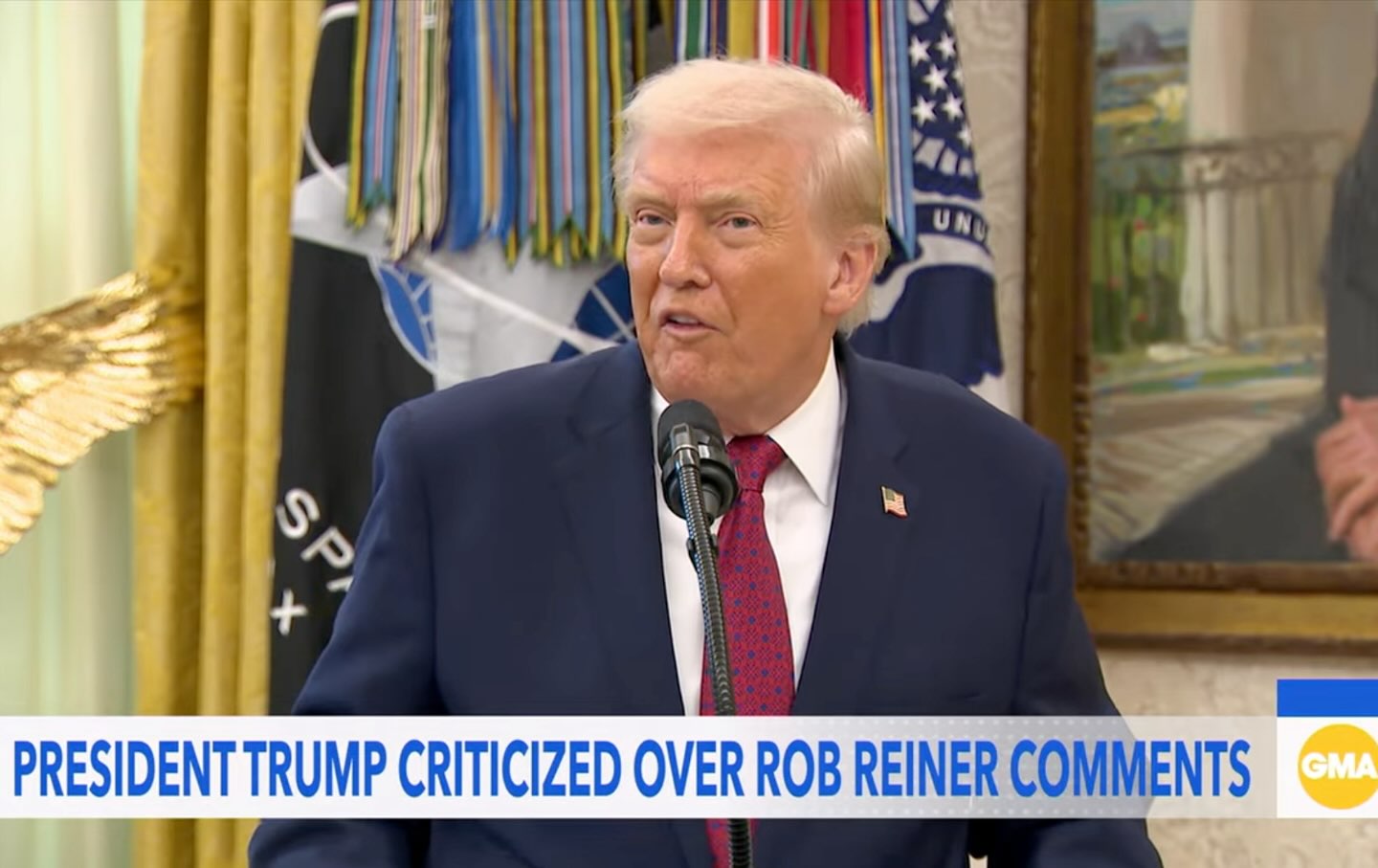
Trump’s Vile Rob Reiner Comments Show How Much He Has Debased His Office Trump’s Vile Rob Reiner Comments Show How Much He Has Debased His Office
Every day, Trump is saying and doing things that would get most elementary school children suspended.